Digestive system · Head and neck
Lower left canine !
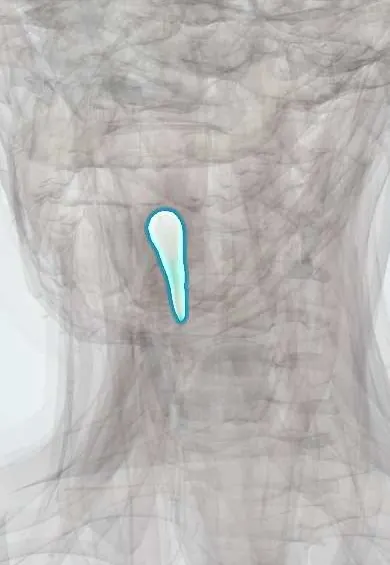
The lower left canine (tooth 33) is the pointed tooth at the corner of the mouth; it grips and tears food.
Opens in the Durgical app, no sign-up needed.
What it is
The corner tooth: one pointed cusp and a long root, a little shorter than the upper canine's.
What it does
Grips and tears food, and guides the jaw when it slides sideways.
Key facts
- Joints with
- Alveolar socket of the mandible (gomphosis held by the periodontal ligament); bites against the opposing teeth
- Landmarks
- FDI 33, lower left canine: 1 root; single pointed cusp; root shorter than the upper canine's; erupts at about 9–10 years; nerve: inferior alveolar nerve (V3)
Relations
- Medial
- The lower left lateral incisor
- Lateral
- The lower left first premolar
- Above
- The upper left lateral incisor and the upper left canine; in a normal bite its cusp sits just in front of the upper canine
- In front
- Lower lip and the canine eminence of the mandible
How to find it
Third tooth from the midline on the lower left, a single pointed cusp at the bend of the arch; in a normal bite it sits just in front of the upper canine.
On imaging
A periapical shows its long root; shifting the beam sideways can reveal a second, lingual root. A panoramic film is used when a lower canine is impacted or has migrated across the midline.
Clinical notes
- Incisive nerve, from the inferior alveolar nerve (V3); the mental foramen lies behind and below it, usually between or below the premolar roots
- In side-to-side jaw movements the upper canine slides along this tooth (canine guidance) and lifts the back teeth apart
- Its long root resists bone loss, so lower canines are often kept as supports (abutments) for overdentures or partial dentures
Anatomical variants
- Rarely an impacted lower canine migrates across the midline (transmigration), something described almost only for this tooth
Development
Replaces the primary lower left canine (FDI 73).
Test yourself
Think of the answer, then tap the question to see it.
Which front tooth is most likely to have 2 roots?
The lower canine, such as the lower left canine (labial and lingual roots).
Why is the lower left canine rarely impacted, unlike the upper canine?
It erupts before the lower premolars, while the upper canine comes after them.
What is transmigration?
An impacted lower canine migrating across the midline, described almost only for this tooth.
At what age does the lower left canine usually erupt?
At about 9–10 years, before the lower premolars and earlier than the upper canine.
Educational information, not medical advice. For any symptom, see a health professional.
Related
Sources: Anatomy, Head and Neck, Teeth; Anatomy, Permanent Dentition; Anatomy, Head and Neck, Tooth Eruption; Anatomy, Head and Neck: Alveolar Nerve; 23.3 The Mouth, Pharynx, and Esophagus (OpenStax (Rice University), 2022) · adapted, CC BY 4.0.
Spotted a mistake?We are always improving for the community. Tell us what is wrong and our team will review it.Report a mistake
Representative model, for educational purposes only.