Skeletal system · Head and neck
Mandible !
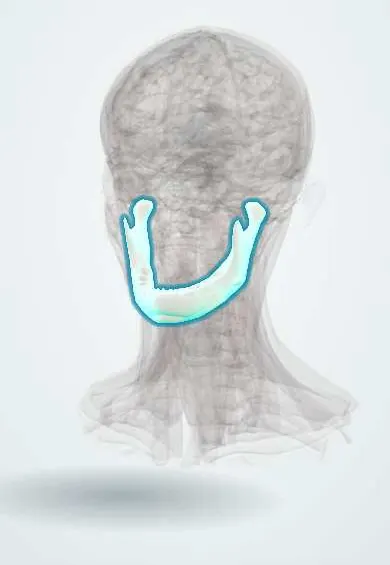
The mandible is the horseshoe-shaped lower jaw, the only movable bone of the skull; it holds the lower teeth and moves for chewing and speaking.
Opens in the Durgical app, no sign-up needed.
What it is
The horseshoe-shaped lower jaw, the only movable bone of the skull.
What it does
Holds the lower teeth and moves for chewing and speaking.
Key facts
- Joints with
- Temporal bones (TMJs); lower teeth
- Landmarks
- Body, ramus, angle, condyle, coronoid process, mental foramen, mandibular foramen, mylohyoid line, symphysis; lingula; mental spines (genial tubercles: genioglossus, geniohyoid); digastric fossa; sublingual and submandibular fossae; mandibular notch; oblique line
Relations
- Above
- Condyle in the mandibular fossa of the temporal bone, with the TMJ disc between them; the coronoid process under the zygomatic arch, gripped by temporalis
- Lateral
- Masseter over the ramus and angle; the parotid gland behind the ramus; branches of the facial nerve crossing superficially; the facial artery crossing the lower border just in front of masseter
- Medial
- Medial pterygoid on the inner ramus; the inferior alveolar nerve and lingual nerve in the pterygomandibular space; the lingual nerve lies against the bone near the third molar
- Below
- Anterior belly of the digastric and platysma; the submandibular gland in its fossa below the mylohyoid line
- Deep
- Floor of the mouth: mylohyoid along the mylohyoid line, the sublingual gland above it, genioglossus and geniohyoid on the genial tubercles
How to find it
The lower border, angle and chin are felt along the jaw. The condyle is felt just in front of the tragus, moving forward when the mouth opens; the mental foramen lies roughly below the second premolar, about halfway down the body in adults.
Examination
- Occlusion: a new malocclusion or a step between the teeth after trauma suggests a fracture
- Tongue blade test: inability to hold a wooden spatula between the teeth while it is twisted suggests a fracture
- Sensation of the lower lip and chin: numbness points to inferior alveolar or mental nerve injury
On imaging
A panoramic radiograph (orthopantomogram) is a good first view of the whole mandible and the teeth; CT shows condylar and comminuted fractures best and is used in multiple trauma.
Common problems
- Fractures, often in two places (for example the angle and the opposite side).
- Dislocation when yawning: the jaw stays open.
How it is diagnosed
Exam of the bite; X-rays or CT.
Treatment
- Soft diet for stable fractures; plates and screws or wiring for displaced fractures.
- Gentle manual reduction of a dislocated jaw.
Clinical notes
- Inferior alveolar nerve block is placed at the mandibular foramen on the inner ramus; it numbs the lower teeth, lip and chin on that side, and the lingual nerve is often caught too
- Third molar removal risks the inferior alveolar nerve (canal close to the roots) and the lingual nerve (against the inner cortex)
- Osteoradionecrosis and medication-related osteonecrosis affect the mandible more often than the maxilla, partly because of its poorer blood supply
Anatomical variants
- Accessory mental foramina and a bifid mandibular canal, seen on imaging, matter for implants and nerve blocks
Development
The two halves form in membrane alongside Meckel cartilage (first pharyngeal arch) and fuse at the symphysis in the first year. The condyle grows from a secondary cartilage, so a condylar injury in childhood can cause asymmetric growth.
Related conditions
Test yourself
Think of the answer, then tap the question to see it.
Why is one fracture of the mandible often paired with a second?
With the skull base it forms a ring through the two TMJs; the second fracture is commonly at the opposite condylar neck or angle.
Which way does the chin deviate on opening after a unilateral condylar fracture of the mandible?
Toward the injured side. Fractures of both condyles give an anterior open bite.
Which nerve runs in the mandibular canal, and what sign follows a fracture along its path?
The inferior alveolar nerve, which leaves at the mental foramen as the mental nerve; injury numbs the lower lip and chin.
What does the tongue blade test assess after jaw trauma?
A mandible fracture: inability to hold a wooden spatula between the teeth while it is twisted suggests a fracture.
Which two nerves are at risk when a lower third molar is removed from the mandible?
The inferior alveolar nerve (canal close to the roots) and the lingual nerve (against the inner cortex).
Educational information, not medical advice. For any symptom, see a health professional.
Its names
- Official Latin (TA2)
- mandibula TA2 835
- Official Spanish (DeCS)
- Mandíbula DeCS D008334
- English (TA2)
- Mandible
- Also called
- lower jaw · jawbone · os mandibulare · mandibular bone
Related
- TMJ disc
- Lower left central incisor
- Lower left lateral incisor
- Lower left canine
- Lower left first premolar
- Lower left second premolar
- Lower left first molar
- Lower left second molar
Sources: Terminologia Anatomica (TA2); DeCS; Anatomy, Head and Neck, Mandible.
Spotted a mistake?We are always improving for the community. Tell us what is wrong and our team will review it.Report a mistake
Representative model, for educational purposes only.