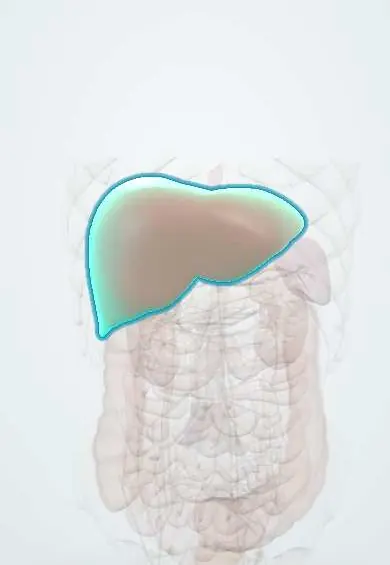
Conditions · Metabolism: heme, bilirubin and iron
Dubin-Johnson syndrome !
A benign inherited condition in which the liver poorly excretes conjugated bilirubin into bile; the liver looks black.
Updated 2026-11-01
Structures involved
Tap one to see what it is and open it in 3D.
In biochemistry
In physiology
Why it happens
What it is
Chronic conjugated hyperbilirubinemia from failure of the canalicular transporter MRP2 (ABCC2 gene), with dark pigment in hepatocytes.
Who gets it
Rare; its highest frequency (about 1 in 1300) has been described among Jews of Iranian and Moroccan origin; isolated cases worldwide.
Causes
- Autosomal recessive inheritance: ABCC2 variants
Risk factors
- Pregnancy and oral contraceptives (increase jaundice)
Pathophysiology
Bilirubin is conjugated normally, but without MRP2 it cannot leave into the canaliculus and refluxes into the blood. A melanin-like pigment (adrenaline derivatives) collects in lysosomes and darkens the liver. Coproporphyrin excretion also changes: total urinary coproporphyrin is normal but over 80 % is isomer I.
Symptoms and signs
- Mild, intermittent jaundice
- Sometimes dark urine or right upper quadrant discomfort
- Many have no symptoms
Diagnosis
- Clinical
- Mild conjugated jaundice in a young adult with otherwise normal liver tests.
- Tests
- High direct bilirubin with normal alkaline phosphatase and transaminases; urinary coproporphyrins over 80 % isomer I; ABCC2 gene testing.
- Imaging
- Hepatobiliary scintigraphy shows prolonged liver visualisation with delayed gallbladder filling; ultrasound rules out obstruction.
Treatment
- Conservative
- No treatment is needed; its benign nature is explained
- Follow-up
- Watching jaundice during pregnancy or with hormonal contraceptives
Complications
- None serious; possible interactions with drugs excreted by MRP2
Prognosis
Excellent.
Test yourself
Think of the answer, then tap the question to see it.
Which transporter fails in Dubin-Johnson syndrome?
MRP2 (ABCC2), which pumps conjugated bilirubin into bile.
Which gross finding is typical of the liver in Dubin-Johnson?
A black liver from melanin-like pigment in lysosomes.
How do urinary coproporphyrins distinguish Dubin-Johnson from Rotor?
In Dubin-Johnson the total is normal with over 80 % isomer I; in Rotor the total is high.
Related conditions
Educational information, not medical advice. For any symptom, see a health professional.
Sources: Dubin-Johnson syndrome: MedlinePlus Genetics (MedlinePlus, US National Library of Medicine, 2026); ABCC2 gene: MedlinePlus Genetics (MedlinePlus, US National Library of Medicine, 2026); Bilirubin blood test: MedlinePlus Medical Encyclopedia (MedlinePlus, US National Library of Medicine, 2026).
Spotted a mistake?We are always improving for the community. Tell us what is wrong and our team will review it.Report a mistake
Representative model, for educational purposes only.