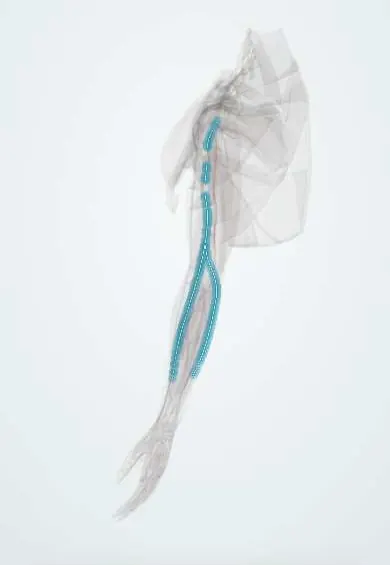
Medial forearm skin nerve !
The medial antebrachial cutaneous nerve comes from the medial cord of the plexus; it gives feeling to the inner, little-finger side of the forearm.
Official name: Medial antebrachial cutaneous nerve
Opens in the Durgical app, no sign-up needed.
What it is
A skin nerve from the medial cord that crosses the inner elbow.
What it does
Feeling on the inner forearm; surgeons protect it at the inner elbow.
Key facts
- Roots
- C8–T1, medial cord
- Moves
- None
- Feeling from
- Medial forearm
Relations
- Course
- From the medial cord it runs down on the medial side of the brachial artery, comes through the deep fascia beside the basilic vein about mid-arm and splits into anterior and posterior (ulnar) branches that pass in front of and around the medial elbow to the medial forearm
- Lateral
- The brachial artery in the upper arm
- Medial
- The basilic vein, which it accompanies through the deep fascia
- Behind
- The ulnar nerve in the upper arm, until that nerve passes through the medial intermuscular septum
How to find it
Not palpable. It travels with the basilic vein on the medial arm; below the elbow its branches run in the subcutaneous fat of the medial forearm. In cubital tunnel surgery its posterior branch is looked for where it crosses the incision a few centimetres from the medial epicondyle.
Examination
- Pinprick on the medial forearm: loss together with ulnar hand symptoms suggests a lesion above the elbow (C8–T1, lower trunk, medial cord)
- Nerve conduction: a reduced or absent sensory response of this nerve is a hallmark of neurogenic thoracic outlet syndrome and other lower plexus lesions
On imaging
Not seen on radiographs. On ultrasound it lies beside the basilic vein, which is the landmark, and pierces the deep fascia with it in the middle of the arm. It is sought when planning elbow or cubital tunnel surgery or when a painful medial scar suggests a neuroma; the ulnar nerve is checked in the same scan.
Clinical notes
- Cubital tunnel release: cutting its posterior branch causes a painful neuroma and numbness over the olecranon, one of the commonest complications
- Basilic vein transposition for an arteriovenous fistula and basilic venipuncture can injure it
- A frequent donor for nerve grafts (for example digital nerves), leaving a numb patch on the medial forearm
Anatomical variants
- It usually ends in two or three branches, and where they cross the elbow varies, which is why they are sought in every medial elbow approach
Test yourself
Think of the answer, then tap the question to see it.
Why does medial forearm numbness point above the elbow rather than to the ulnar nerve?
The medial forearm skin is supplied by the medial forearm skin nerve from the medial cord (C8–T1), not by the ulnar nerve.
What common complication of cubital tunnel release involves the medial forearm skin nerve?
Cutting its posterior branch, causing a painful neuroma and numbness over the olecranon.
With which vein does the medial forearm skin nerve pierce the deep fascia, and why does it matter?
The basilic vein, at mid-arm; it is at risk in basilic vein transposition for dialysis access and in basilic venipuncture.
Educational information, not medical advice. For any symptom, see a health professional.
Its names
- Official Latin (TA2)
- nervus cutaneus medialis antebrachii TA2 6446
- Official Spanish (DeCS)
- Nervio cutáneo medial del antebrazo
- English (TA2)
- Medial antebrachial cutaneous nerve
- Also called
- medial cutaneous nerve of forearm
Related
Sources: Terminologia Anatomica (TA2); Anatomy, Shoulder and Upper Limb, Medial Brachial Cutaneous Nerve; Anatomy, Shoulder and Upper Limb, Cutaneous Innervation.
Spotted a mistake?We are always improving for the community. Tell us what is wrong and our team will review it.Report a mistake
Representative model, for educational purposes only.