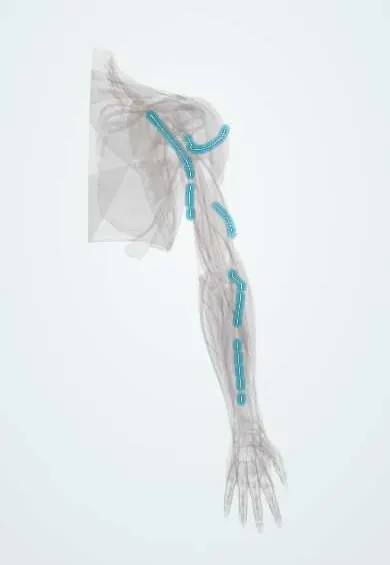
Arm skin nerves !
The arm skin nerves are the other small nerves that give feeling to the skin of the arm and forearm, such as the intercostobrachial nerve.
Official name: Other cutaneous nerves of the arm and forearm
Opens in the Durgical app, no sign-up needed.
What it is
Thin skin nerves of the upper arm and the back of the forearm.
What it does
Give feeling to the skin.
Key facts
- Roots
- Medial brachial (T1, medial cord), lateral brachial (axillary C5–C6, radial), posterior antebrachial (radial)
- Moves
- None
- Feeling from
- Skin of the arm and back of the forearm
Relations
- Course
- The medial cutaneous nerve of the arm runs down medial to the axillary and brachial veins and pierces the fascia mid-arm; the intercostobrachial nerve crosses the axilla from the second intercostal space to join it; the posterior cutaneous nerve of the forearm leaves the radial nerve in the spiral groove
- Medial
- The axillary vein and the axillary lymph nodes, among which the intercostobrachial nerve passes
- Behind
- The lateral head of triceps, which the posterior cutaneous nerve of the forearm pierces on its way to the back of the forearm
How to find it
Not palpable. In axillary dissection the intercostobrachial nerve is seen crossing the axillary fat from the chest wall below the axillary vein toward the medial arm.
Examination
- Pinprick mapping of the arm: patchy medial arm loss after breast or axillary surgery points to the intercostobrachial nerve; lower deltoid loss to the axillary nerve; back of forearm loss to a radial nerve lesion at or above the spiral groove
On imaging
These small skin nerves are not seen on routine imaging. A patch of numbness is localised by examination and nerve conduction, and ultrasound or MRI then looks at the parent nerve: the axillary nerve for the upper lateral arm, the radial nerve for the lower lateral and posterior arm, and the medial cord or the T2 intercostobrachial nerve for the medial arm.
Clinical notes
- Post-mastectomy pain syndrome: burning, numbness and oversensitivity of the axilla and medial arm after intercostobrachial injury; the nerve is preserved when possible
- Pain from the heart can be felt in the medial arm, which shares T1–T2 sensory levels with the heart through these nerves
- Tourniquet pain during arm surgery under axillary block comes from the unblocked medial arm nerves (T1–T2)
Anatomical variants
- The intercostobrachial nerve may be doubled or joined by a branch of the third intercostal nerve, and it tends to be larger when the medial cutaneous nerve of the arm is small
Related conditions
Test yourself
Think of the answer, then tap the question to see it.
Which arm skin nerve is often cut in axillary dissection, and what can follow?
The intercostobrachial nerve (T2); numbness of the medial upper arm and sometimes chronic pain (post-mastectomy pain syndrome).
Why does an axillary block not prevent tourniquet pain in the upper arm?
It does not reach the intercostobrachial and medial cutaneous nerves of the arm (T1–T2), which need an extra injection across the medial arm.
Why can heart pain be felt in the medial arm?
The medial arm skin nerves share T1–T2 sensory levels with the heart.
Educational information, not medical advice. For any symptom, see a health professional.
Its names
- Official Latin (TA2)
- nervus cutaneus medialis brachii TA2 6445
- Official Spanish (DeCS)
- Nervios cutáneos del brazo y nervio cutáneo posterior del antebrazo
- English (TA2)
- Other cutaneous nerves of the arm and forearm
Sources: Terminologia Anatomica (TA2); Anatomy, Shoulder and Upper Limb, Medial Brachial Cutaneous Nerve; Anatomy, Shoulder and Upper Limb, Cutaneous Innervation.
Spotted a mistake?We are always improving for the community. Tell us what is wrong and our team will review it.Report a mistake
Representative model, for educational purposes only.