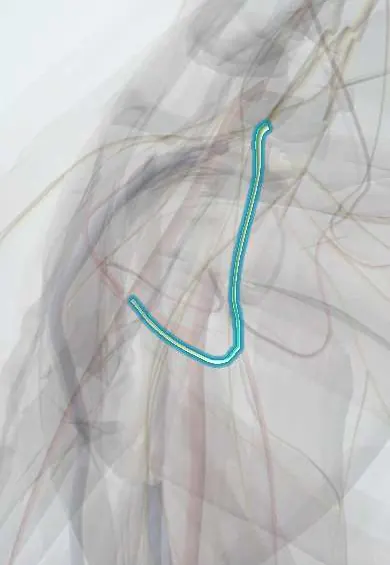
Axillary nerve !
The axillary nerve winds around the neck of the humerus; it moves the deltoid and teres minor and gives feeling over the outer shoulder.
Opens in the Durgical app, no sign-up needed.
What it is
A nerve that wraps around the neck of the humerus, just below the shoulder joint.
What it does
Powers the deltoid and teres minor and gives feeling over the outer shoulder.
Key facts
- Roots
- C5–C6, posterior cord
- Moves
- Deltoid, teres minor
- Feeling from
- Skin over the lower deltoid ('regimental badge' area)
Relations
- Course
- From the posterior cord behind the axillary artery it passes in front of subscapularis, turns back at its lower border just below the shoulder joint capsule, goes through the quadrangular space and divides: a posterior branch to teres minor and the lateral arm skin, an anterior branch around the surgical neck to the deltoid
- Above
- The lower border of subscapularis, then the inferior shoulder capsule, which it touches
- Below
- Teres major, the lower border of the quadrangular space
- Medial
- The long head of triceps at the quadrangular space
- Lateral
- The surgical neck of the humerus, around which its anterior branch winds
- Superficial
- The deltoid, on whose deep surface the anterior branch runs
How to find it
It cannot be felt. In a deltoid-splitting approach its branches are seen on the deep surface of the deltoid about 5 cm below the lateral edge of the acromion. The quadrangular space lies at the back of the shoulder under the posterior deltoid, between teres minor above and teres major below, lateral to the long head of triceps.
Examination
- Deltoid strength in abduction beyond the first 15° and the deltoid extension lag sign (the arm cannot hold full passive extension): weakness indicates axillary nerve palsy
- Pinprick over the lower deltoid ('regimental badge' area): loss supports a lesion, but normal feeling does not exclude one
- Hornblower's sign (weak external rotation with the arm abducted 90°): teres minor weakness, seen when the posterior branch is involved
On imaging
MRI shows denervation of the deltoid and teres minor: oedema early, fatty atrophy later; isolated teres minor atrophy with no cuff tear suggests quadrangular space syndrome.
Common problems
- Stretched in shoulder dislocations and fractures of the humeral neck.
- Then the deltoid is weak and a patch of skin over the outer shoulder is numb ('regimental badge' area).
- Can be squeezed in the quadrilateral space in overhead athletes.
How it is diagnosed
Feeling over the outer shoulder and deltoid strength, checked before and after any reduction. EMG if weakness persists.
Treatment
- Most stretch injuries recover over months with physical therapy.
- Nerve repair, graft or transfer if there is no recovery.
Clinical notes
- Intramuscular injections go into the upper deltoid, a few finger-breadths below the acromion, because the anterior branch runs across the lower part of the muscle
- At risk in inferior capsular shift, arthroscopic procedures on the inferior capsule and lateral deltoid-splitting approaches
- Quadrangular space syndrome: fibrous bands or enlarged muscles compress the nerve in overhead athletes, with posterior shoulder pain and teres minor atrophy
- Long-standing palsy flattens the shoulder contour and makes the acromion prominent; other cuff and shoulder muscles may partly mask the loss of abduction
Anatomical variants
- Fibrous bands and variations in the muscles that border the quadrangular space can narrow it and compress the nerve
Development
Its C5–C6 fibres come from the cranial (preaxial) segments and pass through posterior divisions to dorsal-mass muscles (deltoid, teres minor). It is involved in Erb (upper trunk) birth palsy, in which the arm hangs adducted and turned inward.
Related conditions
Test yourself
Think of the answer, then tap the question to see it.
Through which space does the axillary nerve pass, and with which artery?
The quadrangular space, with the posterior circumflex humeral artery, before winding around the surgical neck of the humerus.
Which muscles does the axillary nerve supply, and what is its skin territory?
Deltoid and teres minor; the skin over the lower deltoid («regimental badge» area).
How far below the acromion does the anterior branch of the axillary nerve run, and why does it matter?
About 5 cm (some texts 5–7 cm); deltoid-splitting incisions and intramuscular injections stay above this level.
Why is the «regimental badge» sensory test alone not enough to rule out axillary nerve palsy?
Feeling can be normal while the deltoid is paralysed, so deltoid contraction is checked as well.
Educational information, not medical advice. For any symptom, see a health professional.
Its names
- Official Latin (TA2)
- nervus axillaris TA2 6440
- Official Spanish (DeCS)
- Nervio axilar
- English (TA2)
- Axillary nerve
Related
Sources: Terminologia Anatomica (TA2); Anatomy, Shoulder and Upper Limb, Axillary Nerve; Anatomy, Shoulder and Upper Limb, Arm Quadrangular Space; Anatomy of the Human Body (20th ed.): The Branchial Region (Lea & Febiger (Gray's Anatomy, 1918), 1918) · adapted, Public domain.
Spotted a mistake?We are always improving for the community. Tell us what is wrong and our team will review it.Report a mistake
Representative model, for educational purposes only.