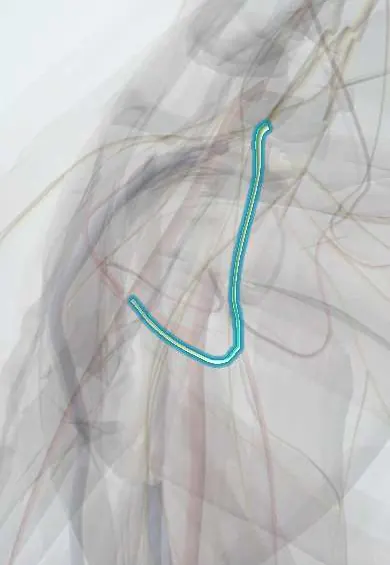
Axillary nerve injury !
An axillary nerve injury damages the nerve that moves the deltoid, often after a shoulder dislocation; it weakens lifting the arm and numbs the outer shoulder.
Updated 2026-10-29
Structures involved
Tap one to see what it is and open it in 3D.
- Axillary nerve
- Front deltoid
- Middle deltoid
- Rear deltoid
- Teres minor
- Posterior cord
- Circumflex humeral arteries
- Humerus
- Shoulder capsule
- Arm skin nerves
Why it happens
What it is
Damage to the axillary nerve, the branch of the posterior cord of the brachial plexus that wraps around the surgical neck of the humerus to supply the deltoid and teres minor and the skin over the lateral shoulder. It most often follows an anterior shoulder dislocation or a proximal humerus fracture.
Who gets it
It is the most commonly injured nerve around the shoulder. Traumatic cases occur in young adults with dislocations and in older adults with falls and fractures; overhead athletes can develop compression in the quadrilateral space.
Causes
- Anterior shoulder dislocation, by stretch of the nerve over the humeral head
- Fracture of the surgical neck of the humerus
- Shoulder surgery or arthroscopy and deltoid-splitting approaches (iatrogenic)
- Direct blow to the shoulder
- Quadrilateral space syndrome: compression by fibrous bands or muscle hypertrophy in overhead athletes
Risk factors
- Shoulder dislocation, especially in older patients or after high-energy trauma
- Proximal humerus fracture
- Shoulder surgery
- Throwing and overhead sports (quadrilateral space syndrome)
Pathophysiology
The nerve leaves the posterior cord (C5 and C6 roots), passes through the quadrilateral space with the posterior circumflex humeral artery and runs tight against the surgical neck of the humerus. Dislocation or fracture stretches or bruises it, usually without complete division. Loss of deltoid power weakens abduction, and loss of teres minor weakens external rotation.
Classification
- Neurapraxia, axonotmesis or neurotmesis (Seddon)
- Traumatic, iatrogenic or compressive (quadrilateral space syndrome)
- Isolated or part of a wider brachial plexus injury
Symptoms and signs
- Weakness in lifting the arm out to the side and forward
- Numbness over the lateral upper arm (regimental badge area)
- Wasting of the deltoid with a flattened shoulder contour after a few weeks
- Weak external rotation from teres minor involvement
- Deep posterior shoulder pain with overhead activity in quadrilateral space syndrome
Diagnosis
- Clinical
- Sensation over the regimental badge area and deltoid function are documented before and after any reduction. Pain can make deltoid testing unreliable early; the deltoid extension lag sign helps. Sensory loss does not always match motor loss.
- Tests
- Electromyography and nerve conduction studies, usually from about 3 to 4 weeks after injury, and repeated to track reinnervation.
- Imaging
- X-rays to confirm reduction and look for fractures; MRI shows rotator cuff tears and denervation of the deltoid and teres minor; MRI or angiography in suspected quadrilateral space syndrome.
Differential diagnosis
- Rotator cuff tear
- Cervical radiculopathy at C5
- Upper trunk brachial plexus injury
- Neuralgic amyotrophy (Parsonage-Turner syndrome)
- Suprascapular neuropathy
Goal of treatment
Protect the shoulder while the nerve recovers, keep the joint mobile and the muscles conditioned, and reconstruct the nerve in time if recovery does not occur.
Treatment
- Acute
- Prompt reduction of the dislocation or treatment of the fracture, with a documented nerve examination before and after.
- Follow-up
- Most closed injuries are observed, with repeated examination and electromyography to check for reinnervation over the following months.
- Rehabilitation
- Physiotherapy to keep passive range of motion, prevent stiffness and strengthen the rotator cuff and scapular muscles; electrical stimulation is sometimes used.
- Surgical
- Exploration with neurolysis, nerve grafting or nerve transfer (for example from a triceps branch of the radial nerve) when there is no recovery by about 3 to 6 months; timing criteria vary.
- Surgical
- Decompression of the quadrilateral space when conservative care fails in quadrilateral space syndrome.
Complications
- Permanent deltoid weakness and wasting
- Shoulder stiffness
- Chronic pain
- Reduced overhead and sports function
Prognosis
Most axillary nerve injuries from closed trauma are stretch injuries that recover spontaneously over months. Older age, complete denervation and associated injuries worsen the outlook; surgery done within months gives better results than late repair.
Prevention
- Gentle, prompt reduction of shoulder dislocations
- Careful surgical technique around the surgical neck of the humerus
Test yourself
Think of the answer, then tap the question to see it.
Which two muscles does the axillary nerve supply?
The deltoid and the teres minor.
Which injuries most often damage the axillary nerve?
Anterior shoulder dislocation and fracture of the surgical neck of the humerus.
Where is sensation lost after an axillary nerve injury?
Over the lateral upper arm, the regimental badge area, supplied by the superior lateral cutaneous nerve of the arm.
Through which space does the axillary nerve pass with the posterior circumflex humeral artery?
The quadrilateral space, bounded by teres minor, teres major, the long head of triceps and the humerus.
From which part of the brachial plexus does the axillary nerve arise?
The posterior cord, carrying fibres from the C5 and C6 roots.
Related conditions
- Shoulder dislocation
- Rotator cuff tear
- Cervical radiculopathy
- Proximal humerus fracture
- Brachial plexus injury
Educational information, not medical advice. For any symptom, see a health professional.
Sources: Axillary Nerve Injury (StatPearls (NCBI Bookshelf), 2026).
Spotted a mistake?We are always improving for the community. Tell us what is wrong and our team will review it.Report a mistake
Representative model, for educational purposes only.