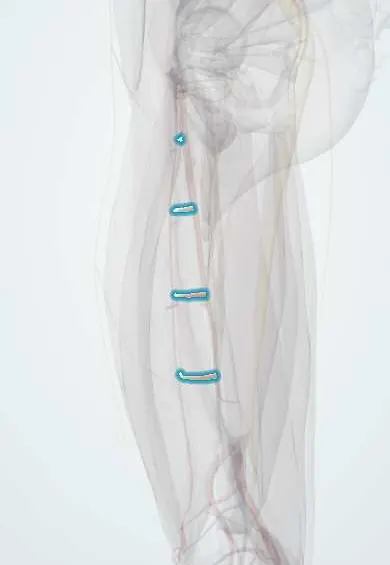
Cardiovascular system · Lower limb
Perforating arteries !
The perforating arteries are branches of the deep femoral artery that pass to the back of the thigh to supply the hamstrings and femur.
Official name: Perforating femoral arteries
Opens in the Durgical app, no sign-up needed.
What it is
Three or four branches of the deep femoral artery that pass through the adductor magnus to reach the back of the thigh.
What it does
Supply the hamstrings, the adductors, the vastus lateralis and the femur.
Key facts
- Origin
- Deep femoral artery, usually 3, its end forming the 4th; pierce adductor magnus near linea aspera
- Branches
- Muscular branches; nutrient arteries of femur; chain of anastomoses with gluteal and popliteal branches
- Supplies
- Hamstrings, adductor magnus, vastus lateralis, femoral shaft
Relations
- Course
- Leave the deep femoral artery close to the femur, turn backward through the adductor brevis (upper ones) and adductor magnus near the linea aspera, then wind laterally behind the femur to reach the vastus lateralis and the hamstrings
- In front
- The linea aspera and the back of the femoral shaft
- Behind
- The short head of biceps femoris and the other hamstrings; the sciatic nerve lies on the adductor magnus behind them
How to find it
In a lateral approach to the femoral shaft they are found at intervals where they pierce the lateral intermuscular septum close to the linea aspera, and are tied before the vastus lateralis is lifted off the septum.
On imaging
CT angiography maps the perforators of the posterior thigh before a profunda artery perforator flap; in a femoral fracture, contrast blush on CT angiography can show active bleeding from one of them.
Clinical notes
- A closed femoral shaft fracture can lose a large volume of blood into the thigh (commonly quoted as 1–1.5 L), partly from these vessels
- The profunda artery perforator flap takes skin and fat from the upper inner back of the thigh on one of these vessels, used in breast reconstruction
- A shaft fracture tears the nutrient artery; healing then leans on the periosteal supply, one reason surgeons avoid stripping the periosteum
Anatomical variants
- Usually three, with the end of the deep femoral artery sometimes counted as a fourth; the first and second often share a common trunk
- When the femur has two nutrient arteries, they usually come from the first and third perforating arteries
Test yourself
Think of the answer, then tap the question to see it.
From which artery do the perforating arteries arise and which muscle do they pierce?
The deep femoral artery (usually three, its end forming a fourth); they pierce the adductor magnus near the linea aspera.
Which perforating artery usually gives the main nutrient artery of the femur?
The second perforating artery.
Why can a closed femoral shaft fracture cause major blood loss?
The thigh can hold a large volume of blood (commonly quoted 1–1.5 L), partly from the perforating arteries torn by the fracture.
Educational information, not medical advice. For any symptom, see a health professional.
Its names
- Official Latin (TA2)
- arteriae perforantes femoris TA2 4696
- Official Spanish (DeCS)
- Arterias perforantes del fémur
- English (TA2)
- Perforating femoral arteries
- Also called
- arteriae perforantes prima · secunda et tertia
Related
- Deep femoral artery
- Perforating veins
- Biceps femoris (long head)
- Biceps femoris (short head)
- Semitendinosus
- Semimembranosus
- Adductor magnus
- Vastus lateralis
Sources: Terminologia Anatomica (TA2); Anatomy, Bony Pelvis and Lower Limb: Femoral Artery; Anatomy of the Human Body (20th ed.): The Arteries of the Lower Extremity (Lea & Febiger (Gray's Anatomy, 1918), 1918) · adapted, Public domain.
Spotted a mistake?We are always improving for the community. Tell us what is wrong and our team will review it.Report a mistake
Representative model, for educational purposes only.