Cardiovascular system · Lower limb
Deep femoral artery !
The deep femoral artery is the largest branch of the femoral artery; it supplies the thigh muscles and the femur.
Opens in the Durgical app, no sign-up needed.
What it is
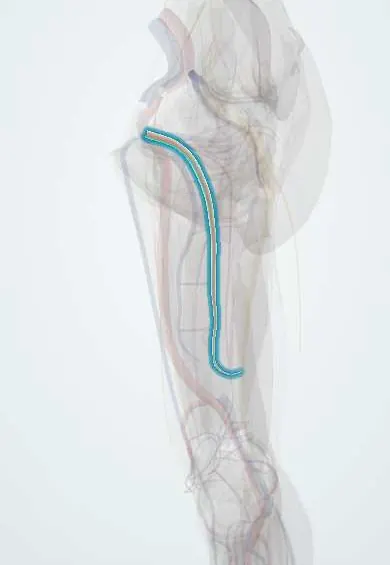
The deep femoral artery (profunda femoris), the largest branch of the femoral artery. It starts just below the groin and runs deep, close to the femur.
What it does
The main blood supply of the thigh muscles and the femur. Its circumflex and perforating branches wrap around the top of the femur and reach the back of the thigh.
Key facts
- Origin
- Lateral side of femoral artery, about 3–5 cm below inguinal ligament
- Branches
- Medial and lateral circumflex femoral (often), 3–4 perforating arteries
- Supplies
- Thigh muscles (adductors, hamstrings, vasti), femur and hip
Relations
- Course
- From the femoral artery in the femoral triangle it curves back and down behind the femoral vessels, passes deep to the adductor longus and runs close to the femur on the pectineus, adductor brevis and adductor magnus, ending as the fourth perforating artery
- In front
- The femoral artery and vein in the triangle and the deep femoral vein; lower down, the adductor longus lies between it and the femoral vessels
- Behind
- The pectineus, adductor brevis and adductor magnus, from above down
- Lateral
- The medial side of the femoral shaft and the vastus medialis
How to find it
Not palpable. On ultrasound or angiography it is seen leaving the femoral artery a few centimetres below the inguinal ligament and diving deep toward the femur; a femoral puncture is aimed above this point.
On imaging
Duplex ultrasound shows its origin from the back or side of the femoral artery a few centimetres below the inguinal ligament; this marks the lowest safe level for a femoral puncture. CT or catheter angiography shows it best in arterial disease: with a blocked superficial femoral artery it is often patent and feeds collaterals to the knee. Radiographs only show calcified walls.
Common problems
- Narrowing from plaque (peripheral artery disease). It becomes an important detour for blood when the main femoral artery is blocked.
- Injury from femur fractures or during hip surgery.
- Rarely, a false aneurysm (a leak contained by surrounding tissue) after an injury or procedure.
How it is diagnosed
Checking pulses; ankle-brachial index; duplex ultrasound; CT or catheter angiography.
Treatment
- Walking programs, quitting smoking and medicines for artery disease.
- Surgery to widen or bypass a narrowed artery (for example profundaplasty).
- Repair of an injured artery, sometimes from inside the vessel (endovascular repair).
Clinical notes
- Its branches lie near the lesser trochanter and the medial femur, at risk from drills, screws, cerclage wires and retractors in hip fracture fixation and hip replacement
- A puncture below the femoral bifurcation may enter it or the superficial femoral artery, raising the risk of a false aneurysm
Anatomical variants
- The height of its origin varies: close to the inguinal ligament in some people, much lower in others
- Its origin may be on the back or medial side of the femoral artery instead of the lateral side
- One or both circumflex femoral arteries may come straight from the femoral artery instead of from it
Related conditions
Test yourself
Think of the answer, then tap the question to see it.
Where does the deep femoral artery arise?
From the lateral side of the femoral artery, about 3–5 cm below the inguinal ligament.
Which muscle separates the deep femoral artery from the femoral vessels in the thigh?
The adductor longus.
Why does a blocked superficial femoral artery often cause only claudication?
The deep femoral artery's perforating and descending branches link with the genicular arteries as the main collateral path.
What are the main branches of the deep femoral artery?
Often the medial and lateral circumflex femoral arteries, and 3–4 perforating arteries.
Educational information, not medical advice. For any symptom, see a health professional.
Its names
- Official Latin (TA2)
- arteria profunda femoris TA2 4685
- Official Spanish (DeCS)
- Arteria femoral profunda
- English (TA2)
- Deep femoral artery
- Also called
- deep artery of thigh
Related
- Femoral artery
- Deep femoral vein
- Circumflex femoral arteries
- Perforating arteries
- Adductor longus
- Adductor brevis
- Adductor magnus
- Pectineus
Sources: Terminologia Anatomica (TA2); Anatomy, Bony Pelvis and Lower Limb: Femoral Artery.
Spotted a mistake?We are always improving for the community. Tell us what is wrong and our team will review it.Report a mistake
Representative model, for educational purposes only.