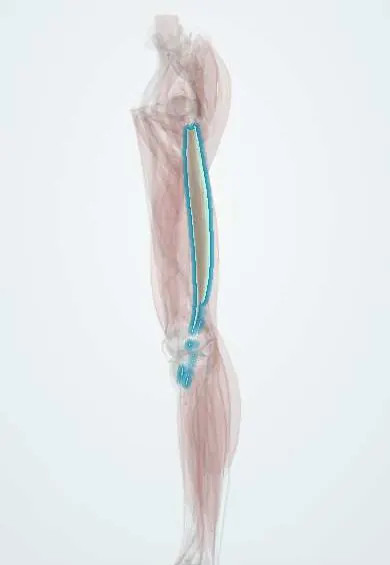
Semitendinosus !
The semitendinosus is an inner hamstring muscle at the back of the thigh; it bends the knee and extends the hip.
Official name: Semitendinosus muscle
Opens in the Durgical app, no sign-up needed.
What it is
One of the hamstring muscles at the back of the thigh, on the inner side.
What it does
Bends the knee and extends the hip; helps control rotation of the knee.
Key facts
- Origin
- Ischial tuberosity (common tendon with long head of biceps femoris)
- Insertion
- Upper medial surface of tibia (pes anserinus)
- Action
- Extends hip; flexes knee; medially rotates flexed knee
- Nerve
- Sciatic nerve, tibial division (L5–S2)
- Blood supply
- Perforating arteries; inferior gluteal artery; medial circumflex femoral artery
Relations
- Superficial
- Gluteus maximus over its origin; below that, fascia lata and skin
- Deep
- Semimembranosus, which lies in front of it and is broader; adductor magnus higher up
- Lateral
- Long head of the biceps femoris, from which it separates in the lower thigh; with the semimembranosus it forms the upper medial border of the popliteal fossa
- Course
- The tendon runs on the back of the semimembranosus, curves around the medial tibial condyle and fans out below the gracilis on the upper medial tibia
How to find it
Prone, with the knee bent against resistance and the leg turned slightly inward, the tendon stands out as a firm cord at the inner side of the back of the knee; it can be followed up into the muscle belly.
Examination
- Passive straight-leg raise: a pull in the back of the thigh at a lower angle than on the other side suggests hamstring tightness or strain; shooting pain below the knee that worsens with ankle dorsiflexion points instead to tension on the sciatic nerve roots
- Popliteal angle (90/90 test): with the hip held at 90° of flexion, the knee is straightened passively; the angle short of full extension measures hamstring tightness
- Resisted knee flexion with the leg turned inward emphasizes the medial hamstrings; pain or weakness suggests a semitendinosus or semimembranosus injury
On imaging
On axial MRI its cord-like tendon lies on the back of the semimembranosus in the posteromedial thigh. In a proximal hamstring avulsion, MRI (or ultrasound) shows its conjoint tendon with the long head of biceps pulled off the ischial tuberosity, with fluid and a gap whose retraction is measured. In adolescents, an AP pelvic radiograph may show a bony fragment from the ischial tuberosity instead.
Common problems
- Hamstring strain, common in sprinting sports.
- Rarely, the tendon pulls off the bone at the hip.
How it is diagnosed
Physical exam; MRI for severe strains.
Treatment
- Rest, then progressive stretching and strengthening; surgery only for complete tendon pull-offs.
Clinical notes
- Graft harvest at the pes anserinus can injure the infrapatellar branch of the saphenous nerve, leaving numbness below and in front of the knee
- Proximal hamstring avulsion typically follows forced hip flexion with the knee straight; the sciatic nerve lies just lateral to the origin and is at risk in the injury and in its repair
Anatomical variants
- Fibrous bands from the tendon to the deep fascia of the calf, and slips joining it to the gracilis tendon; they are released during graft harvest so the tendon is not cut short
Development
A ventral (flexor) muscle mass derivative, so it is supplied by the tibial division of the sciatic nerve, like the other true hamstrings.
Memory aid
SemiTendinosus sits on Top of the semimembranosus, and its Tendon is long and Thin.
Related conditions
Test yourself
Think of the answer, then tap the question to see it.
Which nerve supplies the semitendinosus?
The tibial division of the sciatic nerve (L5–S2).
Where does the semitendinosus arise, and what injury involves that origin?
From the ischial tuberosity, in a conjoint tendon with the long head of the biceps femoris; this tendon is torn in proximal hamstring avulsion.
Which tendons are the usual hamstring autograft for ACL reconstruction?
The semitendinosus and gracilis tendons.
Which nerve can be injured when the semitendinosus tendon is harvested at the pes anserinus, and with what result?
The infrapatellar branch of the saphenous nerve, leaving numbness below and in front of the knee.
How does a straight-leg raise tell semitendinosus strain from nerve root tension?
A pull in the back of the thigh at a lower angle suggests hamstring tightness or strain; shooting pain below the knee, worse with ankle dorsiflexion, points to the sciatic roots.
Educational information, not medical advice. For any symptom, see a health professional.
Its names
- Official Latin (TA2)
- musculus semitendinosus TA2 2641
- Official Spanish (DeCS)
- Músculo semitendinoso DeCS D000070633
- English (TA2)
- Semitendinosus muscle
- Also called
- musculus semitendineus
Related
Sources: Terminologia Anatomica (TA2); DeCS; Anatomy, Bony Pelvis and Lower Limb: Thigh Semitendinosus Muscle; Anatomy, Bony Pelvis and Lower Limb, Hamstring Muscle.
Spotted a mistake?We are always improving for the community. Tell us what is wrong and our team will review it.Report a mistake
Representative model, for educational purposes only.