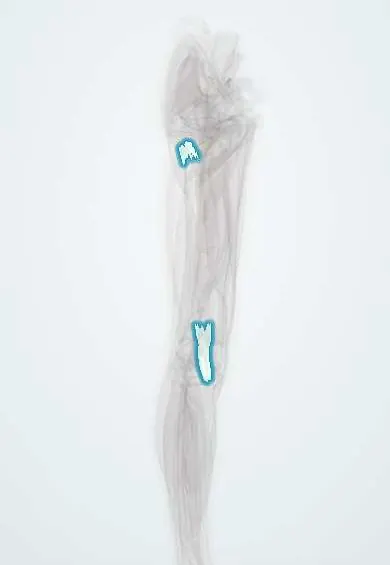
Vastus intermedius tendon !
The vastus intermedius tendon is the deepest layer of the quadriceps tendon, attaching to the top of the kneecap closest to the joint.
Official name: Tendon of vastus intermedius
Opens in the Durgical app, no sign-up needed.
What it is
The deepest layer of the quadriceps tendon.
What it does
Transmits the force of the quadriceps to straighten the knee.
Key facts
- Attaches
- Deepest layer of the quadriceps tendon to the base of the patella; lies on the suprapatellar bursa, which the articularis genus pulls up
- Function
- Carries the vastus intermedius pull to the patella to extend the knee
- Tight in
- Knee flexion
Relations
- Superficial
- Vastus medialis and vastus lateralis tendons (middle layer) and the rectus femoris tendon (top layer)
- Deep
- Suprapatellar (quadriceps) fat pad and the suprapatellar bursa, then the prefemoral fat pad on the front of the femur
- Below
- Base of the patella, as the deepest band of the quadriceps insertion
How to find it
Not palpable: the vastus intermedius is completely covered by the other quadriceps heads, and its tendon is the deepest layer just above the patella. It is reached by splitting the quadriceps tendon or, in a lateral approach, by lifting vastus lateralis, and is seen on ultrasound over the suprapatellar bursa.
On imaging
On sagittal MRI it is the deepest band of the quadriceps tendon, just in front of the suprapatellar fat pad. A knee effusion distends the suprapatellar bursa under it, seen on a lateral radiograph as a soft-tissue density above the patella between two fat lines.
Common problems
- Tendinitis from repeated jumping or kneeling.
- Rupture, usually in older adults; the leg cannot be straightened.
How it is diagnosed
Physical exam; ultrasound or MRI.
Treatment
- Tendinitis: rest, physical therapy.
- Complete tear: surgical repair, usually soon after the injury.
- Part of this tendon can also be used as an ACL graft.
Clinical notes
- Adhesion of the vastus intermedius to the femur is the usual cause of a stiff, straight knee after trauma; quadricepsplasty releases it
- Knee aspiration and the upper arthroscopy portals enter the suprapatellar bursa just deep to this layer
Anatomical variants
- A tensor of the vastus intermedius, an extra muscle slip between the vastus lateralis and the vastus intermedius that joins the quadriceps tendon, is described in several forms
Test yourself
Think of the answer, then tap the question to see it.
Which layer of the quadriceps tendon is the vastus intermedius tendon?
The deepest layer, inserting on the back part of the patellar base, closest to the knee joint.
What is the usual cause of a stiff, straight knee after a femoral fracture?
Adhesion of the vastus intermedius to the femur; quadricepsplasty releases it.
Which bursa lies just deep to the vastus intermedius tendon?
The suprapatellar bursa, entered for knee aspiration and the upper arthroscopy portals.
Educational information, not medical advice. For any symptom, see a health professional.
Its names
- Official Latin (TA2)
- musculus vastus intermedius TA2 2619
- Official Spanish (DeCS)
- Tendón del vasto intermedio DeCS D013710
- English (TA2)
- Tendon of vastus intermedius
Related
Sources: Terminologia Anatomica (TA2); DeCS; Anatomy, Bony Pelvis and Lower Limb: Thigh Quadriceps Muscle; Anatomy of the Human Body (20th ed.): Surface Anatomy of the Lower Extremity (Lea & Febiger (Gray's Anatomy, 1918), 1918) · adapted, Public domain.
Spotted a mistake?We are always improving for the community. Tell us what is wrong and our team will review it.Report a mistake
Representative model, for educational purposes only.