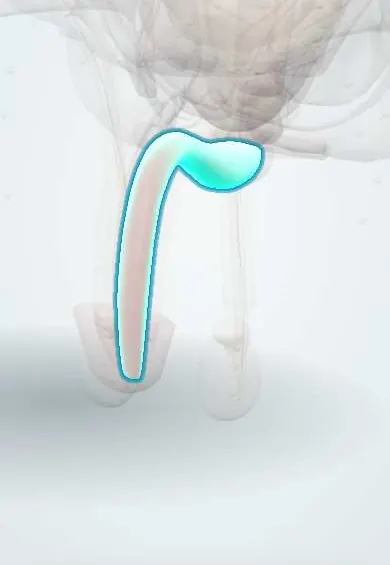
Reproductive system · Pelvis · Male
Corpus spongiosum !
The corpus spongiosum is the spongy column along the underside of the penis that surrounds the urethra; it stays softer in erection so semen can pass.
Official name: Corpus spongiosum of penis
Opens in the Durgical app, no sign-up needed.
What it is
A single cylinder of softer erectile tissue on the underside of the penis, around the spongy urethra. Its back end is the bulb; its front end widens into the glans.
What it does
Stays softer in erection so the urethra stays open for semen to pass.
Key facts
- Where
- Single ventral erectile cylinder around the spongy urethra; the bulb behind is fixed to the perineal membrane under bulbospongiosus; ends in front as the glans
- Blood supply
- Artery of the bulb and urethral artery (internal pudendal); dorsal arteries to the glans
- Nerve
- Cavernous nerves (parasympathetic, pelvic splanchnic S2–S4) for erection; sympathetic (T11–L2) for detumescence; dorsal nerve of penis (pudendal, S2–S4) for sensation
- Function
- Thin tunica keeps it compressible in erection so the urethra stays open; bulbospongiosus squeezes the bulb to expel semen and the last drops of urine
Relations
- Contents
- Spongy urethra, running through its centre
- Above
- Corpora cavernosa along the shaft, with the corpus spongiosum in the groove beneath them
- Superficial
- Bulbospongiosus over the bulb; Buck fascia, dartos and skin along the shaft
- Behind
- The bulb rests on the perineal membrane, just in front of the perineal body
- In front
- Expands into the glans penis, which caps the blunt ends of the corpora cavernosa
How to find it
Felt as the softer ridge along the underside of the shaft; in the perineum the bulb is felt in the midline behind the scrotum.
On imaging
Urethral ultrasound shows its thickness and scarring around a stricture; on MRI the bulb is seen in the midline of the perineum.
Common problems
- Scarring of it and the urethra causes a urethral stricture.
How it is diagnosed
Examination; Doppler ultrasound when needed.
Treatment
- Depends on the cause; a penile fracture is repaired surgically.
Clinical notes
- Bulbar urethroplasty: the bulbospongiosus is split and the bulb mobilized to reach the stricture, which is excised and rejoined or widened with a buccal mucosa graft
- Its bulb is fed by the artery of the bulb, a branch of the internal pudendal artery, which bleeds briskly when the bulb is mobilized in urethroplasty or perineal surgery
Development
Forms from tissue around the urethral folds as they fuse on the underside of the genital tubercle; in hypospadias it is often poorly formed beyond the meatus, with fibrous tissue that bends the penis downward (chordee).
Related conditions
Test yourself
Think of the answer, then tap the question to see it.
What runs through the corpus spongiosum, and why does it stay softer in erection?
The spongy urethra; its thin tunica keeps it compressible so the urethra stays open for semen.
Which part of the corpus spongiosum is crushed in straddle injuries?
The bulb, lying on the perineal membrane behind the scrotum, crushed against the pubic arch.
What is spongiofibrosis, and why does it matter?
Scarring of the corpus spongiosum around a urethral stricture; it sets the stricture's depth and length and whether urethroplasty is needed.
Educational information, not medical advice. For any symptom, see a health professional.
Its names
- Official Latin (TA2)
- corpus spongiosum penis; bulbus penis
- Official Spanish (DeCS)
- Cuerpo esponjoso del pene
- English (TA2)
- Corpus spongiosum of penis
- Also called
- bulb of penis (back end)
Related
Sources: Anatomy, Abdomen and Pelvis, Penis.
Spotted a mistake?We are always improving for the community. Tell us what is wrong and our team will review it.Report a mistake
Representative model, for educational purposes only.