Hypospadias !
Hypospadias is a birth difference in which the urethra opens on the underside of the penis instead of at the tip, often with a downward bend.
Updated 2026-10-29
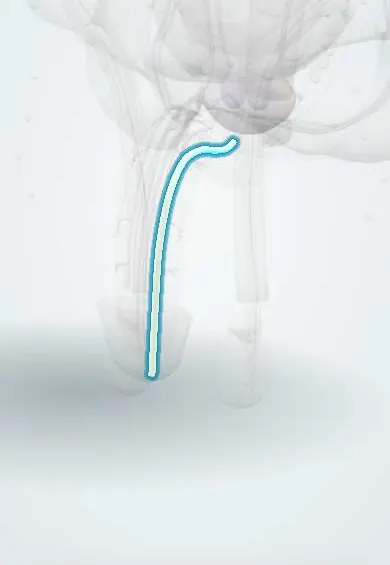
Structures involved
Tap one to see what it is and open it in 3D.
In embryology
- Valproate, carbamazepine and phenytoin
- External genitalia and their male–female homologues
- Hypospadias and epispadias
In physiology
Why it happens
What it is
Congenital anomaly in which the urethral opening is on the underside of the penis, from just below the tip to the scrotum or perineum. It is often associated with ventral curvature and a hooded foreskin.
Who gets it
It is one of the most common congenital anomalies in boys. Most cases are distal; proximal forms are less frequent and more often linked to other genital anomalies or disorders of sex development.
Causes
- Incomplete fusion of the urethral folds during fetal development, an androgen-dependent process
- Genetic factors (family history)
- Disorders of sex development and partial androgen insensitivity in some cases
- Placental insufficiency and other prenatal factors
- Possible role of endocrine-disrupting exposures (evidence uncertain)
Risk factors
- Affected father or brother
- Low birth weight or growth restriction
- Assisted reproduction in some studies
- Maternal hormonal exposures in pregnancy
Pathophysiology
The penile urethra forms when the urethral folds fuse along the underside of the developing penis under the influence of testosterone and dihydrotestosterone. Incomplete fusion leaves the meatus proximal to its normal site, with an underdeveloped spongiosum, incomplete ventral foreskin and often ventral curvature (chordee).
Classification
- Distal (glanular, coronal, subcoronal): the most common
- Middle (distal penile, midshaft, proximal penile)
- Proximal (penoscrotal, scrotal, perineal)
- With or without ventral curvature
Symptoms and signs
- Urethral opening on the underside of the penis
- Dorsal hooded foreskin with a deficient ventral side
- Downward curvature of the penis, more visible on erection
- Urine stream directed downward or spraying
- Possible associated undescended testis or inguinal hernia
Diagnosis
- Clinical
- Newborn exam: meatus position, foreskin, curvature, scrotum and both testes. Neonatal circumcision is deferred because the foreskin may be needed for the repair.
- Tests
- Karyotype and hormonal studies (for example 17-hydroxyprogesterone) when hypospadias is proximal or occurs with undescended testes or ambiguous genitalia.
- Imaging
- Not routine for isolated distal forms. Pelvic and renal ultrasound in severe forms or as part of a disorder of sex development evaluation.
Differential diagnosis
- Disorder of sex development (including congenital adrenal hyperplasia)
- Congenital penile curvature with a normal meatus
- Megameatus with intact prepuce
- Epispadias (dorsal opening)
Goal of treatment
Create a urethra that ends at the tip of the glans, straighten the penis and give a normal appearance, allowing standing urination and future sexual function.
Treatment
- Surgical
- Hypospadias repair, often between six and eighteen months of age (timing varies): straightening of curvature, urethroplasty (for example tubularised incised plate repair), glans and skin reconstruction; proximal forms may need two stages.
- Medical
- Preoperative androgen stimulation in selected boys with a small glans; practice varies between centres.
- Follow-up
- Follow-up through puberty for urinary stream, curvature and cosmetic result.
Complications
- Urethrocutaneous fistula
- Meatal stenosis or urethral stricture
- Urethral diverticulum
- Glans dehiscence
- Persistent or recurrent curvature
- Need for further surgery and cosmetic or psychosexual concerns
Prognosis
Distal repairs usually give good functional and cosmetic results with low complication rates; proximal repairs carry more complications and often need further surgery. Long-term follow-up is advised.
Test yourself
Think of the answer, then tap the question to see it.
Why is neonatal circumcision avoided in a boy with hypospadias?
The foreskin may be needed as tissue for the surgical repair.
Which combination in a newborn requires evaluation for a disorder of sex development?
Hypospadias (especially proximal) with one or both testes not palpable.
What is the most common location of the meatus in hypospadias?
Distal: glanular, coronal or subcoronal.
What is the most common complication after hypospadias repair?
A urethrocutaneous fistula.
Related conditions
Educational information, not medical advice. For any symptom, see a health professional.
Sources: Hypospadias Urogenital Reconstruction (StatPearls (NCBI Bookshelf), 2023).
Spotted a mistake?We are always improving for the community. Tell us what is wrong and our team will review it.Report a mistake
Representative model, for educational purposes only.