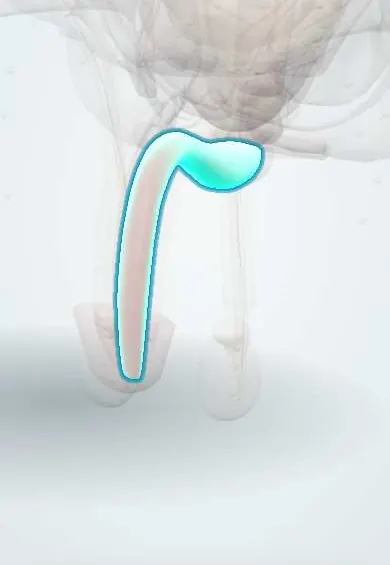
Priapism !
Priapism is an erection lasting more than four hours without, or beyond, sexual arousal; the ischaemic (low-flow) form is a urological emergency.
Updated 2026-10-29
Structures involved
Tap one to see what it is and open it in 3D.
- Corpora cavernosa
- Deep artery of penis
- Corpus spongiosum
- Glans penis
- Dorsal veins of penis
- Internal pudendal artery
- Pelvic plexus and cavernous nerves
In physiology
Why it happens
What it is
A full or partial erection that lasts more than four hours (a widely used cut-off) and is unrelated to, or persists beyond, sexual stimulation. The ischaemic form is a urological emergency.
Who gets it
It is uncommon overall but frequent in males with sickle cell disease, including children. In adults it is most often linked to intracavernosal drugs and other medicines. In parts of Latin America, envenomation by some scorpions and spiders is a recognised cause, especially in children.
Causes
- Sickle cell disease and other haematological disorders (for example leukaemia)
- Intracavernosal vasoactive injections; rarely oral erectile dysfunction drugs
- Other drugs: alpha-blockers, trazodone, antipsychotics and other antidepressants
- Cocaine, alcohol and other recreational drugs
- Perineal or penile trauma causing an arterial–cavernous fistula (non-ischaemic)
- Spinal cord injury, scorpion or spider envenomation, pelvic tumours; often idiopathic
Risk factors
- Sickle cell disease
- Use of intracavernosal injections or other erection-inducing drugs
- Psychiatric drugs that block alpha receptors
- Recreational drug use
- Straddle injury or blunt perineal trauma
- Previous episodes (stuttering priapism)
Pathophysiology
In ischaemic (low-flow) priapism, venous outflow is blocked and blood stagnates in the corpora cavernosa, becoming hypoxic and acidotic, like a compartment syndrome; prolonged ischaemia leads to smooth muscle necrosis and fibrosis. In non-ischaemic (high-flow) priapism, unregulated arterial inflow, usually from a traumatic fistula, keeps the blood oxygenated.
Classification
- Ischaemic (low-flow, veno-occlusive): the most common form, painful and an emergency
- Non-ischaemic (high-flow, arterial): usually after trauma, painless, not an emergency
- Stuttering (recurrent ischaemic): repeated short episodes, typical of sickle cell disease
Symptoms and signs
- Prolonged erection not related to sexual desire
- Ischaemic: painful, fully rigid corpora cavernosa with a soft glans
- Non-ischaemic: painless, partially rigid erection, often days or weeks after perineal trauma
- Recurrent, self-limited painful erections in stuttering priapism
Diagnosis
- Clinical
- Duration, pain, previous episodes, drugs, trauma and sickle cell disease; exam of the rigidity of the corpora cavernosa, the glans and the perineum.
- Tests
- Blood gas from the corpora cavernosa: dark, hypoxic, hypercapnic and acidotic blood in ischaemic priapism; bright red, arterial-like blood in non-ischaemic. Blood count, reticulocytes, haemoglobin studies and toxicology as indicated.
- Imaging
- Penile colour duplex Doppler ultrasound: little or no cavernous flow in ischaemic priapism; high flow or a fistula in non-ischaemic priapism.
Differential diagnosis
- Ischaemic versus non-ischaemic priapism
- Prolonged normal erection after sexual activity
- Penile fracture or haematoma
- Penile infiltration by a tumour or leukaemia (malignant priapism)
Goal of treatment
In ischaemic priapism, achieve rapid detumescence to stop the ischaemia and preserve erectile function; in all forms, treat the cause and prevent recurrence.
Treatment
- Acute
- Ischaemic priapism: aspiration of blood from the corpora cavernosa, with or without saline irrigation, and intracavernosal injection of an alpha-adrenergic agonist with blood pressure and heart rate monitoring.
- Surgical
- Corporal shunt (distal or proximal) when aspiration and alpha-agonists fail; early penile prosthesis may be considered in prolonged cases.
- Procedure
- Non-ischaemic priapism: selective arterial embolisation when it does not resolve on its own.
- Follow-up
- Observation for non-ischaemic priapism, which often resolves spontaneously.
- Medical
- Treatment of the cause together with urological care: sickle cell management with haematology, stopping causative drugs, and preventive strategies for stuttering priapism.
Complications
- Erectile dysfunction from cavernous fibrosis
- Penile shortening and deformity
- Recurrence
- Effects of alpha-agonists: hypertension, arrhythmias
- Shunt complications and, with embolisation, recanalisation
Prognosis
With early treatment of ischaemic priapism, erectile function is often preserved; the longer the ischaemia lasts, the higher the risk of permanent erectile dysfunction. Non-ischaemic priapism usually has a good prognosis.
Prevention
- Careful dosing and education for patients using intracavernosal injections
- Management of sickle cell disease and preventive strategies for stuttering priapism
Test yourself
Think of the answer, then tap the question to see it.
Which type of priapism is a urological emergency?
Ischaemic (low-flow) priapism, which is painful and behaves like a compartment syndrome.
What does a cavernous blood gas show in ischaemic priapism?
Dark blood with low oxygen, high carbon dioxide and acidosis.
What is the usual cause of non-ischaemic priapism?
Perineal or penile trauma that creates an arterial–cavernous fistula.
Which drug class is injected into the corpora cavernosa to treat ischaemic priapism?
An alpha-adrenergic agonist, with blood pressure and heart rate monitoring.
What is the most common cause of priapism in children?
Sickle cell disease.
Related conditions
Educational information, not medical advice. For any symptom, see a health professional.
Sources: Priapism (StatPearls (NCBI Bookshelf), 2025).
Spotted a mistake?We are always improving for the community. Tell us what is wrong and our team will review it.Report a mistake
Representative model, for educational purposes only.