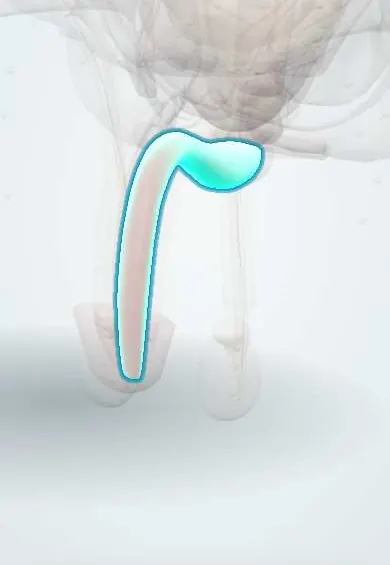
Peyronie disease !
Peyronie disease is scarring inside the penis that forms a hard plaque, causing it to curve, shorten or hurt during erection.
Updated 2026-10-29
Structures involved
Tap one to see what it is and open it in 3D.
- Corpora cavernosa
- Corpus spongiosum
- Dorsal artery of penis
- Dorsal nerve of penis
- Deep artery of penis
- Skin of penis
Why it happens
- Fibrosis in organs: TGF-β and the myofibroblast
- Abnormal repair: chronic wounds, hypertrophic scar, keloid, contracture
- Erection and ejaculation
- Extracellular matrix: collagen types, elastin, ground substance
What it is
Acquired fibrous scarring of the tunica albuginea of the corpora cavernosa, forming a plaque that causes penile curvature, deformity, pain or shortening during erection.
Who gets it
It mostly affects middle-aged and older men and is probably under-reported. It is associated with diabetes, erectile dysfunction and other fibrotic disorders such as Dupuytren contracture.
Causes
- Repeated microtrauma to the tunica albuginea during sexual activity
- Abnormal wound healing with excess fibrosis
- Genetic predisposition
- Association with Dupuytren contracture and other connective tissue disorders
- After penile trauma or surgery (for example radical prostatectomy) in some men
Risk factors
- Middle or older age
- Diabetes mellitus
- Erectile dysfunction
- Dupuytren contracture or plantar fibromatosis
- Hypertension, dyslipidaemia and smoking
- Penile trauma or previous urethral or prostate procedures
Pathophysiology
Microtrauma causes bleeding and fibrin deposition in the tunica albuginea; disordered healing, with factors such as TGF-beta, produces a collagen plaque that may calcify. The inelastic plaque cannot stretch, so the penis bends towards it (a dorsal plaque gives an upward curve), and it may shorten or narrow the shaft.
Classification
- Active (acute) phase: pain on erection and changing curvature, usually during the first year to eighteen months
- Stable (chronic) phase: stable deformity for several months, pain usually gone
- By deformity: curvature, indentation or hourglass narrowing, shortening
Symptoms and signs
- Penile curvature on erection, usually dorsal
- Palpable lump or band in the shaft
- Pain during erection in the active phase
- Narrowing (hourglass), indentation or shortening
- Difficulty with penetration
- Erectile dysfunction and emotional distress
Diagnosis
- Clinical
- History of onset, pain and stability; palpation of the plaque on the flaccid penis and stretched length. Curvature is assessed in erection, by photographs or after an in-office intracavernosal injection.
- Tests
- No specific laboratory test; glucose or HbA1c and other risk-factor tests when indicated.
- Imaging
- Penile ultrasound shows the plaque and any calcification; duplex Doppler after injection assesses vascular function before surgery.
Differential diagnosis
- Congenital penile curvature
- Penile fracture or its sequelae
- Penile tumour or metastasis
- Superficial dorsal vein thrombosis (Mondor disease)
- Fibrosis after priapism or intracavernosal injections
Goal of treatment
Relieve pain, stabilise and reduce the deformity and restore the ability to have satisfactory intercourse, while preserving erectile function and length.
Treatment
- Follow-up
- Observation in the active phase; the deformity may stabilise and a minority improve on their own.
- Medical
- Anti-inflammatory analgesics for pain in the active phase. Most oral therapies have weak evidence and are not recommended by several guidelines.
- Conservative
- Penile traction therapy may reduce curvature and preserve length in some men.
- Procedure
- Intralesional injections into the plaque (such as collagenase, calcium channel blockers or interferon) in selected men; evidence and availability vary.
- Surgical
- In the stable phase: tunical plication, plaque incision or partial excision with grafting, or a penile prosthesis when erectile dysfunction coexists.
Complications
- Erectile dysfunction
- Penile shortening and deformity
- Inability to have penetrative intercourse
- Depression, anxiety and relationship strain
- After surgery: further shortening, altered sensation, recurrence
Prognosis
Pain usually resolves over time, but the curvature rarely disappears without treatment; in many men it stabilises and in some it worsens. Surgery in the stable phase usually corrects the curvature well.
Test yourself
Think of the answer, then tap the question to see it.
Which layer of the penis is affected in Peyronie disease?
The tunica albuginea of the corpora cavernosa.
Towards which side does the penis bend in Peyronie disease?
Towards the plaque; a dorsal plaque, the most common, causes an upward curve.
Why is surgery usually delayed until the stable phase?
In the active phase the curvature is still changing; operating once it is stable gives a predictable correction.
Which hand condition is associated with Peyronie disease?
Dupuytren contracture.
Related conditions
Educational information, not medical advice. For any symptom, see a health professional.
Sources: Peyronie Disease (StatPearls (NCBI Bookshelf), 2024).
Spotted a mistake?We are always improving for the community. Tell us what is wrong and our team will review it.Report a mistake
Representative model, for educational purposes only.