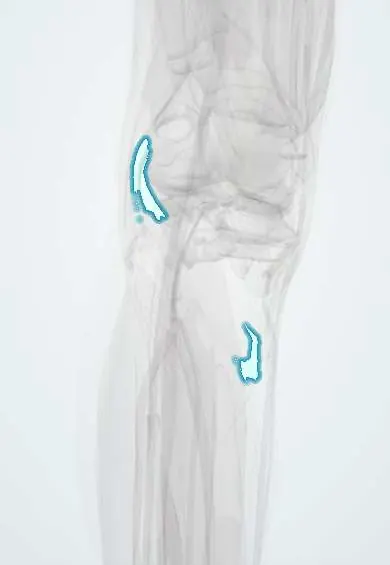
Popliteus tendon !
The popliteus tendon runs from the outer femur around the back of the knee; it helps unlock the straight knee so it can bend.
Official name: Tendon of popliteus
Opens in the Durgical app, no sign-up needed.
What it is
The tendon of the popliteus, running from the outer femur around the back of the knee.
What it does
Helps unlock the knee and steadies the back-outer corner.
Key facts
- Attaches
- Anterior end of the popliteal groove on the lateral femoral condyle; runs inside the capsule, deep to the LCL and through the popliteal hiatus beside the lateral meniscus, with fascicles to the meniscus and the popliteofibular ligament
- Function
- Unlocks the extended knee (rotates the tibia medially on the femur, or the femur laterally on a fixed tibia); retracts the lateral meniscus; part of the posterolateral corner
- Tight in
- Lateral rotation of the tibia and varus stress
Relations
- Course
- From the front of the popliteal groove on the lateral femoral condyle it runs back and down inside the capsule, deep to the LCL, through the hiatus behind the lateral meniscus, and becomes the muscle above the soleal line of the tibia
- Superficial
- LCL and, further out, the biceps femoris tendon
- Medial
- Posterior horn of the lateral meniscus, linked to it by popliteomeniscal fascicles
- Behind
- Arcuate popliteal ligament and the lateral head of gastrocnemius
How to find it
Not palpable; at arthroscopy it is seen in the lateral gutter and through the popliteal hiatus behind the lateral meniscus.
Examination
- Dial test, prone: outward tibial rotation 10° or more greater than the other side at 30° of knee flexion suggests a posterolateral corner injury; if it is also greater at 90°, the PCL is likely torn as well
- Posterolateral drawer test: with the knee bent and the foot turned out, the lateral tibial plateau rotates backward under pressure in posterolateral corner injuries
On imaging
Coronal and sagittal MRI show the tendon in its groove and through the hiatus; tears, avulsions and oedema around it are part of every posterolateral corner review.
Clinical notes
- Popliteus tendinopathy causes pain on the outer knee, classically with downhill running
- Reconstructed together with the LCL and the popliteofibular ligament in chronic posterolateral corner instability
- Tears of the small popliteomeniscal fascicles at the hiatus can leave the lateral meniscus hypermobile, so the knee locks although MRI shows no meniscal tear; at arthroscopy a probe lifts the meniscus far into the joint
Anatomical variants
- A sesamoid in the tendon (cyamella) can mimic a fragment from a lateral meniscal tear
- A small extra muscle, the popliteus minor, is rare
Test yourself
Think of the answer, then tap the question to see it.
What is the main action of the popliteus?
It unlocks the extended knee by rotating the tibia medially on the femur (or the femur laterally on a fixed tibia).
Why can the popliteal hiatus be misread as a lateral meniscus tear on MRI?
At the hiatus the lateral meniscus has no capsular attachment: a normal gap where the popliteus tendon passes.
Where is the femoral attachment of the popliteus tendon relative to the LCL?
In front of and below the LCL attachment, on the lateral femoral condyle.
What does popliteus tendinopathy classically cause?
Pain on the outer knee, classically with downhill running.
Educational information, not medical advice. For any symptom, see a health professional.
Its names
- Official Latin (TA2)
- musculus popliteus TA2 2665
- Official Spanish (DeCS)
- Tendón del poplíteo DeCS D013710
- English (TA2)
- Tendon of popliteus
Related
Sources: Terminologia Anatomica (TA2); DeCS; Anatomy, Bony Pelvis and Lower Limb: Popliteus Muscle.
Spotted a mistake?We are always improving for the community. Tell us what is wrong and our team will review it.Report a mistake
Representative model, for educational purposes only.