Joints and ligaments · Lower limb
Lateral meniscus !
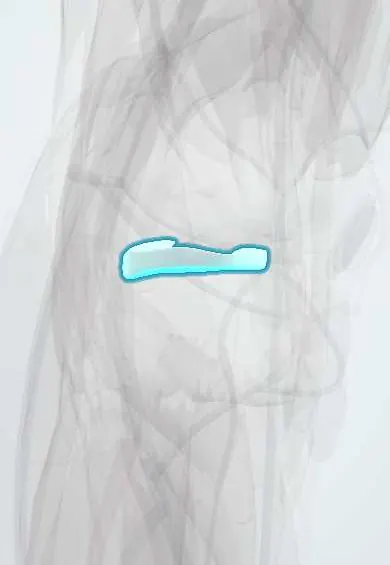
The lateral meniscus is a C-shaped cartilage cushion on the outer side of the knee, between thigh and shin bones; it absorbs shock.
Opens in the Durgical app, no sign-up needed.
What it is
A C-shaped cushion of cartilage between the femur and tibia, on the outer side. It is more rounded and mobile than the medial meniscus.
What it does
Spreads the body's weight across the joint, absorbs shock and helps keep the knee steady.
Key facts
- Where
- Lateral tibial plateau; nearly circular, covers more of the plateau than the medial meniscus
- Attaches
- Horns to intercondylar area of tibia; meniscofemoral ligaments to medial femoral condyle; not attached to LCL; popliteus tendon separates it from capsule
- Function
- Spreads load; absorbs shock; more mobile than medial meniscus (popliteus pulls it back in flexion)
Relations
- Above
- Lateral femoral condyle
- Below
- Articular cartilage of the lateral tibial plateau
- Lateral
- Separated from the lateral collateral ligament by the popliteus tendon; looser capsular attachment than on the medial side
- Behind
- Popliteus tendon and the popliteal hiatus; the meniscofemoral ligaments; beyond the capsule, the posterolateral corner
- Medial
- Its two horns attach close together near the intercondylar eminence, the anterior horn next to the ACL tibial footprint
How to find it
Lateral joint-line tenderness is sought with the knee bent, between the lateral femoral condyle and the plateau, in front of the lateral collateral ligament. A meniscal cyst can be felt as a firm lump on the lateral joint line, clearer with the knee slightly bent.
Examination
- McMurray test with the tibia internally rotated and varus stress: a painful click on the lateral joint line suggests a lateral meniscus tear
- Thessaly test: lateral joint-line pain or catching while rotating on the slightly bent standing leg
On imaging
MRI: a discoid meniscus shows a continuous bow-tie shape on three or more consecutive sagittal slices; on X-ray the lateral joint space may look widened. The popliteal hiatus is a normal gap that can mimic a posterior horn tear.
Common problems
- Tears from twisting the bent knee, common in sports.
- Wear-related (degenerative) tears with age, sometimes with little injury.
- Symptoms: pain on the joint line, swelling, catching or locking.
How it is diagnosed
A physical exam (joint-line tenderness, special twisting tests such as McMurray). MRI shows the tear.
Treatment
- Without surgery: rest, physical therapy, anti-inflammatory medicine; injections in some wear-related cases.
- Surgery (usually arthroscopic): repairing the tear with stitches, or trimming the torn part (partial meniscectomy).
- Meniscal allograft transplant (a donor meniscus) for selected patients who have lost most of a meniscus.
Clinical notes
- A parameniscal cyst arising from a horizontal tear can form a palpable lump on the lateral joint line
- Posterior root tears are linked to ACL injuries and are repaired at the same operation when possible
- The convex lateral plateau depends heavily on this meniscus, so lateral meniscectomy carries a high risk of later osteoarthritis
Anatomical variants
- Discoid lateral meniscus: complete, incomplete or Wrisberg type (no posterior tibial attachment, so unstable); more common in East Asian populations
Development
Normal fetal menisci are already crescent-shaped, so a discoid meniscus is a congenital variant, not an arrested fetal stage.
Related conditions
Test yourself
Think of the answer, then tap the question to see it.
Which tendon passes through the popliteal hiatus of the lateral meniscus?
The popliteus tendon. The gap and the meniscus's mobility make it torn less often than the medial meniscus.
What is the commonest meniscal variant, and how can it present in children?
Discoid lateral meniscus; it can cause a snapping knee in children.
Which ligaments run from the posterior horn of the lateral meniscus to the medial femoral condyle?
The meniscofemoral ligaments: Humphrey in front of the posterior cruciate ligament and Wrisberg behind it.
Why does lateral meniscectomy carry a high risk of later osteoarthritis?
The convex lateral tibial plateau depends heavily on the lateral meniscus to spread load.
Educational information, not medical advice. For any symptom, see a health professional.
Its names
- Official Latin (TA2)
- meniscus lateralis TA2 1885
- Official Spanish (DeCS)
- Menisco lateral DeCS D008592
- English (TA2)
- Lateral meniscus
- Also called
- meniscus fibularis
Related
Sources: Terminologia Anatomica (TA2); DeCS; Anatomy, Bony Pelvis and Lower Limb, Knee Lateral Meniscus.
Spotted a mistake?We are always improving for the community. Tell us what is wrong and our team will review it.Report a mistake
Representative model, for educational purposes only.