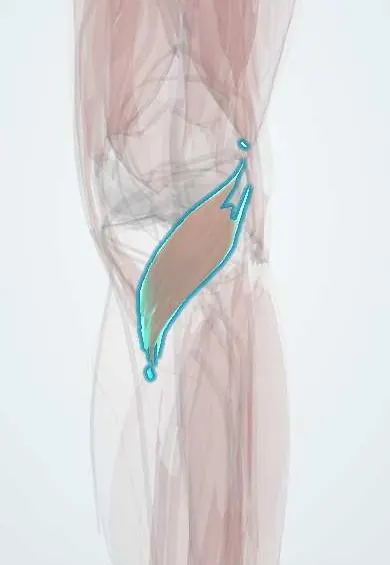
Popliteus !
The popliteus is a small muscle behind the knee that unlocks the straightened knee so it can start to bend.
Official name: Popliteus muscle
Opens in the Durgical app, no sign-up needed.
What it is
A small, flat muscle behind the knee.
What it does
Unlocks the straight knee so it can start to bend.
Key facts
- Origin
- Lateral femoral condyle (popliteal groove); posterior horn of lateral meniscus
- Insertion
- Posterior tibia above soleal line
- Action
- Unlocks extended knee (laterally rotates femur on fixed tibia); weak knee flexion; pulls lateral meniscus back
- Nerve
- Tibial nerve (L4–S1)
- Blood supply
- Inferior medial and lateral genicular arteries (from popliteal artery)
Relations
- Course
- From its groove on the lateral femoral condyle the tendon runs deep to the lateral collateral ligament and through the popliteal hiatus behind the lateral meniscus, then fans out as a triangular belly down and medially to the tibia above the soleal line
- Superficial
- Popliteal artery and vein and the tibial nerve, then plantaris and the two heads of gastrocnemius
- Deep
- Back of the upper tibia, the proximal tibiofibular joint and the knee capsule
- Lateral
- Lateral collateral ligament, superficial to its tendon, and the lateral meniscus, linked to it by popliteomeniscal fascicles
- Below
- Soleal line and the soleus origin; the popliteal vessels and tibial nerve pass under the tendinous arch of soleus just below it
How to find it
It cannot be felt. It is seen in the floor of the popliteal fossa in a posterior approach to the knee. On MRI its tendon sits in a groove on the lateral femoral condyle and runs behind the posterior horn of the lateral meniscus.
Examination
- Dial test (prone, external rotation of both feet compared at 30° and 90° of knee flexion): more rotation on one side at 30° only suggests a posterolateral corner injury; at both angles, a combined posterolateral corner and posterior cruciate ligament injury
- Posterolateral drawer test: with the foot externally rotated, a backward push makes the lateral tibial plateau rotate posteriorly, pointing to a posterolateral corner injury
On imaging
On MRI the tendon sheath at the hiatus can mimic a tear of the posterior horn of the lateral meniscus, and a small sesamoid in the tendon (cyamella) can mimic a loose body or tear.
Clinical notes
- Posterolateral corner injuries often accompany anterior or posterior cruciate ligament tears; missing them is a common cause of failed cruciate reconstruction
- Popliteus tendinopathy causes posterolateral knee pain, typically in downhill running
- The popliteal artery is held in place near the lower border of popliteus and at the soleal arch, which is why knee dislocations and upper tibial fractures can tear it
Anatomical variants
- A sesamoid in its tendon (cyamella) is uncommon
- A small extra muscle, popliteus minor, is rare
Development
A ventral (flexor) muscle mass derivative of the deep calf, supplied by a branch of the tibial nerve that curls round its lower border.
Test yourself
Think of the answer, then tap the question to see it.
What is the main action of the popliteus?
It unlocks the extended knee by laterally rotating the femur on the fixed tibia; it also pulls the lateral meniscus back.
What is the popliteal hiatus?
The gap in the attachment of the lateral meniscus through which the popliteus tendon passes, inside the capsule but outside the synovium.
Of which knee complex is the popliteus part, and what does its injury cause?
The posterolateral corner, with the lateral collateral and popliteofibular ligaments; injury causes posterolateral rotatory instability.
What does more external rotation at 30° only, on the dial test, suggest?
A posterolateral corner injury; more rotation at both 30° and 90° suggests a combined posterolateral corner and posterior cruciate ligament injury.
Educational information, not medical advice. For any symptom, see a health professional.
Its names
- Official Latin (TA2)
- musculus popliteus TA2 2665
- Official Spanish (DeCS)
- Músculo poplíteo
- English (TA2)
- Popliteus muscle
Related
Sources: Terminologia Anatomica (TA2); Anatomy, Bony Pelvis and Lower Limb: Popliteus Muscle.
Spotted a mistake?We are always improving for the community. Tell us what is wrong and our team will review it.Report a mistake
Representative model, for educational purposes only.