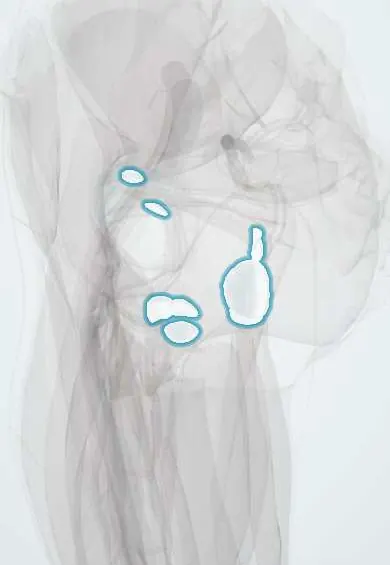
Deep hip bursae !
The deep hip bursae are small fluid sacs under the deep buttock and hip muscles, including one over the sitting bone; they reduce friction.
Official name: Bursa of piriformis muscle
Opens in the Durgical app, no sign-up needed.
What it is
Several small fluid sacs deep in the buttock and around the hip: under the piriformis, obturator internus, gluteus maximus and iliacus tendons, between the gluteal muscles, and at the top of the biceps femoris near the sitting bone.
What it does
Reduce friction where muscles and tendons slide over bone or over each other.
Key facts
- Where
- Under piriformis, obturator internus (at lesser sciatic notch) and gluteus maximus over ischial tuberosity
- Function
- Reduce friction of deep hip muscles on bone; ischial bursa inflamed by prolonged sitting
Relations
- Superficial
- Gluteus maximus covers all of them
- Deep
- Ischial tuberosity (ischial bursa), lesser sciatic notch (obturator internus bursa), and the greater trochanter and hip capsule (piriformis bursa)
- Lateral
- Sciatic nerve, running down over obturator internus and the gemelli, lateral to the ischial tuberosity
- Below
- Hamstring origin on the ischial tuberosity, next to the ischial bursa
How to find it
Lying on the side with the hips bent, the ischial tuberosity is felt deep in the lower buttock as the sitting bone; tenderness directly over it suggests ischial bursitis or a problem at the hamstring origin. The other bursae are too deep to feel and are met in the posterior approach to the hip.
On imaging
Ultrasound or MRI shows a fluid collection over the ischial tuberosity or around the obturator internus tendon; MRI also separates bursitis from a hamstring tendon tear and from a soft-tissue tumour.
Common problems
- They can become irritated and sore (bursitis), for example near the sitting bone after long sitting.
Clinical notes
- Ischial bursitis and proximal hamstring tendinopathy both hurt on sitting; tendon pain also comes with stretching the hamstrings and resisted knee flexion
- The posterior approach to the hip detaches the piriformis and obturator internus tendons and opens the bursae beneath them
- A chronically enlarged ischial bursa can be mistaken for a soft-tissue tumour
Test yourself
Think of the answer, then tap the question to see it.
Which deep hip bursa causes «weaver's bottom», and why?
The ischial (ischiogluteal) bursa: when sitting, the gluteus maximus slides off the ischial tuberosity and the bursa takes the pressure.
Why can a large ischial bursa mimic sciatica?
The sciatic nerve passes close to the ischial tuberosity.
How is proximal hamstring tendinopathy told apart from ischial bursitis?
Both hurt on sitting, but tendon pain also comes with hamstring stretching and resisted knee flexion.
Educational information, not medical advice. For any symptom, see a health professional.
Its names
- Official Latin (TA2)
- bursa musculi piriformis; bursa ischiadica obturatoris interni TA2 2727
- Official Spanish (DeCS)
- Bolsas del piriforme y del obturador interno DeCS D002061
- English (TA2)
- Bursa of piriformis muscle
- Also called
- isciatic bursa of obturator internus · sciatic bursa of obturator internus muscle
Related
Sources: Terminologia Anatomica (TA2); DeCS; Anatomy, Skin Bursa; Anatomy, Bony Pelvis and Lower Limb, Hip.
Spotted a mistake?We are always improving for the community. Tell us what is wrong and our team will review it.Report a mistake
Representative model, for educational purposes only.