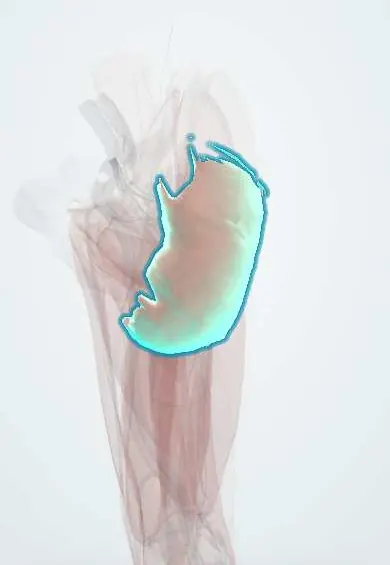
Gluteus maximus !
The gluteus maximus is the large buttock muscle; it extends the hip when standing up, climbing stairs or running.
Official name: Gluteus maximus muscle
Opens in the Durgical app, no sign-up needed.
What it is
The largest and most superficial buttock muscle, from the back of the pelvis, sacrum and coccyx to the femur and the IT band.
What it does
Extends the hip powerfully: standing up from a chair, climbing stairs, running and jumping. It also turns the thigh outward and steadies the knee through the IT band.
Key facts
- Origin
- Posterior ilium behind posterior gluteal line; dorsal sacrum and coccyx; sacrotuberous ligament; thoracolumbar fascia
- Insertion
- Iliotibial tract (most fibres); gluteal tuberosity of femur
- Action
- Extends hip, mainly from flexion (rising, climbing); laterally rotates hip; steadies thigh
- Nerve
- Inferior gluteal nerve (L5–S2)
- Blood supply
- Inferior and superior gluteal arteries
Relations
- Superficial
- Thick fat and skin of the buttock, crossed by the cluneal nerves
- Deep
- Gluteus medius above; piriformis, gemelli, obturator internus and quadratus femoris; the sciatic and posterior femoral cutaneous nerves; the superior and inferior gluteal vessels and nerves; the ischial tuberosity
- Lateral
- Greater trochanter, with the trochanteric bursa between bone and muscle; the iliotibial tract, into which it blends with the tensor fasciae latae
- Below
- The hamstring origins and the sciatic nerve appear below its lower border on their way into the back of the thigh
How to find it
Prone with the knee bent, lifting the thigh off the couch makes the whole buttock firm; bending the knee takes the hamstrings out of the movement. Bony landmarks around it: the posterior superior iliac spines (the dimples), the coccyx, the ischial tuberosity and the greater trochanter.
Examination
- Manual muscle test: prone, knee bent to 90°, the thigh is lifted against resistance; weakness points to the muscle or the inferior gluteal nerve (L5–S2)
- Gait: a backward lurch of the trunk at heel strike on the weak side (gluteus maximus gait) keeps the hip extended without muscle power
On imaging
MRI shows it as the large superficial muscle of the buttock; axial images also show the sciatic nerve deep to its lower part. Look for tears, haematoma or fatty atrophy, for example after hip surgery or nerve injury. Ultrasound shows haematomas and injection-site abscesses. CT shows gas and fluid in deep infection. Radiographs show only soft-tissue swelling or calcification.
Common problems
- Strains from sprinting or jumping (less common than hamstring strains).
- Weakness from inactivity or after injury, linked to back, hip and knee pain.
- Buttock pain from a bruise or an irritated bursa under the muscle.
How it is diagnosed
Physical exam and strength testing; ultrasound or MRI if a tear is suspected.
Treatment
- Rest, ice, then progressive strengthening (bridges, squats, step-ups) with a physical therapist.
- Treating the underlying cause of buttock pain, such as a back or hip problem.
Clinical notes
- Dorsogluteal injection: the area above and lateral to a line from the posterior superior iliac spine to the greater trochanter keeps away from the sciatic nerve; many guidelines now prefer the ventrogluteal site
- Gluteal artery perforator flaps (superior or inferior) are used in breast reconstruction; gluteus maximus musculocutaneous flaps cover sacral and ischial pressure ulcers
- The posterior approach to the hip splits it in the line of its fibres to reach the short rotators; the sciatic nerve lies just deep to it
Development
Comes from the dorsal muscle mass of the limb bud and keeps a nerve of posterior-division origin, the inferior gluteal nerve (L5–S2).
Related conditions
- Marasmus
- Piriformis syndrome
- Immobility syndrome and hospital-associated deconditioning
- Malignant hyperthermia
Test yourself
Think of the answer, then tap the question to see it.
What is the nerve supply of the gluteus maximus?
The inferior gluteal nerve (L5–S2).
Where does the gluteus maximus insert?
Mostly into the iliotibial tract, the rest into the gluteal tuberosity of the femur.
Which activities depend most on the gluteus maximus, and what gait shows its weakness?
Hip extension from flexion: rising from a chair and climbing stairs; weakness gives a backward lurch of the trunk at heel strike.
Why do intramuscular injections avoid the lower medial part of the gluteus maximus?
The sciatic nerve lies deep there; the upper outer quadrant of the buttock is the traditional site.
Does the gluteal fold mark the lower border of the gluteus maximus?
No: the lower edge of the muscle crosses the gluteal fold obliquely.
Educational information, not medical advice. For any symptom, see a health professional.
Its names
- Official Latin (TA2)
- musculus gluteus maximus TA2 2598
- Official Spanish (DeCS)
- Músculo glúteo mayor DeCS D002081
- English (TA2)
- Gluteus maximus muscle
- Also called
- musculus glutaeus maximus
Related
- Gluteus medius
- IT band
- Trochanteric bursae
- Sciatic nerve
- Gluteal arteries
- Gluteus maximus tendon
- Coccyx
- Femur
Sources: Terminologia Anatomica (TA2); DeCS; Anatomy, Bony Pelvis and Lower Limb, Gluteus Maximus Muscle.
Spotted a mistake?We are always improving for the community. Tell us what is wrong and our team will review it.Report a mistake
Representative model, for educational purposes only.