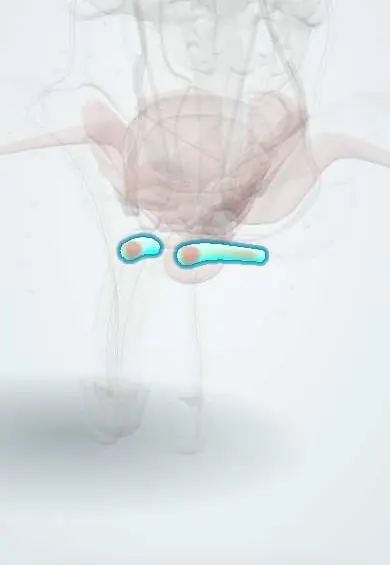
Ischiocavernosus !
The ischiocavernosus is a small muscle along each side of the vulva, over the crura of the clitoris; it helps keep the clitoris erect during arousal.
Official name: Ischiocavernosus muscle
Opens in the Durgical app, no sign-up needed.
What it is
A thin muscle along each ischiopubic ramus, covering the crura (roots) of the corpora cavernosa.
What it does
Squeezes the crura to help keep the penis erect.
Key facts
- Origin
- Ischial tuberosity and ischiopubic ramus
- Insertion
- Crus of clitoris
- Action
- Maintains erection of the clitoris by compressing the crus
- Nerve
- Perineal branch of pudendal nerve (S2–S4)
- Blood supply
- Perineal branch of internal pudendal artery
Relations
- Lateral
- The ischiopubic ramus and the ischial tuberosity
- Medial
- The bulbospongiosus, with a small triangle of perineal membrane between them
- Deep
- The crus of the clitoris (male: crus of the penis), fixed to the ramus and the perineal membrane
- Behind
- The superficial transverse perineal muscle at the ischial tuberosity
- Superficial
- Colles fascia and the labium majus
How to find it
Not felt on examination; in dissection it is the narrow strip of muscle lying on the ischiopubic ramus once Colles fascia is lifted.
On imaging
Seen on axial and coronal MRI as a narrow muscle on the ischiopubic ramus, wrapped over the crus of the clitoris. It is rarely assessed alone; MRI shows the crura and erectile tissue in trauma, masses or congenital anomalies. In the male it is larger, and MRI shows it over the crura of the penis in penile fracture or perineal trauma. Radiographs do not show it.
Common problems
- Straddle injuries (falling astride a bar or a beam) can bruise the perineum and tear the urethra.
- Perineal pain or numbness, for example from long cycling.
How it is diagnosed
Examination; ultrasound or MRI when needed.
Treatment
- Depends on the cause: rest, a better bicycle seat, or treatment of a urethral injury by a urologist.
Clinical notes
- The dorsal nerve and artery of the clitoris run forward close to it along the ramus, a point to protect in vulvar surgery
- Male: its contraction helps make the penis rigid; weakness of the pelvic floor muscles is one factor studied in erectile dysfunction
Related conditions
Test yourself
Think of the answer, then tap the question to see it.
What does the ischiocavernosus cover, and how does it help maintain erection?
The crus of the clitoris (male: crus of the penis); by compressing it, it slows blood outflow and keeps the erectile tissue filled.
Which side of the superficial perineal triangle does the ischiocavernosus form?
The lateral side, along the ischiopubic ramus, with bulbospongiosus medially and the superficial transverse perineal muscle behind.
Which nerve and artery run close to the ischiocavernosus and need protection in vulvar surgery?
The dorsal nerve and dorsal artery of the clitoris, running forward along the ischiopubic ramus.
Educational information, not medical advice. For any symptom, see a health professional.
Its names
- Official Latin (TA2)
- musculus ischiocavernosus TA2 2417
- Official Spanish (DeCS)
- Músculo isquiocavernoso
- English (TA2)
- Ischiocavernosus muscle
Related
Sources: Terminologia Anatomica (TA2); Anatomy, Abdomen and Pelvis: Superficial Perineal Space.
Spotted a mistake?We are always improving for the community. Tell us what is wrong and our team will review it.Report a mistake
Representative model, for educational purposes only.