Erectile dysfunction !
Erectile dysfunction is the ongoing inability to get or keep an erection firm enough for sex; it is common and can be an early sign of heart and vessel disease.
Updated 2026-10-30
Structures involved
Tap one to see what it is and open it in 3D.
- Corpora cavernosa
- Deep artery of penis
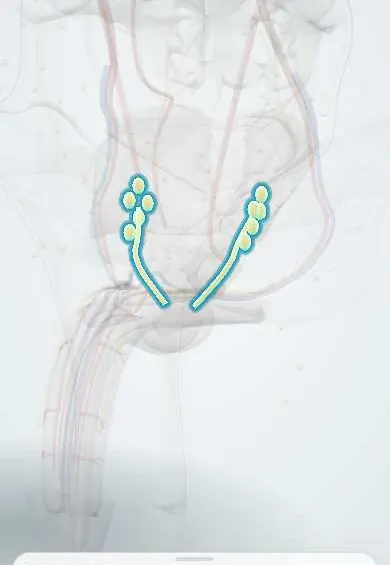
- Pelvic plexus and cavernous nerves
- Internal pudendal artery
- Dorsal veins of penis
- Ischiocavernosus
- Bulbospongiosus
- Pudendal nerve
- Prostate
In biochemistry
In physiology
Why it happens
What it is
Persistent or recurrent inability to achieve or keep an erection firm enough for satisfactory sexual activity. It is common, often has a vascular cause and can be an early sign of cardiovascular disease.
Who gets it
Its frequency rises with age and with diabetes, hypertension, obesity, smoking and depression. In a 2020 online survey of 466 men from 17 Latin American countries during the COVID-19 pandemic, 37.55% screened positive for erectile dysfunction (not a representative sample). It is under-reported, so clinicians are encouraged to ask about it.
Causes
- Vasculogenic (most common): atherosclerosis and endothelial dysfunction
- Neurogenic: diabetes, spinal cord injury, multiple sclerosis, pelvic surgery that damages the cavernous nerves
- Hormonal: hypogonadism, hyperprolactinaemia, thyroid disease
- Drug-induced: some antihypertensives, antidepressants, antipsychotics, antiandrogens, alcohol and recreational drugs
- Anatomical: Peyronie disease, fibrosis after priapism
- Psychogenic: performance anxiety, depression, relationship problems
Risk factors
- Older age
- Diabetes mellitus
- Hypertension, dyslipidaemia and cardiovascular disease
- Obesity, metabolic syndrome and physical inactivity
- Smoking and heavy alcohol use
- Radical prostatectomy or pelvic radiotherapy
- Depression and anxiety
Pathophysiology
Sexual stimulation activates parasympathetic cavernous nerves, which release nitric oxide; cyclic GMP relaxes the smooth muscle of the corpora cavernosa, arterial inflow fills the sinusoids, and compression of venules against the tunica albuginea traps blood. Disease of arteries, nerves, smooth muscle or hormones disrupts this; PDE5 normally breaks down cyclic GMP.
Classification
- Organic (vasculogenic, neurogenic, hormonal, anatomical, drug-induced), psychogenic or mixed
- Severity scored with validated questionnaires such as the IIEF-5
Symptoms and signs
- Difficulty getting an erection
- Difficulty keeping an erection during sexual activity
- Reduced rigidity
- Preserved morning or nocturnal erections suggest a psychogenic component
- Reduced libido when hypogonadism is present
Diagnosis
- Clinical
- Sexual, medical, medication and psychosocial history, with a questionnaire such as the IIEF-5. Exam of the genitals, secondary sexual characteristics, blood pressure and peripheral pulses; cardiovascular risk is assessed.
- Tests
- Fasting glucose or HbA1c, lipid profile and early-morning total testosterone; prolactin, thyroid tests or others when indicated.
- Imaging
- Not routine. Penile duplex Doppler ultrasound after intracavernosal injection of a vasoactive drug in selected cases, such as before surgery or with Peyronie disease.
Differential diagnosis
- Hypoactive sexual desire
- Ejaculatory or orgasmic disorders
- Peyronie disease
- Hypogonadism
- Depression
Goal of treatment
Restore satisfactory sexual function and treat underlying causes and cardiovascular risk factors, choosing therapy with the patient and partner.
Treatment
- Lifestyle
- Weight loss, regular exercise, stopping smoking, moderating alcohol and control of diabetes, hypertension and lipids; review of medicines that may contribute.
- Medical
- Phosphodiesterase-5 (PDE5) inhibitors are first-line oral therapy and are contraindicated with nitrates. Testosterone therapy only for confirmed hypogonadism.
- Conservative
- Psychosexual therapy or counselling, alone or with other treatments, especially when psychological factors are important.
- Procedure
- Vacuum erection devices, intraurethral or intracavernosal vasoactive agents (such as prostaglandin E1 analogues), and low-intensity shockwave therapy in some settings (evidence varies).
- Surgical
- Penile prosthesis (malleable or inflatable) when other options fail or are unsuitable.
Complications
- Reduced quality of life, anxiety, depression and relationship strain
- Missed or delayed diagnosis of cardiovascular disease or diabetes
- Treatment effects: headache, flushing, hypotension with nitrates, priapism or penile fibrosis with injections
- Prosthesis infection, erosion or mechanical failure
Prognosis
Most men improve with treatment, though few causes are fully reversible. Psychogenic and lifestyle-related forms respond best; men with diabetes or after radical prostatectomy often need second-line therapy.
Prevention
- Healthy weight, physical activity and not smoking
- Good control of diabetes, hypertension and lipids
- Nerve-sparing techniques in pelvic surgery when oncologically safe
Test yourself
Think of the answer, then tap the question to see it.
Which mediator released by the cavernous nerves starts erection?
Nitric oxide, which raises cyclic GMP and relaxes cavernous smooth muscle.
Which drug group is an absolute contraindication with PDE5 inhibitors?
Nitrates, because together they can cause severe hypotension.
Why is erectile dysfunction considered a marker of cardiovascular disease?
It shares endothelial dysfunction and atherosclerosis; penile arteries are small, so symptoms may appear before coronary events.
What does the persistence of morning erections suggest?
That the vascular and neural pathways work and a psychogenic component is likely.
Which hormone is measured in the early morning in a man with erectile dysfunction?
Total testosterone, to look for hypogonadism.
Related conditions
- Type 2 diabetes mellitus
- Arterial hypertension
- Atherosclerosis and dyslipidaemia
- Peripheral artery disease
- Prostate cancer
- Peyronie disease
- Priapism
Educational information, not medical advice. For any symptom, see a health professional.
Sources: Erectile Dysfunction (StatPearls (NCBI Bookshelf), 2024); Interaction between the impact of the Coronavirus disease 2019 pandemic and demographic characteristics on sexual/erectile dysfunction in Latin America: cross-sectional study (International braz j urol : official journal of the Brazilian Society of Urology, 2022) · adapted, CC BY 4.0.
Spotted a mistake?We are always improving for the community. Tell us what is wrong and our team will review it.Report a mistake
Representative model, for educational purposes only.