Reproductive system · Pelvis · Female
Clitoris !
The clitoris is the erectile organ at the front of the vulva, with a small visible glans and a larger internal part; it is the main organ of sexual sensation.
Opens in the Durgical app, no sign-up needed.
What it is
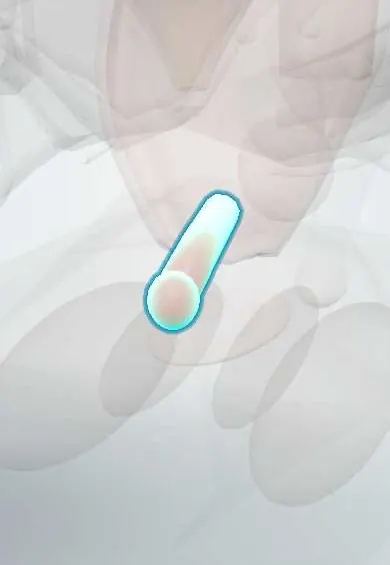
An erectile organ: the small visible glans under its hood, a body, and two crura that run back along the pubic arch; with the vestibular bulbs it is several centimetres long.
What it does
The main organ of sexual sensation; it has a dense nerve supply from the dorsal nerve of the clitoris.
Key facts
- Where
- Erectile organ at the front of the vulva: glans (under the prepuce), body (folded back under the symphysis) and two crura along the ischiopubic rami
- Blood supply
- Deep and dorsal arteries of the clitoris (internal pudendal artery)
- Nerve
- Dorsal nerve of clitoris (pudendal, S2–S4); cavernous nerves (autonomic, uterovaginal plexus)
- Function
- Sexual sensation and arousal; homologue of the penis
Relations
- In front
- The suspensory ligament of the clitoris, tying the body to the front of the pubic symphysis
- Superficial
- The prepuce (hood) and frenulum, formed by the labia minora
- Behind
- The vestibule with the external urethral orifice
- Lateral
- The crura along the ischiopubic rami, covered by the ischiocavernosus; the vestibular bulbs beside the vaginal orifice, covered by the bulbospongiosus
- Deep
- The perineal membrane, to which the crura and bulbs are attached
How to find it
The glans is seen at the front of the vestibule under its hood; the body can be felt as a firm cord under the skin running up toward the pubic symphysis. The crura and bulbs are deep and are seen only on MRI or in dissection.
Examination
- Bulbocavernosus (clitoroanal) reflex: a gentle squeeze or tap on the clitoris makes the external anal sphincter contract; an absent reflex points to a lesion of the S2–S4 segments, the conus medullaris or the pudendal nerve
On imaging
Ultrasound and MRI show the whole organ: glans and body in front, crura along the ischiopubic rami and vestibular bulbs beside the vagina; contrast MRI outlines the erectile tissue well. Imaging is used in clitoromegaly and disorders of sex development (with pelvic ultrasound for the uterus and gonads), for masses, and to plan reconstruction after genital cutting.
Common problems
- Infections and skin conditions (e.g. lichen sclerosus).
- Bartholin gland cysts and abscesses.
- Vulvar pain (vulvodynia).
- Vulvar cancer (rare, mostly in older women).
How it is diagnosed
Careful examination; swabs or a small skin biopsy when needed.
Treatment
- Depends on the cause: medicines, creams, drainage of an abscess, surgery for cancer.
Clinical notes
- The dorsal nerve of the clitoris runs along the ischiopubic ramus and under the pubic arch; it is at risk in surgery near the pubic arch and the anterior vulva
- Enlargement of the clitoris at birth can be a sign of androgen exposure (for example congenital adrenal hyperplasia) and prompts evaluation for a difference of sex development
- Female genital mutilation/cutting: WHO type I removes part or all of the clitoral glans and/or the prepuce; it causes pain, scarring and sexual and obstetric problems and WHO treats it as a public health problem and a human rights violation
Anatomical variants
- Size and shape of the glans and hood vary widely between individuals; this is normal
Development
Grows from the genital tubercle, the same origin as the penis; without dihydrotestosterone it stays small and the folds around the urogenital opening remain separate.
Related conditions
Test yourself
Think of the answer, then tap the question to see it.
What are the male homologues of the parts of the clitoris?
Glans = glans of the penis; corpora cavernosa = penile corpora cavernosa; vestibular bulbs = bulb and corpus spongiosum.
How does the clitoris differ from the penis in relation to the urethra?
The urethra does not run through the clitoris; it opens separately behind the glans in the vestibule.
What can enlargement of the clitoris at birth indicate?
Androgen exposure, for example congenital adrenal hyperplasia; it prompts evaluation for a difference of sex development.
Which nerve gives the clitoris its dense sensory supply, and where is it at risk?
The dorsal nerve of the clitoris, running along the ischiopubic ramus and under the pubic arch; at risk in surgery there and on the anterior vulva.
Educational information, not medical advice. For any symptom, see a health professional.
Its names
- Official Latin (TA2)
- clitoris; corpus clitoridis; glans clitoridis TA2 3565
- Official Spanish (DeCS)
- Clítoris DeCS D002987
- English (TA2)
- Clitoris
Related
Sources: Terminologia Anatomica (TA2); DeCS; Anatomy, Abdomen and Pelvis: Female External Genitalia.
Spotted a mistake?We are always improving for the community. Tell us what is wrong and our team will review it.Report a mistake
Representative model, for educational purposes only.