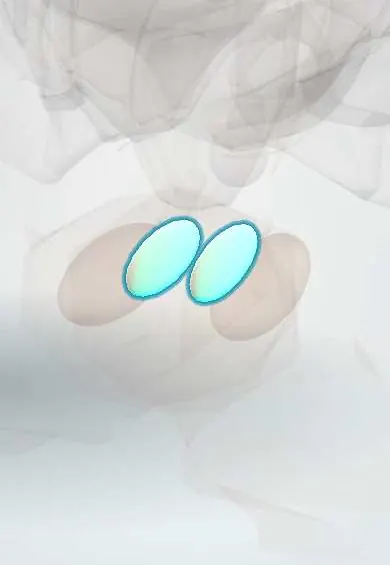
Reproductive system · Pelvis · Female
Labia minora !
The labia minora are the two thin inner folds of the vulva; they border the vestibule and protect the urethral and vaginal openings.
Official name: Labium minus of vulva
Opens in the Durgical app, no sign-up needed.
What it is
Two thin inner folds without fat, which join in front around the clitoris (its hood) and behind at the fourchette. Their size and shape vary widely.
What it does
Border the vestibule and protect the urethral and vaginal openings.
Key facts
- Where
- Thin hairless skin folds inside the labia majora; join in front as the prepuce and frenulum of the clitoris, behind as the frenulum of the labia (fourchette)
- Function
- Bound the vestibule; rich in sebaceous glands and nerve endings; size and shape vary widely (normal)
Relations
- Lateral
- The labia majora, separated by the interlabial groove
- Medial
- The vestibule with the urethral and vaginal orifices; the Bartholin ducts open in the groove between them and the hymen
- In front
- The glans of the clitoris, wrapped by their prepuce and frenulum
- Behind
- The fourchette (frenulum of the labia), in front of the perineal body
- Deep
- The vestibular bulbs and the bulbospongiosus
How to find it
Seen on parting the labia majora. On their inner surface a fine border (Hart's line) marks where their skin meets the moist lining of the vestibule.
On imaging
Rarely imaged: labial adhesions, enlargement and surface lesions are diagnosed by inspection and biopsy. MRI (axial and coronal T2) maps the vulva when the extent of a tumour, an abscess or a congenital anomaly must be known. Ultrasound shows a fluid collection or a foreign body.
Common problems
- Infections and skin conditions (e.g. lichen sclerosus).
- Bartholin gland cysts and abscesses.
- Vulvar pain (vulvodynia).
- Vulvar cancer (rare, mostly in older women).
How it is diagnosed
Careful examination; swabs or a small skin biopsy when needed.
Treatment
- Depends on the cause: medicines, creams, drainage of an abscess, surgery for cancer.
Clinical notes
- The fourchette is a frequent site of superficial (first-degree) tears in vaginal birth
- Lichen sclerosus and other scarring conditions can shrink them and fuse them over the clitoris, changing the anatomy seen at examination
- Asymmetry and protrusion beyond the labia majora are common normal findings and are not by themselves a sign of disease
Development
Forms from the urethral (urogenital) folds, which stay separate in the female.
Related conditions
- Vulvovaginal candidiasis
- Syphilis
- Sexual violence (care of the survivor)
- Genitourinary syndrome of menopause (atrophic vaginitis)
- Vulvar lichen sclerosus and vulvar cancer
Test yourself
Think of the answer, then tap the question to see it.
What is the male homologue of the labia minora?
The skin on the underside of the penis; the same urethral folds fuse in the male to close the spongy urethra.
In whom do labial adhesions of the labia minora typically occur?
Young girls with low oestrogen; the fusion can cover much of the vestibule.
Is asymmetry or protrusion of the labia minora beyond the labia majora a sign of disease?
No; both are common normal findings and are not by themselves a sign of disease.
Educational information, not medical advice. For any symptom, see a health professional.
Its names
- Official Latin (TA2)
- labium minus vulvae; preputium clitoridis; frenulum labiorum vulvae TA2 3553
- Official Spanish (DeCS)
- Labio menor de la vulva DeCS D014844
- English (TA2)
- Labium minus of vulva
- Also called
- fourchette · labium minus pudendi
Related
Sources: Terminologia Anatomica (TA2); DeCS; Anatomy, Abdomen and Pelvis: Female External Genitalia.
Spotted a mistake?We are always improving for the community. Tell us what is wrong and our team will review it.Report a mistake
Representative model, for educational purposes only.