Respiratory system · Head and neck
Lateral cricoarytenoid !
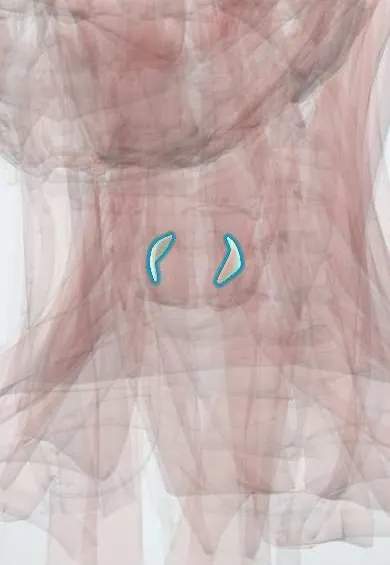
The lateral cricoarytenoid is a small muscle on the side of the larynx; it brings the vocal folds together for speaking.
Official name: Lateral cricoarytenoid muscle
Opens in the Durgical app, no sign-up needed.
What it is
A small muscle on the side of the cricoid.
What it does
Brings the vocal folds together.
Key facts
- Origin
- Arch of the cricoid
- Insertion
- Muscular process of the arytenoid
- Action
- Adducts the vocal folds
- Nerve
- Recurrent laryngeal nerve (X)
- Blood supply
- Laryngeal arteries
Relations
- Lateral
- Lamina of the thyroid cartilage, which covers it
- Medial
- Conus elasticus and the mucosa of the subglottic airway
- Above
- Thyroarytenoid, which lies just above it and blends with its fibres
- Behind
- Muscular process of the arytenoid cartilage and, behind it, the posterior cricoarytenoid
How to find it
Not palpable; it lies deep to the thyroid lamina. In surgery it is reached by lifting the back edge of the thyroid lamina or through a window cut in it (thyroplasty).
Examination
- Laryngoscopy on a sustained vowel: the folds should meet in the midline; a gap with a still fold suggests recurrent laryngeal nerve palsy
On imaging
Too small to assess well on routine imaging. It lies in the paraglottic space beside the cricoid and the arytenoid's muscular process, so CT and MRI judge that space; tumour spread into the paraglottic fat is a key staging point. In recurrent laryngeal nerve palsy, CT shows a thin, flat fold with a wider ventricle and piriform sinus on that side; laryngoscopy shows the fold does not close.
Clinical notes
- Weak adduction gives a breathy voice and a weak cough, with a risk of aspiration when swallowing
- Medialisation thyroplasty, injection of filler into the fold and arytenoid adduction are the main ways of making up for its loss
- In adductor spasmodic dysphonia, botulinum toxin is aimed at the thyroarytenoid–lateral cricoarytenoid complex, weakening both adductors together
Development
Develops from sixth-arch mesoderm, like the posterior cricoarytenoid, hence its supply by the recurrent laryngeal nerve.
Test yourself
Think of the answer, then tap the question to see it.
What is the action of the lateral cricoarytenoid?
Main adductor: it pulls the muscular process of the arytenoid forward so the vocal processes swing together; antagonist of the posterior cricoarytenoid.
What nerve supplies the lateral cricoarytenoid?
The recurrent laryngeal nerve (X), like the other glottic closers.
What does weakness of the lateral cricoarytenoid cause?
A breathy voice and a weak cough, with a risk of aspiration when swallowing.
Which surgery reproduces the pull of the lateral cricoarytenoid on a paralysed vocal fold?
Arytenoid adduction: a suture on the muscular process brings the fold to the midline.
Educational information, not medical advice. For any symptom, see a health professional.
Its names
- Official Spanish (DeCS)
- Músculo cricoaritenoideo lateral DeCS D007821
- English (TA2)
- Lateral cricoarytenoid muscle
Related
Sources: DeCS; Anatomy, Head and Neck: Cervical, Respiratory, Larynx, and Cricoarytenoid; Anatomy, Head and Neck: Laryngeal Muscles.
Spotted a mistake?We are always improving for the community. Tell us what is wrong and our team will review it.Report a mistake
Representative model, for educational purposes only.