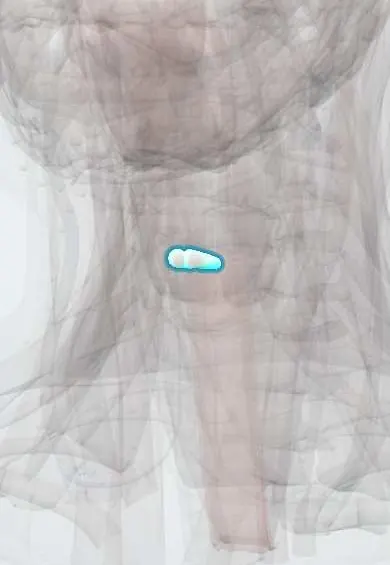
Respiratory system · Head and neck
Vocal folds !
The vocal folds (vocal cords) are two bands of muscle and ligament across the larynx; they vibrate to make the voice and close to protect the airway.
Official name: Vocal fold
Opens in the Durgical app, no sign-up needed.
What it is
Two bands of muscle and ligament stretched across the larynx from front to back.
What it does
Vibrate to make the voice and close to protect the airway.
Key facts
- Attaches
- Inner angle of the thyroid cartilage to the vocal processes of the arytenoids
- Function
- Produce voice; close the airway (cough, effort)
- Tight in
- Cricothyroid contraction (high pitch)
Relations
- Above
- Laryngeal ventricle, then the vestibular (false) folds
- Below
- Conus elasticus and the subglottic space, down to the cricoid cartilage
- Lateral
- Thyroarytenoid muscle, paraglottic space and the thyroid cartilage lamina
- In front
- Anterior commissure, where the two folds meet behind the thyroid cartilage
- Behind
- Vocal processes of the arytenoid cartilages and the interarytenoid region (posterior commissure)
How to find it
Seen with a laryngeal mirror, a flexible nasal endoscope or a rigid endoscope as two pearly white bands in a V with the point in front; they open on breathing in and meet on a sustained vowel. Stroboscopy shows the mucosal wave.
On imaging
Laryngoscopy with stroboscopy is the main examination. CT and MRI stage cancer by looking at the paraglottic space, the anterior commissure and the laryngeal cartilages.
Common problems
- Laryngitis and overuse: hoarseness.
- Nodules and polyps from voice strain (singers, teachers).
- Paralysis from recurrent laryngeal nerve injury.
- Hoarseness for more than 3 weeks, especially in smokers, needs a check for cancer.
How it is diagnosed
Laryngoscopy (a camera to look at the vocal folds).
Treatment
- Voice rest and voice therapy.
- Microsurgery for polyps; treatment of cancer by surgery or radiotherapy.
Clinical notes
- Reinke oedema: smoking-related swelling of the superficial lamina propria, giving a low, husky voice
- Recurrent respiratory papillomatosis: HPV-related warty growths (mainly types 6 and 11) in children and adults, which tend to come back
- Vocal fold dysfunction (the folds close on breathing in) can mimic asthma
Development
The laryngeal lumen closes and then reopens in the embryo; incomplete reopening leaves a laryngeal web, usually across the front of the glottis.
Related conditions
- Farber disease (Farber lipogranulomatosis)
- Laryngeal cancer
- Anaphylaxis
- Botulism
- Vocal fold nodules, polyps and laryngitis
- Vocal fold paralysis (recurrent laryngeal nerve injury)
- Croup (laryngotracheobronchitis)
- Cri-du-chat syndrome (5p deletion)
Test yourself
Think of the answer, then tap the question to see it.
What are the layers of the vocal fold, and which one produces the mucosal wave?
Epithelium, superficial lamina propria (Reinke space), vocal ligament and vocalis muscle; the loose superficial cover glides over the body to make the mucosal wave.
Why does early glottic cancer have a good prognosis?
It causes hoarseness early, and the true vocal folds have few lymphatics, so early tumours rarely reach the neck nodes.
Where do vocal fold nodules form and how do they differ from polyps?
Bilaterally at the junction of the front and middle thirds, from voice overuse; polyps are usually one-sided.
Which muscle tenses the vocal folds to raise pitch?
The cricothyroid, which tilts the thyroid cartilage forward and lengthens the folds.
What is Reinke oedema?
Smoking-related swelling of the superficial lamina propria (Reinke space) of the vocal folds, giving a low, husky voice.
Educational information, not medical advice. For any symptom, see a health professional.
Its names
- Official Latin (TA2)
- plica vocalis TA2 3198
- Official Spanish (DeCS)
- Pliegues Vocales DeCS D014827
- English (TA2)
- Vocal fold
- Also called
- vocal cords · labium vocale
Related
Sources: Terminologia Anatomica (TA2); DeCS; Anatomy, Head and Neck, Larynx Vocal Cords.
Spotted a mistake?We are always improving for the community. Tell us what is wrong and our team will review it.Report a mistake
Representative model, for educational purposes only.