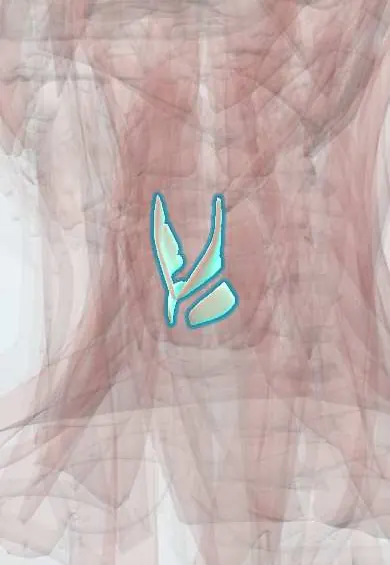
Muscular system · Head and neck
Thyroarytenoid !
The thyroarytenoid is the muscle inside each vocal fold; it shortens and fine-tunes the folds to adjust the voice.
Official name: Musculus thyreoarytenoideus
Opens in the Durgical app, no sign-up needed.
What it is
The muscle inside each vocal fold.
What it does
Shortens and fine-tunes the vocal folds.
Key facts
- Origin
- Inner angle of the thyroid cartilage
- Insertion
- Arytenoid (vocalis part to the vocal process)
- Action
- Shortens and relaxes the vocal folds (fine tuning)
- Nerve
- Recurrent laryngeal nerve (X)
- Blood supply
- Laryngeal arteries
Relations
- Medial
- Vocal ligament and the fold's mucosa, with the loose superficial layer (Reinke space) under the epithelium
- Lateral
- Paraglottic space and the lamina of the thyroid cartilage
- Above
- Laryngeal ventricle and saccule, then the vestibular fold
- Below
- Conus elasticus and the lateral cricoarytenoid
How to find it
Not palpable. On laryngoscopy it is the bulk of each true vocal fold, between the anterior commissure and the vocal process of the arytenoid cartilage.
On imaging
Laryngoscopy shows the fold first. On axial contrast CT or MRI, the thyroarytenoid with its vocalis part makes up the body of each true vocal fold, at the level of the arytenoid vocal processes. In glottic cancer, imaging stages spread into the paraglottic fat, across the anterior commissure and into the thyroid cartilage. In nerve palsy the muscle thins and the fold looks slack and flat.
Clinical notes
- Age-related thinning of the vocalis (presbyphonia) gives bowed folds with a spindle-shaped gap and a weak, breathy voice
- Botulinum toxin is injected into this muscle for adductor spasmodic dysphonia, a focal dystonia with a strained, broken voice
- Glottic cancer that invades it and the paraglottic space fixes the vocal fold, which raises the tumour stage (T3)
- Nerve-monitoring tracheal tubes carry surface electrodes that rest against the vocal folds and record this muscle's response when the vagus or recurrent laryngeal nerve is stimulated during thyroid surgery
Development
Develops from sixth-arch mesoderm, like the other laryngeal muscles supplied by the recurrent laryngeal nerve.
Test yourself
Think of the answer, then tap the question to see it.
What is the vocalis muscle?
The inner part of the thyroarytenoid, lying along the vocal ligament; it forms the body of the vocal fold and fine-tunes pitch and voice quality.
What is the action of the thyroarytenoid, and which muscle does it oppose?
It shortens and slackens the vocal folds and helps close the glottis; it opposes the cricothyroid.
Into which muscle is botulinum toxin injected for adductor spasmodic dysphonia?
The thyroarytenoid; adductor spasmodic dysphonia is a focal dystonia with a strained, broken voice.
What does invasion of the thyroarytenoid by glottic cancer do to the vocal fold and the stage?
It fixes the vocal fold, which raises the tumour stage to T3.
Educational information, not medical advice. For any symptom, see a health professional.
Its names
- Official Latin (TA2)
- musculus thyreoarytenoideus TA2 2199
- Official Spanish (DeCS)
- Músculo tiroaritenoideo y músculo vocal DeCS D007821
- English (TA2)
- Musculus thyreoarytenoideus
- Also called
- vocalis · musculus thyreoarytaenoideus
Related
Sources: Terminologia Anatomica (TA2); DeCS; Anatomy, Head and Neck: Laryngeal Muscles; Anatomy, Head and Neck, Larynx Vocal Cords.
Spotted a mistake?We are always improving for the community. Tell us what is wrong and our team will review it.Report a mistake
Representative model, for educational purposes only.