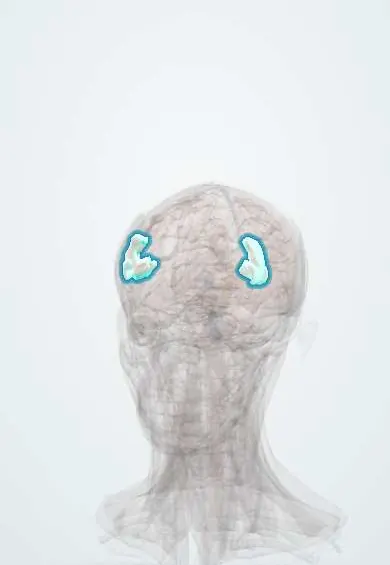
Nervous system · Head and neck
Broca's area !
Broca's area is a region in the lower frontal lobe, usually on the left, that produces speech; damage makes speech slow and effortful.
Official name: Opercular part of inferior frontal gyrus
Opens in the Durgical app, no sign-up needed.
What it is
The back of the inferior frontal gyrus, usually on the left.
What it does
Produces speech; damage makes speech slow and effortful (expressive aphasia).
Key facts
- Where
- Inferior frontal gyrus (opercular and triangular parts), usually left
- Blood supply
- MCA superior division
- Function
- Speech production (areas 44, 45)
Relations
- In front
- Pars orbitalis, the front part of the inferior frontal gyrus
- Behind
- Lower end of the motor cortex (precentral gyrus), which moves the face, tongue and larynx
- Above
- Inferior frontal sulcus and the middle frontal gyrus
- Below
- Lateral sulcus, whose anterior horizontal and ascending rami cut the region into the pars triangularis and pars opercularis
- Deep
- Frontal operculum over the insula; the arcuate fasciculus links it to Wernicke's area
How to find it
On the lateral surface, the two short anterior rami of the lateral sulcus divide the inferior frontal gyrus into three parts: orbital, triangular (between the rami) and opercular (behind the ascending ramus). Broca's area is the triangular and opercular parts; on sagittal MRI the gyrus often looks like a letter M.
Examination
- Bedside language exam: spontaneous speech (fluency), naming, repetition, comprehension of commands, reading and writing; non-fluent speech with fair comprehension fits Broca aphasia
On imaging
On sagittal MRI it is the triangular and opercular parts of the left inferior frontal gyrus, outlined by the horizontal and ascending rami of the lateral sulcus (a «Y» or «M» shape). In acute Broca aphasia, CT first excludes bleeding and diffusion MRI shows an infarct in the superior division of the left middle cerebral artery. Before surgery nearby, functional MRI helps locate language.
Clinical notes
- Not to be confused with dysarthria, in which articulation is slurred but language, reading and writing are normal
- Transcortical motor aphasia resembles Broca aphasia but repetition is preserved; the lesion lies near Broca's area, often in the border zone between the anterior and middle cerebral arteries
- Many people with Broca aphasia sing familiar songs better than they speak, a feature used in melodic intonation therapy
- Tumour and epilepsy surgery near it is often done with the person awake, mapping language by cortical stimulation
Memory aid
Broca is broken speech (expressive); Wernicke is wordy speech without understanding (receptive).
Related conditions
Test yourself
Think of the answer, then tap the question to see it.
Where is Broca's area?
The opercular and triangular parts of the inferior frontal gyrus, usually on the left (areas 44 and 45).
What are the features of Broca (expressive) aphasia?
Slow, effortful, telegraphic speech with impaired repetition and naming, while comprehension of simple speech is largely spared; the person usually knows the speech is wrong.
Why does Broca aphasia often come with weakness of the right face and arm?
Their motor area lies just behind Broca's area in the same territory, the superior division of the middle cerebral artery.
How does transcortical motor aphasia differ from Broca aphasia?
Repetition is preserved; the lesion lies near Broca's area, often in the border zone between the anterior and middle cerebral arteries.
Educational information, not medical advice. For any symptom, see a health professional.
Its names
- Official Latin (TA2)
- pars opercularis gyri frontalis inferioris TA2 5452
- Official Spanish (DeCS)
- Área de Broca DeCS D065711
- English (TA2)
- Opercular part of inferior frontal gyrus
Related
Sources: Terminologia Anatomica (TA2); DeCS; Neuroanatomy, Broca Area.
Spotted a mistake?We are always improving for the community. Tell us what is wrong and our team will review it.Report a mistake
Representative model, for educational purposes only.