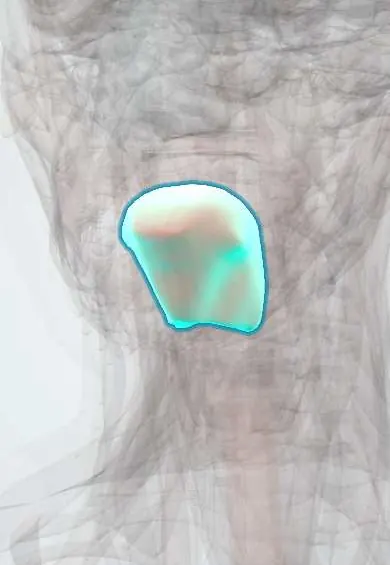
Digestive system · Head and neck
Tongue !
The tongue is a muscular organ on the floor of the mouth; it moves food, shapes speech and carries the taste buds.
Opens in the Durgical app, no sign-up needed.
What it is
A muscular organ on the floor of the mouth, made of intrinsic and extrinsic muscles.
What it does
Moves food, shapes speech and carries the taste buds.
Key facts
- Where
- Floor of the mouth; anterior two thirds (oral) and posterior third (pharyngeal)
- Blood supply
- Lingual artery
- Nerve
- Motor: XII (palatoglossus: X); anterior 2/3: touch V3, taste VII; posterior 1/3: IX
- Function
- Chewing, swallowing, speech, taste
Relations
- Below
- Floor of the mouth: mylohyoid and geniohyoid, the sublingual glands and the submandibular ducts opening beside the frenulum
- Behind
- Oropharynx: the palatine tonsils at the sides and the epiglottis behind, joined by the glossoepiglottic folds with the valleculae between them
- Above
- Hard palate and soft palate
- Lateral
- Teeth and gums; the lingual nerve lies just under the mucosa beside the lower third molar
How to find it
Inspected with a light and a tongue depressor: dorsum, lateral borders (lifted with gauze), underside and frenulum. The pharyngeal third is seen with a mirror or an endoscope, and the tongue base can be felt with a gloved finger.
Examination
- Protrusion in the midline and side-to-side movement test the hypoglossal nerve; deviation, wasting or fasciculations suggest a lower motor neuron lesion
- Taste on each side of the front two thirds tests the chorda tympani branch of the facial nerve, for example in Bell palsy
On imaging
MRI is the best study: it shows the muscles, the midline septum and how deep a cancer reaches (depth of invasion is part of staging). Contrast CT is used for abscess and neck nodes, and ultrasound helps in the floor of mouth. A thyroid scan shows a lingual thyroid as uptake at the tongue base, at the foramen caecum. In sleep apnoea, sagittal MRI shows the tongue base narrowing the airway.
Clinical notes
- Injury to the lingual nerve, most often during removal of a lower third molar, leaves numbness and loss of taste on the front two thirds of the same side
- A persistent ulcer or a red or white patch on the lateral border is evaluated with biopsy (clinical teaching), since early tongue cancer can look harmless
- The tongue base is a common site of HPV-related oropharyngeal cancer, which may first show as a neck lump
Development
The front two thirds form from first-arch swellings and the back third from third and fourth arch tissue; the muscles come from occipital somites (hence XII). The thyroid begins at the foramen caecum, so a lingual thyroid can appear there.
Related conditions
- Pellagra (niacin deficiency)
- Obstructive sleep apnoea
- HIV infection and AIDS
- Urticaria and angioedema
- Cutaneous and mucocutaneous candidiasis
- Oropharyngeal dysphagia in older adults
- Dyskeratosis congenita and other telomere biology disorders
- Paracoccidioidomycosis
- Candidiasis: oral, oesophageal and invasive
- Head and neck squamous cell carcinoma (oral cavity and oropharynx, HPV)
- Thyroglossal duct cyst and branchial cleft cyst
- Recurrent aphthous stomatitis
- Scarlet fever
- Hand, foot and mouth disease
- Beckwith–Wiedemann syndrome
- Behçet disease
Test yourself
Think of the answer, then tap the question to see it.
What is the sensory and taste supply of the oral two thirds and pharyngeal third of the tongue?
Front two thirds: touch by V3 (lingual nerve), taste by VII (chorda tympani). Back third: both by IX.
What is the motor supply of the tongue muscles, and which muscle is the exception?
The hypoglossal nerve (XII) supplies them all except palatoglossus, which is supplied by the vagus nerve (X).
Where does lymph from the tongue drain?
Tip to submental nodes, sides to submandibular nodes, back to deep cervical nodes; central and rear parts drain to both sides of the neck.
Where does tongue cancer usually arise, and how does it spread?
Squamous cell carcinoma of the lateral border; it spreads early to neck nodes, sometimes on both sides.
What follows injury to the lingual nerve during removal of a lower third molar?
Numbness and loss of taste on the front two thirds of the tongue on the same side.
Educational information, not medical advice. For any symptom, see a health professional.
Its names
- Official Latin (TA2)
- lingua TA2 2820
- Official Spanish (DeCS)
- Lengua DeCS D014059
- English (TA2)
- Tongue
Related
Sources: Terminologia Anatomica (TA2); DeCS; Anatomy, Head and Neck, Tongue.
Spotted a mistake?We are always improving for the community. Tell us what is wrong and our team will review it.Report a mistake
Representative model, for educational purposes only.