
Congenital nasolacrimal duct obstruction
A blocked tear duct in a baby: a watery, sticky but white eye. Most open alone by the first birthday; persistent ones are probed.
Quick facts
- Key signs
- Watery eye from the first weeks of life
- Diagnosis
- Clinical
Red flags ↓
No doses: the clinician sets them by the current guideline.
What it is
Failure of the lower end of the nasolacrimal duct to open at birth, usually from a persistent membrane at the valve of Hasner. Tears and mucus cannot drain into the nose, so the eye waters and the lashes become sticky, while the eye itself stays white. Most cases resolve spontaneously in the first year.
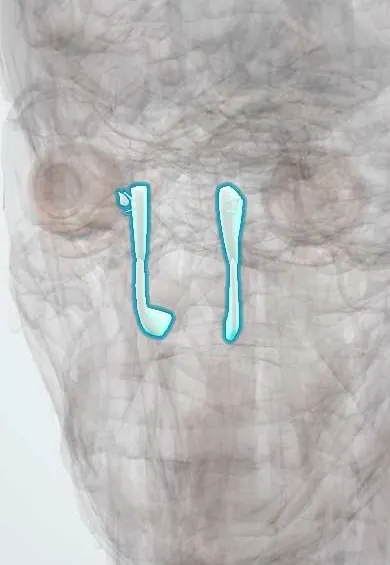
See it in 3D
Who gets it
Common in newborns; symptoms usually start in the first weeks of life. More frequent in premature babies and in Down syndrome.
Causes
- Persistent membrane at the valve of Hasner
- Less often, craniofacial or bony anomalies
Risk factors
- Prematurity
- Down syndrome
- Craniofacial anomalies
Pathophysiology
The duct canalises late in fetal life; if the membrane at its lower end persists, tears stagnate in the lacrimal sac, which can become secondarily infected (dacryocystitis).
Symptoms and signs
- Watery eye from the first weeks of life
- Sticky lashes and mucus, especially on waking
- Mucus reflux on pressing the inner corner
- White eye without light sensitivity
Diagnosis
- Clinical
- Clinical diagnosis from the history and mucus reflux on sac pressure; the fluorescein dye disappearance test can confirm delayed drainage.
- Tests
- Culture of discharge only if conjunctivitis or dacryocystitis is suspected.
- Imaging
- Not needed in typical cases.
Differential diagnosis
- Primary congenital glaucoma
- Neonatal conjunctivitis
- Dacryocele
- Entropion or epiblepharon
Goal of treatment
Wait for spontaneous opening while keeping the eye clean, and open the duct if it persists.
Treatment
- Conservative
- Lacrimal sac massage and cleaning of the lids with boiled water.
- Medical
- Topical antibiotics only for episodes of infected discharge.
- Procedure
- Probing of the duct if it persists beyond about 12 months, sometimes with intubation.
- Acute
- Urgent treatment of acute dacryocystitis or an infected dacryocele.
Complications
- Dacryocystitis
- Preseptal cellulitis
- Persistent watering
Prognosis
Excellent: most resolve in the first year and probing cures most of the rest.
Test yourself
Think of the answer, then tap the question to see it.
What usually causes congenital nasolacrimal duct obstruction?
A persistent membrane at the lower end of the duct (valve of Hasner).
What is the usual course?
Most open spontaneously in the first year of life.
Which signs in a tearing infant point instead to glaucoma?
Light sensitivity, lid squeezing and a large or cloudy cornea.
In ophthalmology
Connections
Educational information, not medical advice. For any symptom, see a health professional.
Sources: Congenital Nasolacrimal Duct Obstruction (StatPearls Publishing (NCBI Bookshelf), 2026).
Spotted a mistake?We are always improving for the community. Tell us what is wrong and our team will review it.Report a mistake
Representative model, for educational purposes only.