Conditions · Metabolism: carbohydrates and glycogen
Cori disease (glycogen storage disease type III) !
In Cori disease the enzyme that removes glycogen's branches is missing: the liver enlarges, there is hypoglycaemia and sometimes muscle weakness.
Updated 2026-11-01
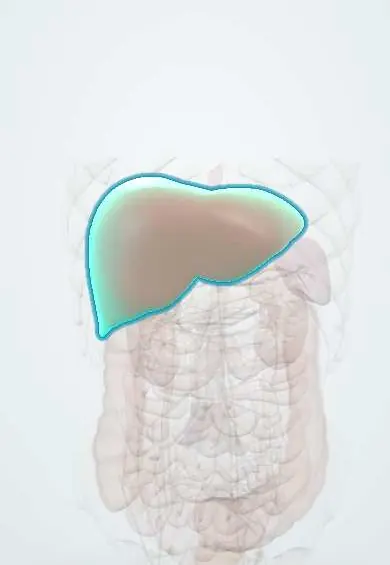
Structures involved
Tap one to see what it is and open it in 3D.
In biochemistry
What it is
Inherited glycogen storage disease caused by lack of the debranching enzyme (AGL gene). Glycogen with short outer branches (limit dextrin) accumulates in the liver and, in most cases, in muscle.
Who gets it
About 1 in 100,000 people; commoner in North African Jews. It is one of the most frequently diagnosed liver glycogen storage diseases in Latin America.
Causes
- Autosomal recessive inheritance: AGL gene variants
Risk factors
- Carrier parents or affected siblings
- Consanguinity
Pathophysiology
Phosphorylase breaks down the outer chains up to near the branches and stops; without the debranching enzyme only part of the glycogen is released. Hypoglycaemia is milder than in type I because gluconeogenesis works, so lactate and uric acid are usually normal; instead there is fasting ketosis. In type IIIa abnormal glycogen also damages skeletal muscle and heart.
Classification
- IIIa (about 85 %): liver and muscle
- IIIb (about 15 %): liver only
- IIIc and IIId: very rare
Symptoms and signs
- Large abdomen from hepatomegaly in childhood
- Fasting hypoglycaemia and ketosis
- Short stature
- Progressive muscle weakness in type IIIa
- Fatigue or breathlessness from cardiomyopathy
Diagnosis
- Clinical
- Child with hepatomegaly, fasting hypoglycaemia with ketosis and high transaminases; in IIIa, high CK and weakness.
- Tests
- Low glucose with ketones; normal lactate and uric acid; raised transaminases and CK; glucagon raises glucose after a meal but not when fasting. AGL gene testing.
- Imaging
- Abdominal ultrasound with hepatomegaly; echocardiogram for hypertrophic cardiomyopathy.
Treatment
- Lifestyle
- Frequent meals with uncooked cornstarch and a high-protein diet, as set by the metabolic team
- Acute
- Intravenous glucose in severe hypoglycaemia
- Follow-up
- Monitoring of liver (fibrosis, adenomas), heart and muscle strength
- Surgical
- Liver transplant in advanced cirrhosis
Complications
- Liver fibrosis and cirrhosis
- Hepatic adenomas
- Hypertrophic cardiomyopathy
- Progressive myopathy in adulthood
Prognosis
Hepatomegaly and hypoglycaemia usually improve with age; myopathy and cardiomyopathy may progress in adulthood.
Test yourself
Think of the answer, then tap the question to see it.
Which molecule accumulates in Cori disease?
Glycogen with short outer branches (limit dextrin).
How does it differ from von Gierke on testing?
In Cori disease lactate and uric acid are usually normal and transaminases and CK are high.
Which subtype also affects muscle?
Type IIIa, the most common.
Related conditions
- Von Gierke disease (glycogen storage disease type I)
- Hers disease (glycogen storage disease type VI)
- Cirrhosis
- Heart failure
Educational information, not medical advice. For any symptom, see a health professional.
Sources: Glycogen storage disease type III: MedlinePlus Genetics (MedlinePlus, US National Library of Medicine, 2026); AGL gene: MedlinePlus Genetics (MedlinePlus, US National Library of Medicine, 2026); Textbook of Biochemistry for Medical Students, 6th ed. (Jaypee Brothers Medical Publishers (Vasudevan DM, Sreekumari S, Vaidyanathan K), 2011).
Spotted a mistake?We are always improving for the community. Tell us what is wrong and our team will review it.Report a mistake
Representative model, for educational purposes only.