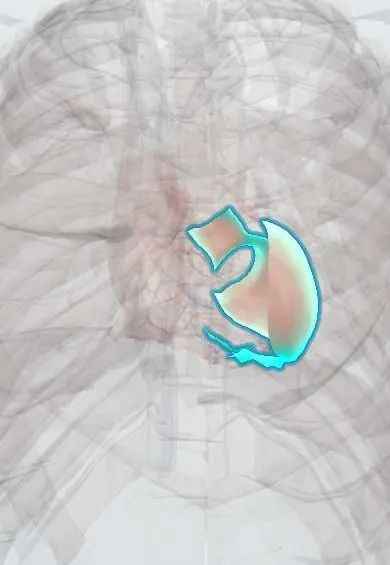
Heart failure !
Heart failure is a condition in which the heart cannot pump enough blood for the body's needs, causing breathlessness, tiredness and swelling.
Updated 2026-10-30
Structures involved
Tap one to see what it is and open it in 3D.
- Left ventricle
- Right ventricle
- Left atrium
- Right atrium
- Pulmonary veins
- Inferior vena cava
- Pleura
- Interventricular septum
In biochemistry
- Cardiac troponin as a lab test
- Aldosterone
- Albumin
- Transthyretin (prealbumin)
- Angiotensin-converting enzyme (ACE)
- Na⁺/K⁺-ATPase (sodium pump)
- Thiamine (vitamin B1)
- Selenium
In histology
- Cardiac muscle: intercalated discs
- Stem cells and tissue renewal: labile, stable and permanent tissues
In embryology
- Ventricular septal defect
- Coarctation of the aorta
- Persistent truncus arteriosus
- Atrioventricular septal defect (endocardial cushion defect)
- Ebstein anomaly
- Hypoplastic left heart syndrome
- ACE inhibitors and ARBs: fetal kidney damage
In the clinical exam
- Precordial inspection and palpation: apex beat, heaves and thrills
- Heart sounds: S1, S2 and its splitting, S3 and S4
- Jugular venous pressure and the venous pulse
- Hepatojugular (abdominojugular) reflux
- Abnormal pulses: paradoxus, alternans, parvus et tardus, bounding
- Heart failure syndrome: left- and right-sided signs
- Respiratory rate and breathing patterns
- Edema: pitting, grading and distribution
- Adventitious sounds: crackles, wheezes, rhonchi, stridor and pleural rub
- Respiratory symptoms: cough, sputum, hemoptysis and dyspnea
- Pleural effusion syndrome
- Dehydration and fluid overload
In physiology
- The cardiac cycle
- Heart sounds and where they come from
- The ventricular pressure–volume loop
- The Frank–Starling mechanism
- Cardiac output and what sets it
- Starling forces at the capillary
- How edema forms
- The renin–angiotensin–aldosterone system
- Preload, afterload and contractility
- Heart failure physiology
- Cardiac excitation–contraction coupling
- Venous return and the Guyton curves
- Central venous pressure and the jugular pulse
- Long-term blood pressure control by the kidney
- Muscle blood flow and the cardiovascular response to exercise
- How the lymphatic system works
- Aldosterone: actions and control
- Sodium and extracellular volume regulation (with natriuretic peptides)
- Where and how diuretics act
- Dehydration and fluid overload
- Physiology of pulmonary edema
- Pleural fluid: formation and drainage
- Abnormal breathing patterns and sleep apnea
Why it happens
- Edema and effusions: the four mechanisms
- Hyperemia and congestion (the nutmeg liver, heart-failure cells)
- Hypertrophy: physiologic and pathologic
- Pigments in tissue: lipofuscin, hemosiderin, melanin, bilirubin, carbon
- The myocardial infarct over time: what the pathologist sees from hours to months
- Cachexia, anorexia nervosa and bulimia
What it is
A clinical syndrome in which the heart cannot pump enough blood for the body's needs, or can do so only at high filling pressures, causing breathlessness, fatigue and fluid retention.
Who gets it
Common in older adults and a leading cause of hospital admission. In Colombia and Latin America, Chagas cardiomyopathy and rheumatic valve disease add to the usual causes (ischaemia and hypertension). In 61 public hospitals in São Paulo, Brazil (2008–2015), heart failure admissions were up to 30% higher in winter than in summer.
Causes
- Coronary artery disease and previous myocardial infarction
- Long-standing arterial hypertension
- Valve disease (aortic stenosis, rheumatic mitral disease)
- Cardiomyopathies: dilated, hypertrophic, Chagas, alcohol or toxin-related
- Arrhythmias such as atrial fibrillation with a fast rate
Risk factors
- Hypertension
- Diabetes
- Obesity
- Smoking
- Older age
- Chronic kidney disease
- Living in or coming from areas where Chagas disease is endemic
Pathophysiology
Reduced contraction (systolic dysfunction) or a stiff ventricle that fills poorly (diastolic dysfunction) lowers cardiac output. The kidneys and the sympathetic and renin–angiotensin–aldosterone systems respond by retaining salt and water and constricting vessels. This helps at first but raises filling pressures and drives remodelling, congestion and progression.
Classification
- HFrEF: heart failure with reduced ejection fraction (ejection fraction about 40% or less)
- HFmrEF: mildly reduced ejection fraction (in between)
- HFpEF: preserved ejection fraction (about 50% or more), with signs of raised filling pressure
- NYHA class I–IV: no limitation, slight limitation, marked limitation, symptoms at rest
- ACC/AHA stages A–D: from at risk to advanced disease
- Left-sided, right-sided or biventricular; acute decompensated or chronic
Symptoms and signs
- Breathlessness on exertion, later at rest
- Orthopnoea and paroxysmal nocturnal dyspnoea
- Fatigue and reduced exercise tolerance
- Ankle and leg oedema, weight gain
- Raised jugular venous pressure, hepatomegaly, ascites (right-sided congestion)
- Lung crackles, third heart sound, displaced apex beat
Diagnosis
- Clinical
- History and examination for congestion and low output; the Framingham criteria are one classic tool. The cause is always sought (ischaemia, valves, hypertension, Chagas).
- Tests
- Natriuretic peptides (BNP or NT-proBNP): a normal value makes heart failure unlikely. ECG, blood count, kidney function, electrolytes, thyroid and iron studies; Chagas serology where relevant.
- Imaging
- Echocardiography is the key test: ejection fraction, wall motion, valves and filling pressures. Chest X-ray shows cardiomegaly, effusions and pulmonary congestion; cardiac MRI or coronary angiography look for the cause.
Differential diagnosis
- COPD or asthma
- Pneumonia
- Pulmonary embolism
- Kidney failure or nephrotic syndrome (oedema)
- Liver cirrhosis (oedema, ascites)
- Anaemia or thyroid disease
Goal of treatment
Relieve congestion and symptoms, treat the cause, slow remodelling and reduce hospital admissions and death.
Treatment
- Acute
- Acute decompensation: oxygen if needed, intravenous loop diuretics, vasodilators when blood pressure allows, and support for cardiogenic shock.
- Medical
- HFrEF: the classic disease-modifying classes are ACE inhibitors, angiotensin receptor blockers or angiotensin receptor–neprilysin inhibitors, beta-blockers, mineralocorticoid receptor antagonists and SGLT2 inhibitors.
- Medical
- Diuretics relieve congestion in all types; in HFpEF, SGLT2 inhibitors and control of blood pressure, atrial fibrillation and other conditions are the mainstays.
- Procedure
- Devices in selected patients: implantable defibrillator, cardiac resynchronisation therapy; advanced cases may need ventricular assist devices or transplant.
- Lifestyle
- Salt and fluid advice per local guidance, daily weights, regular activity, stopping smoking and alcohol, vaccination.
- Follow-up
- Regular follow-up in heart failure programmes with kidney function and electrolyte checks.
Drugs for this condition
- Enalapril
- Losartan
- Metoprolol
- Digoxin
- Bisoprolol
- Captopril
- Carvedilol
- Lisinopril
- Sacubitril/valsartan
- Valsartan
- Candesartan
- Ramipril
- Dobutamine
- Hydralazine
- Sodium nitroprusside
- Milrinone
- Levosimendan
- Empagliflozin
- Dapagliflozin
- Furosemide
- Hydrochlorothiazide
- Spironolactone
- Acetazolamide
- Chlortalidone
- Bumetanide
- Etacrynic acid
- Torasemide
- Amiloride
- Eplerenone
- Triamterene
- Indapamide
- Metolazone
- Tolvaptan
- Chlorothiazide
Complications
- Acute pulmonary oedema
- Ventricular arrhythmias and sudden cardiac death
- Atrial fibrillation and thromboembolism
- Cardiorenal syndrome
- Cardiac cachexia
- Repeated hospital admissions
Prognosis
A chronic, progressive condition with high mortality, especially after a hospital admission. Modern drug therapy and devices have clearly improved survival in HFrEF; outcomes depend on the cause, NYHA class and adherence.
Prevention
- Control of blood pressure, diabetes and lipids
- Early treatment of myocardial infarction
- Chagas screening and vector control in endemic areas
- Prevention and secondary prophylaxis of rheumatic fever
Test yourself
Think of the answer, then tap the question to see it.
What ejection fraction defines heart failure with reduced ejection fraction (HFrEF)?
About 40% or less on echocardiography. HFpEF has an ejection fraction of about 50% or more with evidence of raised filling pressure.
What does NYHA class III mean?
Marked limitation of physical activity: comfortable at rest, but less than ordinary activity causes symptoms.
Why is BNP useful in a breathless patient?
A normal BNP or NT-proBNP makes heart failure unlikely; a high value supports it and has prognostic value.
Which drug classes are the main disease-modifying therapy in HFrEF?
Renin–angiotensin system blockers (ACE inhibitor, ARB or ARNI), beta-blockers, mineralocorticoid receptor antagonists and SGLT2 inhibitors.
What is the key imaging test to confirm heart failure and its type?
Transthoracic echocardiography: it measures ejection fraction and assesses valves, walls and filling pressures.
Related conditions
- Myocardial Infarction (Heart Attack)
- Hypertensive heart disease
- Chagas cardiomyopathy
- Rheumatic heart disease
- Aortic Valve Stenosis
- Atrial fibrillation
- Chronic obstructive pulmonary disease (COPD)
- Arterial hypertension
- Type 2 diabetes mellitus
- Pulmonary embolism
Educational information, not medical advice. For any symptom, see a health professional.
Sources: Heart Failure (Congestive Heart Failure) (StatPearls (NCBI Bookshelf), 2025); Increased hospitalizations for decompensated heart failure and acute myocardial infarction during mild winters: A seven-year experience in the public health system of the largest city in Latin America (PloS one, 2018) · adapted, CC BY 4.0.
Spotted a mistake?We are always improving for the community. Tell us what is wrong and our team will review it.Report a mistake
Representative model, for educational purposes only.