Conditions · Metabolism: carbohydrates and glycogen
Von Gierke disease (glycogen storage disease type I) !
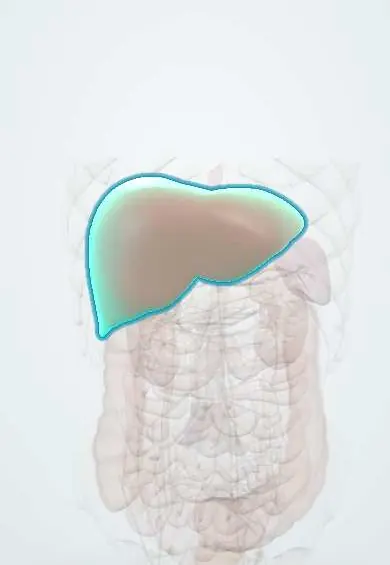
In von Gierke disease the liver cannot release glucose: there is severe hypoglycaemia between meals and a very large liver.
Updated 2026-11-01
Structures involved
Tap one to see what it is and open it in 3D.
In biochemistry
- Gluconeogenesis: Step 10 · Glucose-6-phosphatase
- Glycogen metabolism: Step 8 · Glucose-6-phosphatase (liver and kidney only)
- Glucose-6-phosphatase
- Glycogen
- Ribose 5-phosphate
- Cori cycle
- Fed, fasting and starvation states
Why it happens
What it is
Inherited glycogen storage disease caused by lack of glucose-6-phosphatase (type Ia, G6PC1 gene) or its transporter (type Ib, SLC37A4 gene). The last step of glycogenolysis and gluconeogenesis fails.
Who gets it
About 1 in 100,000 people; type Ia makes up 80 % of cases. It has been described across Latin America; there are no Colombian figures of its own.
Causes
- Autosomal recessive inheritance: variants of G6PC1 (Ia) or SLC37A4 (Ib)
Risk factors
- Carrier parents or affected siblings
- Consanguinity
Pathophysiology
Without glucose-6-phosphatase, the liver cannot turn glucose 6-phosphate into free glucose, either from glycogen or from gluconeogenesis: hypoglycaemia appears after 3–4 hours of fasting. Trapped glucose 6-phosphate is diverted into glycolysis (lactate), fat synthesis (high triglycerides, fatty liver) and the pentose pathway (more purines and uric acid); lactate also competes with urate in the kidney. Glycogen and fat enlarge liver and kidneys. In type Ib neutrophils also fail.
Classification
- Type Ia: enzyme deficiency (G6PC1)
- Type Ib: transporter deficiency (SLC37A4), with neutropenia and infections
Symptoms and signs
- Hypoglycaemia with seizures or tremor at 3–6 months of age, when the baby sleeps longer between feeds
- Large abdomen from hepatomegaly
- Round «doll-like» face and short stature
- Fast breathing from lactic acidosis
- Easy nosebleeds (platelet dysfunction)
- Infections and mouth ulcers in type Ib
Diagnosis
- Clinical
- Infant with short-fast hypoglycaemia, hepatomegaly, doll-like face and poor growth.
- Tests
- Low glucose with high lactate, uric acid, triglycerides and cholesterol; glucose does not rise with glucagon. Blood count with neutropenia in type Ib. Genetic testing of G6PC1 and SLC37A4 (avoids liver biopsy).
- Imaging
- Abdominal ultrasound: large liver and kidneys; follow-up of hepatic adenomas with ultrasound or MRI.
Treatment
- Lifestyle
- Frequent daytime meals and a continuous glucose supply at night (tube feeding or uncooked cornstarch), as set by the metabolic team
- Lifestyle
- Limit fructose, sucrose and galactose, which cannot be turned into glucose
- Medical
- Treatment of hyperuricaemia and hyperlipidaemia; in type Ib, treatment of neutropenia
- Acute
- Urgent intravenous glucose in severe hypoglycaemia or acidosis
- Surgical
- Liver transplant for adenomas turning malignant or disease that does not respond
- Follow-up
- Regular monitoring of growth, kidney function, lipids and hepatic adenomas
Complications
- Hepatic adenomas with risk of hepatocellular carcinoma
- Chronic kidney disease and stones
- Gout
- Osteoporosis
- Inflammatory bowel disease in type Ib
Prognosis
With good glucose control most reach adulthood; outlook depends on avoiding hypoglycaemia and watching liver and kidneys.
Test yourself
Think of the answer, then tap the question to see it.
Which enzyme is missing in GSD Ia?
Glucose-6-phosphatase (G6PC1) of liver and kidney.
Why is there lactic acidosis in von Gierke disease?
Trapped glucose 6-phosphate flows down glycolysis to lactate, and gluconeogenesis cannot use that lactate.
Which feature distinguishes type Ib from Ia?
Neutropenia with infections, because neutrophils need the SLC37A4 transporter.
What happens to blood glucose after glucagon in this disease?
It does not rise, because glycogen is broken down but glucose 6-phosphate cannot leave as glucose.
Related conditions
- Lactic acidosis
- Gout
- Hers disease (glycogen storage disease type VI)
- Cori disease (glycogen storage disease type III)
- Hepatocellular carcinoma
Educational information, not medical advice. For any symptom, see a health professional.
Sources: Glycogen storage disease type I: MedlinePlus Genetics (MedlinePlus, US National Library of Medicine, 2026); G6PC1 gene: MedlinePlus Genetics (MedlinePlus, US National Library of Medicine, 2026); SLC37A4 gene: MedlinePlus Genetics (MedlinePlus, US National Library of Medicine, 2026); Textbook of Biochemistry for Medical Students, 6th ed. (Jaypee Brothers Medical Publishers (Vasudevan DM, Sreekumari S, Vaidyanathan K), 2011).
Spotted a mistake?We are always improving for the community. Tell us what is wrong and our team will review it.Report a mistake
Representative model, for educational purposes only.