Conditions · Metabolism: carbohydrates and glycogen
Essential fructosuria !
Essential fructosuria is a benign inherited trait: fructose is not processed and leaves in the urine, causing no symptoms.
Updated 2026-11-01
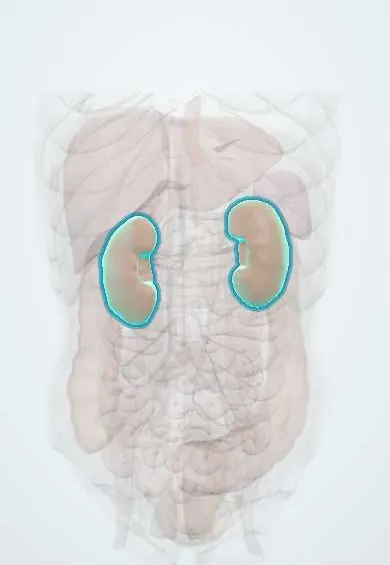
Structures involved
Tap one to see what it is and open it in 3D.
In biochemistry
What it is
Lack of fructokinase (ketohexokinase, KHK gene). Dietary fructose stays in the blood and is cleared by the kidney.
Who gets it
Rare; its true frequency is unknown because it causes no symptoms and many cases go unnoticed.
Causes
- Autosomal recessive inheritance: KHK gene variants
Risk factors
- Carrier parents
Pathophysiology
Without fructokinase, fructose is not phosphorylated in the liver. Part of it is slowly phosphorylated by muscle and adipose hexokinase to fructose 6-phosphate; the rest leaves in the urine. Since no fructose 1-phosphate forms, phosphate is not trapped and ATP does not fall: hence no damage.
Symptoms and signs
- It causes no symptoms
- It is found through a positive urine reducing-sugar test
Diagnosis
- Clinical
- Incidental finding of sugar in the urine in a healthy person with normal blood glucose.
- Tests
- Positive reducing-sugar test with a negative glucose strip; identification of fructose in urine by chromatography; KHK gene testing if needed.
- Imaging
- No imaging is needed.
Treatment
- Follow-up
- No treatment needed; explaining the finding avoids a mistaken diagnosis of diabetes
Complications
- None known; the risk is a wrong diagnosis of diabetes
Prognosis
Excellent: normal life.
Test yourself
Think of the answer, then tap the question to see it.
Which enzyme is missing in essential fructosuria?
Fructokinase (ketohexokinase, KHK).
Why is essential fructosuria benign while hereditary fructose intolerance is not?
Without fructokinase no fructose 1-phosphate forms, the toxic molecule that traps phosphate.
Which urine test pattern suggests fructosuria?
Positive reducing sugars with a negative glucose strip.
Related conditions
Educational information, not medical advice. For any symptom, see a health professional.
Sources: KHK: Ketohexokinase (human) (UniProt, 2026); Fructose metabolism (Reactome, 2026); Textbook of Biochemistry for Medical Students, 6th ed. (Jaypee Brothers Medical Publishers (Vasudevan DM, Sreekumari S, Vaidyanathan K), 2011).
Spotted a mistake?We are always improving for the community. Tell us what is wrong and our team will review it.Report a mistake
Representative model, for educational purposes only.