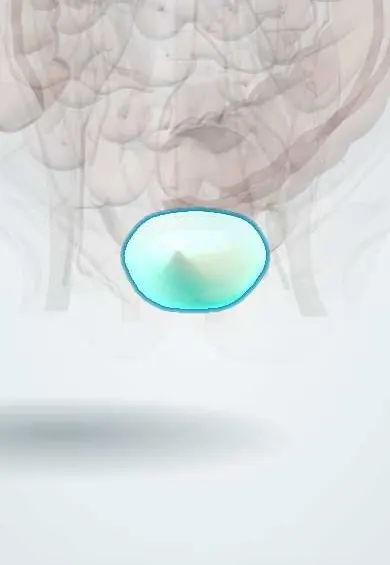
Urinary bladder !
The urinary bladder is the muscular bag behind the pubic bone that stores urine, about 400-600 ml, and empties it through the urethra.
Opens in the Durgical app, no sign-up needed.
What it is
A hollow muscular bag behind the pubic bone that stores urine. In the female it sits in front of the uterus and the vagina.
What it does
Holds about 400-600 ml and empties through the urethra.
Key facts
- Where
- Pelvis behind pubic symphysis, rising into abdomen when full; trigone between ureteric orifices and internal urethral orifice
- Blood supply
- Superior and inferior vesical arteries (internal iliac; in females vaginal arteries); vesical venous plexus
- Nerve
- Pelvic splanchnics (S2–S4) contract detrusor; sympathetic (T11–L2) relaxes it; pudendal nerve (S2–S4) to external urethral sphincter
- Function
- Stores urine (about 400–600 ml) and empties it by detrusor contraction (micturition reflex)
Relations
- In front
- Pubic symphysis and the retropubic space (of Retzius), filled with fat and the vesical venous plexus
- Above
- Peritoneum over the dome; in the female the body of the uterus leans forward on it across the vesicouterine pouch; in the male small bowel and sigmoid colon
- Behind
- Female: the cervix and the anterior wall of the vagina. Male: the seminal glands and the ends of the ductus deferens, with the rectum behind and the rectovesical pouch above
- Below
- Female: the neck rests on the pelvic floor beside the urethra. Male: the neck sits on the base of the prostate
- Lateral
- Levator ani and obturator internus, with the obturator nerve and vessels on the side wall
How to find it
Empty, it hides behind the pubic symphysis and cannot be felt. In urinary retention it rises out of the pelvis as a smooth, tender midline mass above the pubis, dull to percussion, sometimes reaching toward the umbilicus. A suprapubic catheter goes in the midline just above the symphysis, into a full bladder, so the needle passes below the peritoneal reflection.
On imaging
Ultrasound shows wall thickness and the volume left after voiding; a full bladder is the window for transabdominal pelvic ultrasound. For suspected rupture, CT cystography (the bladder filled through a catheter): contrast around bowel loops means intraperitoneal; flame-shaped streaks in the perivesical fat mean extraperitoneal.
Common problems
- Bladder infections (cystitis), much more common in women.
- Overactive bladder and incontinence.
- Cystocele: the bladder bulges into the front wall of the vagina.
- Injury risk in a caesarean section or hysterectomy, so it is moved away and emptied with a catheter.
How it is diagnosed
Urine test and culture; bladder diary; ultrasound; cystoscopy in some cases.
Treatment
- Antibiotics for infections; bladder training and medicines for overactive bladder.
- Anterior repair for a cystocele.
Clinical notes
- Extraperitoneal rupture is usually managed with catheter drainage; intraperitoneal rupture usually needs surgical repair
- Spinal cord injury above the sacral segments gives a spastic, reflex bladder; damage to S2–S4 or the cauda equina gives a flaccid bladder that overflows
- Male: an enlarged prostate obstructs outflow; the detrusor thickens and trabeculates and diverticula can form
- Part of the bladder wall can slide into an inguinal or femoral hernia, more often in men, and is at risk when the hernia sac is opened
Development
Forms from the urogenital sinus after the urorectal septum divides the cloaca. The urachus runs from the dome to the umbilicus and normally closes into the median umbilical ligament; if it stays open, urine can leak at the umbilicus, or a urachal cyst or sinus forms.
Memory aid
Parasympathetic makes you Pee; Sympathetic helps you Store.
Related conditions
- Kidney stones (urolithiasis)
- Acute kidney injury
- Urinary tract infection (acute cystitis)
- Pelvic organ prolapse
- Stress urinary incontinence
- Bladder cancer
- Anticholinergic toxicity (incl. scopolamine «burundanga»)
- Urinary incontinence in older adults (urge, overflow, functional)
- Healthcare-associated infections (CLABSI, CAUTI, VAP)
- Schistosomiasis
- Hydronephrosis and obstructive uropathy
- Acute urinary retention
- Catheter-associated urinary tract infection
- Overactive bladder and urge incontinence
- Neurogenic bladder
- Vesicoureteral reflux
- Interstitial cystitis (bladder pain syndrome)
- Asymptomatic bacteriuria
- Placenta accreta spectrum
- Obstetric fistula (vesicovaginal and rectovaginal)
- Nocturnal enuresis
- Posterior urethral valves
- Pelvic fracture
- Bladder and urethral injury
Test yourself
Think of the answer, then tap the question to see it.
Why can a suprapubic catheter be placed into a full urinary bladder without entering the peritoneum?
As it fills, the bladder rises above the symphysis with no peritoneum in front, so the needle passes below the peritoneal reflection.
How do extraperitoneal and intraperitoneal bladder ruptures differ in cause?
Extraperitoneal: usually with a pelvic fracture, urine in the retropubic space. Intraperitoneal: a blow to a full bladder tears the dome.
How do extraperitoneal and intraperitoneal bladder ruptures differ in management?
Extraperitoneal is usually managed with catheter drainage; intraperitoneal usually needs surgical repair.
Which autonomic divisions control storage and voiding of the urinary bladder?
Storage: sympathetic plus voluntary (pudendal). Voiding: parasympathetic, coordinated by the pontine micturition centre.
What type of bladder results from damage to S2–S4 or the cauda equina?
A flaccid bladder that overflows; injury above the sacral segments gives a spastic, reflex bladder.
Educational information, not medical advice. For any symptom, see a health professional.
Its names
- Official Latin (TA2)
- vesica urinaria TA2 3401
- Official Spanish (DeCS)
- Vejiga urinaria DeCS D001743
- English (TA2)
- Urinary bladder
Related
Sources: Terminologia Anatomica (TA2); DeCS; Anatomy, Abdomen and Pelvis: Bladder.
Spotted a mistake?We are always improving for the community. Tell us what is wrong and our team will review it.Report a mistake
Representative model, for educational purposes only.