
Ocular hypertension
Eye pressure above the normal range with a healthy optic nerve and normal visual field. It is a risk factor for glaucoma, not glaucoma itself.
What it is
Intraocular pressure repeatedly above about 21 mmHg with an open angle and a normal optic disc, nerve fibre layer and visual field. It is the main modifiable risk factor for primary open-angle glaucoma, yet most people with it never lose vision; a thick cornea can make the reading falsely high.
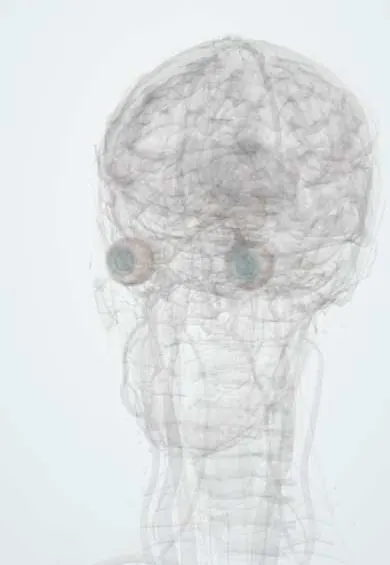
See it in 3D
Who gets it
Found in a few percent of adults over 40, far more often than glaucoma itself; only a minority convert to glaucoma over years of follow-up.
Causes
- Reduced outflow through the trabecular meshwork without nerve damage
- Artefactually high readings from a thick central cornea
- Secondary causes such as corticosteroid use, pigment dispersion or pseudoexfoliation
Risk factors
- Older age
- African ancestry
- Family history of glaucoma
- Corticosteroid use (drops, inhaled or systemic)
- High myopia
Pathophysiology
Aqueous humour drains less easily through the trabecular meshwork, so pressure rises. The optic nerve tolerates it for now; the risk of glaucomatous damage grows with higher pressure, thinner cornea, older age and a larger cup-to-disc ratio.
Symptoms and signs
- None; found on routine tonometry
Diagnosis
- Clinical
- Repeated tonometry on different days, gonioscopy to confirm an open angle and dilated optic disc examination.
- Tests
- Central corneal thickness (pachymetry), standard automated perimetry with a normal result.
- Imaging
- OCT of the retinal nerve fibre layer and optic disc photographs as a baseline.
Differential diagnosis
- Early primary open-angle glaucoma
- Normal-tension glaucoma with a coincidental high reading
- Steroid-induced pressure rise
- Measurement artefact (thick cornea, squeezing of the lids)
High pressure or a damaged nerve: which is it?
| Feature | Ocular hypertension | Primary open-angle glaucoma | Normal-tension glaucoma |
|---|---|---|---|
| Intraocular pressure | Repeatedly above about 21 mmHg | Usually above about 21 mmHg | Never above about 21 mmHg |
| Optic disc | Normal cup and rim | Glaucomatous cupping, rim thinning | Glaucomatous cupping, often disc haemorrhages |
| Visual field | Normal | Arcuate defects, peripheral first | Dense paracentral defects near fixation |
| Nerve fibre layer on OCT | Normal | Thinned | Thinned |
| Management | Treat only if high risk; otherwise monitor | Lower the pressure | Lower the pressure by about a third and correct systemic factors |
Goal of treatment
Identify people at highest risk of conversion to glaucoma and lower the pressure in them, while monitoring the rest.
Treatment
- Follow-up
- Low-risk patients are followed with pressure, disc imaging and visual fields at regular intervals.
- Medical
- Pressure-lowering drops (a prostaglandin analogue first) for higher-risk patients; large trials showed treatment roughly halves conversion to glaucoma.
- Procedure
- Selective laser trabeculoplasty as an alternative to drops.
Complications
- Conversion to primary open-angle glaucoma
- Retinal vein occlusion
Common traps
- A pressure above 21 mmHg means glaucoma: glaucoma is defined by optic nerve damage and field loss; with a normal disc and field this is ocular hypertension, and most such patients never lose vision
- A thick cornea with high pressure is the most worrying combination: a thick cornea makes applanation read falsely high, while a thin cornea both under-reads the pressure and is an independent risk factor for conversion
- Every patient with ocular hypertension needs drops: treatment is aimed at higher-risk patients (higher pressure, thin cornea, older age, larger cup-to-disc ratio); low-risk patients can be monitored
- A single high reading is enough to make the diagnosis: pressure varies through the day and with lid squeezing, so it is confirmed on repeated visits, with gonioscopy showing an open angle
- Inhaled or skin steroids are too weak to matter for eye pressure: a steroid response can follow any route, so pressure is rechecked whenever steroids continue
Prognosis
Good: most people never develop glaucoma, and treatment reduces the risk in those who are high risk.
Test yourself
Think of the answer, then tap the question to see it.
A 55-year-old has pressures of 26 mmHg in both eyes, open angles, normal discs and normal fields. What is the diagnosis and what decides whether to treat?
Ocular hypertension. Treatment depends on the risk of conversion: pressure level, central corneal thickness, age and cup-to-disc ratio; low-risk patients can simply be monitored.
Why must central corneal thickness be measured before acting on a high pressure reading?
Applanation reads high on a thick cornea and low on a thin one, and a thin cornea is itself a risk factor for glaucoma.
A patient on long-term steroid eye drops after uveitis shows a new pressure rise with a quiet eye. What is the likely cause and what next?
A steroid response. Review with the prescriber whether the steroid can be reduced or changed, recheck the pressure and examine the disc and field.
During follow-up, what finding turns ocular hypertension into glaucoma?
Reproducible glaucomatous damage: a new field defect, rim thinning or a disc haemorrhage with nerve fibre loss on OCT.
Why it happens
Connections
In physiology1
Educational information, not medical advice. For any symptom, see a health professional.
Sources: Ocular Hypertension (EyeWiki (American Academy of Ophthalmology), 2025).
Spotted a mistake?We are always improving for the community. Tell us what is wrong and our team will review it.Report a mistake
Representative model, for educational purposes only.