
Normal-tension glaucoma
Glaucoma damage to the optic nerve even though eye pressure stays in the normal range. Poor blood flow to the nerve seems to play a part.
What it is
A form of open-angle glaucoma with typical optic disc cupping and visual field loss while the intraocular pressure never exceeds about 21 mmHg. Field defects tend to be dense, close to fixation and paracentral. Lowering pressure still slows progression, but other causes of optic neuropathy must be excluded first.
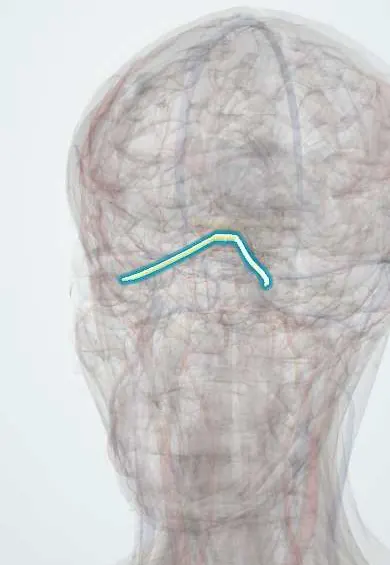
See it in 3D
Who gets it
Accounts for a large share of open-angle glaucoma in East Asian populations (most cases in Japan) and a smaller share in European populations; more common in women and older adults.
Causes
- Optic nerve susceptibility to normal pressure
- Vascular dysregulation and reduced optic nerve perfusion
- Genetic variants (for example OPTN and TBK1 in familial cases)
Risk factors
- Older age and female sex
- East Asian ancestry
- Migraine and Raynaud phenomenon (vasospasm)
- Low blood pressure, especially nocturnal dips from over-treated hypertension
- Obstructive sleep apnoea
Pathophysiology
Retinal ganglion cell axons die at the optic disc although pressure is normal. Proposed mechanisms include unstable blood flow to the optic nerve head, a weak lamina cribrosa and a low pressure gradient across it from low cerebrospinal fluid pressure.
Symptoms and signs
- Usually none until advanced
- Paracentral field loss noticed late, sometimes as difficulty reading
Diagnosis
- Clinical
- Glaucomatous cupping, often with disc haemorrhages and focal rim notching, plus repeated normal pressure readings including a diurnal curve; gonioscopy shows an open angle.
- Tests
- Visual fields (including central 10-2 testing), pachymetry, blood pressure profile; screening for anaemia, syphilis and other causes of optic neuropathy when atypical.
- Imaging
- OCT of the nerve fibre layer and ganglion cell layer; MRI of the brain and orbits when the picture is atypical.
Differential diagnosis
- Primary open-angle glaucoma with missed pressure peaks
- Compressive optic neuropathy (pituitary tumour, meningioma)
- Previous ischaemic optic neuropathy or shock
- Congenital disc anomalies (optic pit, tilted disc)
- Hereditary optic neuropathy
Cupped or pale disc with normal pressure: glaucoma or something else?
| Feature | Normal-tension glaucoma | Compressive optic neuropathy | Previous ischaemic optic neuropathy |
|---|---|---|---|
| Disc | Cupping greater than pallor; rim notching, disc haemorrhages | Pallor greater than cupping | Sectoral pallor, little or no cupping |
| Visual field | Paracentral or arcuate, respecting the horizontal midline | Often respects the vertical midline (bitemporal or hemianopic) | Altitudinal defect |
| Central acuity and colour vision | Preserved until late | Reduced early | Reduced at onset, then stable |
| Course | Slow and painless; migraine, Raynaud, nocturnal hypotension | Progressive; headache or endocrine symptoms possible | Sudden painless loss, then no progression |
| Key test | Diurnal pressure curve, OCT and serial fields | MRI of brain and orbits | History and stable serial fields |
Goal of treatment
Slow progression by lowering pressure by about 30 percent from baseline and correcting contributing systemic factors.
Treatment
- Medical
- Pressure-lowering drops (prostaglandin analogue first).
- Procedure
- Selective laser trabeculoplasty.
- Surgical
- Trabeculectomy or another filtering operation when the disease progresses despite treatment.
- Lifestyle
- Coordinate with the physician to avoid nocturnal hypotension; treat sleep apnoea.
- Follow-up
- Serial visual fields and OCT to detect progression.
Complications
- Progressive loss of visual field near fixation
- Loss of central vision in advanced disease
Common traps
- Normal pressure rules out glaucoma: the nerve, not the number, defines glaucoma; many patients, especially of East Asian ancestry, have cupping and field loss at pressures that never exceed about 21 mmHg
- Lowering a pressure that is already normal cannot help: lowering it by about 30 percent slowed progression in the Collaborative Normal-Tension Glaucoma Study, so drops and laser remain the core treatment
- The lower the blood pressure, the better for the nerve: over-treated hypertension with nocturnal dips can starve the optic nerve head, so the physician may need to avoid night-time hypotension
- Any cupped disc with normal pressure is normal-tension glaucoma: pallor greater than cupping, a field defect respecting the vertical midline, early loss of acuity or colour vision, or young age point to a compressive or other optic neuropathy and need MRI
- One clinic reading is enough to call the pressure normal: peaks are easily missed, so a diurnal curve and pachymetry come before the label, to avoid missing primary open-angle glaucoma
Prognosis
Many patients progress slowly; lowering pressure reduces the rate of progression, as shown in the Collaborative Normal-Tension Glaucoma Study.
Test yourself
Think of the answer, then tap the question to see it.
A 62-year-old woman with migraine has an inferior rim notch, a disc haemorrhage and a paracentral defect; a diurnal curve shows pressures of 14 to 17 mmHg. Most likely diagnosis?
Normal-tension glaucoma: glaucomatous disc and field damage with an open angle and repeatedly normal pressures, plus a vasospastic risk factor.
Why is a central 10-2 field worth adding in suspected normal-tension glaucoma?
Its defects tend to be dense and close to fixation, which the wider standard grid samples coarsely and can miss.
A 45-year-old labelled as normal-tension glaucoma has pale discs, poor colour vision and a bitemporal defect. What next?
MRI of the brain and orbits: pallor exceeding cupping and a field respecting the vertical midline suggest a compressive lesion such as a pituitary tumour, not glaucoma.
Why does the timing of a patient's antihypertensive treatment matter in normal-tension glaucoma?
Night-time dips from over-treatment can lower optic nerve perfusion, so the physician may adjust the regimen to avoid low nocturnal blood pressure.
Why it happens
Connections
In physiology1
Educational information, not medical advice. For any symptom, see a health professional.
Sources: Normal Tension Glaucoma (StatPearls Publishing (NCBI Bookshelf), 2022).
Spotted a mistake?We are always improving for the community. Tell us what is wrong and our team will review it.Report a mistake
Representative model, for educational purposes only.