
Pigment dispersion syndrome and pigmentary glaucoma
In young short-sighted adults the iris rubs on the lens fibres and sheds pigment that clogs the drain. Pressure can spike with exercise.
What it is
A condition in which the back of the iris rubs against the lens zonules and releases pigment granules into the aqueous humour. The pigment deposits on the cornea, lens and trabecular meshwork. In a proportion of patients the meshwork clogs and pigmentary glaucoma develops, typically in young, short-sighted adults.
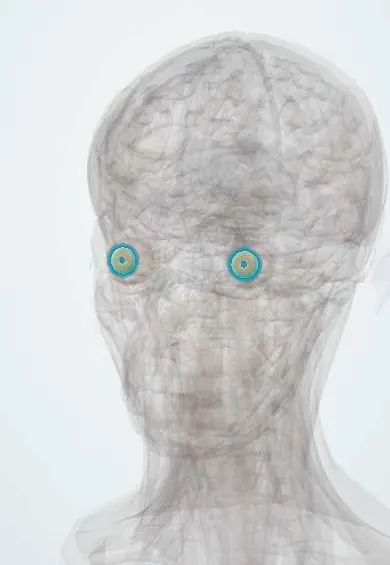
See it in 3D
Who gets it
Most often in short-sighted men in their twenties to forties; both eyes usually affected.
Causes
- Backward bowing of the peripheral iris (reverse pupillary block)
- Myopia and a deep anterior chamber
- Genetic predisposition
Risk factors
- Myopia
- Male sex
- Age 20 to 45
- Family history
Pathophysiology
A concave peripheral iris contacts the zonules and lens; movement of the iris rubs off pigment from its posterior epithelium. Pigment-laden cells in the trabecular meshwork reduce outflow; exercise or pupil dilation can release a burst of pigment and a pressure spike.
Symptoms and signs
- Usually none
- Blurred vision and halos after exercise or in the dark (pressure spikes)
- Late field loss if glaucoma develops
Diagnosis
- Clinical
- Vertical pigment line on the back of the cornea (Krukenberg spindle), slit-like iris transillumination defects in the mid-periphery and a deep anterior chamber with a concave iris.
- Tests
- Tonometry, gonioscopy (dense, even pigmentation of the meshwork), optic disc and field evaluation.
- Imaging
- Anterior segment OCT can show the concave iris.
Differential diagnosis
- Pseudoexfoliation syndrome
- Uveitic pigment release
- Pigment from trauma or iris surgery
Goal of treatment
Detect and control raised pressure early to protect the optic nerve.
Treatment
- Follow-up
- Regular pressure and optic nerve checks in pigment dispersion without glaucoma.
- Medical
- Pressure-lowering drops; prostaglandin analogues and miotics reduce pigment release in some cases.
- Procedure
- Laser trabeculoplasty; laser iridotomy is used selectively to flatten the iris.
- Surgical
- Glaucoma surgery for uncontrolled pressure.
Complications
- Pigmentary glaucoma
- Retinal detachment (associated myopia)
Prognosis
Pigment release often declines with age; glaucoma is controllable with early treatment.
Test yourself
Think of the answer, then tap the question to see it.
Who typically has pigment dispersion syndrome?
Young, short-sighted adults, more often men.
What is a Krukenberg spindle?
A vertical line of pigment on the inner surface of the cornea.
What can trigger pressure spikes?
Exercise or pupil dilation, which release bursts of pigment.
In ophthalmology
Connections
Educational information, not medical advice. For any symptom, see a health professional.
Sources: Pigment Dispersion Syndrome (StatPearls Publishing (NCBI Bookshelf), 2023); Pigment Dispersion Glaucoma (StatPearls Publishing (NCBI Bookshelf), 2023).
Spotted a mistake?We are always improving for the community. Tell us what is wrong and our team will review it.Report a mistake
Representative model, for educational purposes only.