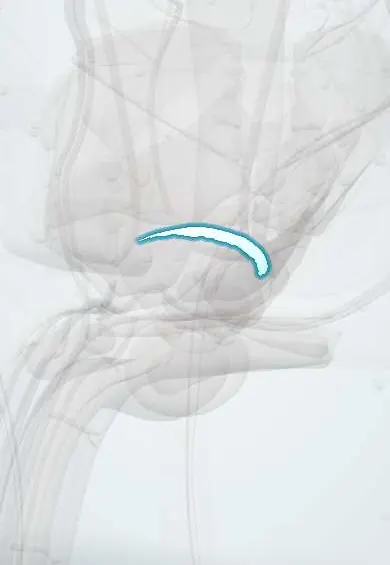
Reproductive system · Pelvis · Male
Central zone !
The central zone is the part of the prostate at its base that surrounds the ejaculatory ducts on their way to the urethra; few cancers start here.
Official name: Central zone of prostate
Opens in the Durgical app, no sign-up needed.
What it is
A cone-shaped zone (about 25% of the gland) around the ejaculatory ducts, at the base of the prostate under the bladder.
What it does
Surrounds the ejaculatory ducts on their way to the urethra; few cancers start here.
Key facts
- Where
- Cone at the prostate base around the ejaculatory ducts, apex at the verumontanum; about 25% of the young gland
- Function
- Carries the ejaculatory ducts to the urethra; few cancers and little BPH start here; thought to derive from the Wolffian (mesonephric) duct
Relations
- Contents
- Both ejaculatory ducts, running from the base down and forward to the verumontanum
- Above
- Bladder base and the point where each seminal vesicle duct joins the ampulla of the ductus deferens
- Behind
- Peripheral zone, which wraps around it behind and on each side, and beyond it the rectum
- In front
- Transition zone and the proximal prostatic urethra
On imaging
On T2-weighted MRI it is a symmetric band of darker tissue at the base around the ejaculatory ducts, shaped like an inverted cone; this normal appearance can mimic cancer, and symmetry is the clue that it is normal. In older men BPH compresses it and it becomes hard to see.
Common problems
- Benign prostatic hyperplasia (BPH): growth with age, mainly of the transition zone, that squeezes the urethra.
- Prostate cancer, one of the most common cancers in men; most start in the peripheral zone.
- Prostatitis (infection or inflammation).
How it is diagnosed
Digital rectal examination; PSA blood test; MRI and a needle biopsy if cancer is suspected; ultrasound.
Treatment
- Medicines for BPH (alpha-blockers, 5-alpha-reductase inhibitors); surgery through the urethra (TURP) if needed.
- Prostate cancer: active surveillance, radical prostatectomy or radiotherapy, depending on the risk.
Clinical notes
- Cancer arising here can spread along the ejaculatory ducts into the seminal vesicles, which raises the stage
- Cysts, stones or scarring around the ejaculatory ducts within it can block them, causing low-volume semen and infertility
Development
Some texts hold that it comes from the mesonephric (Wolffian) duct, like the seminal vesicles, while the other zones come from the urogenital sinus; this would fit its vesicle-like glands, but the point is debated.
Related conditions
Test yourself
Think of the answer, then tap the question to see it.
Which structures pass through the central zone of the prostate?
Both ejaculatory ducts, running from the base down and forward to the verumontanum.
Why do cancers arising in the central zone matter despite being uncommon?
They tend to be higher grade and to spread along the ejaculatory ducts into the seminal vesicles, raising the stage.
How can the normal central zone mimic cancer on T2-weighted MRI?
It is a darker band at the base around the ejaculatory ducts; symmetry is the clue that it is normal.
Educational information, not medical advice. For any symptom, see a health professional.
Its names
- Official Spanish (DeCS)
- Zona central de la próstata
- English (TA2)
- Central zone of prostate
Related
Sources: Anatomy, Abdomen and Pelvis, Prostate.
Spotted a mistake?We are always improving for the community. Tell us what is wrong and our team will review it.Report a mistake
Representative model, for educational purposes only.