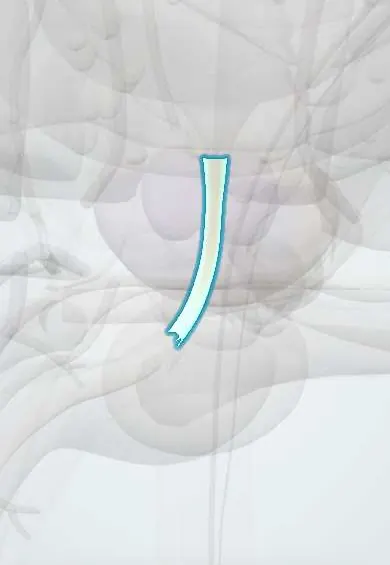
Urinary system · Pelvis · Male
Prostatic urethra !
The prostatic urethra is the first part of the male urethra, running through the prostate; semen enters it here, and an enlarged prostate can squeeze it.
Official name: Prostatic urethra; seminal colliculus
Opens in the Durgical app, no sign-up needed.
What it is
The first 3-4 cm and the widest part, running down through the prostate. On its back wall a mound, the verumontanum (seminal colliculus), holds the openings of the ejaculatory ducts.
What it does
Receives semen from the ejaculatory ducts and the prostate; enlarged transition-zone tissue squeezes it in BPH.
Key facts
- Where
- First 3–4 cm, the widest and most distensible part, down through the prostate from the bladder neck to the apex
- Attaches
- Posterior wall: urethral crest with the verumontanum (seminal colliculus), holding the prostatic utricle and both ejaculatory ducts; prostatic ducts open into the sinuses beside it
- Function
- Receives sperm, seminal fluid and prostatic secretion; narrowed by transition-zone BPH; the verumontanum is the distal limit of TURP, protecting the external sphincter
Relations
- Above
- Bladder neck and internal urethral orifice
- Below
- Membranous urethra at the prostatic apex, within the external urethral sphincter
- Behind
- Verumontanum with the prostatic utricle and the openings of the ejaculatory ducts; behind them the central and peripheral zones and the rectum
- Lateral
- Transition zone lobes and the prostatic sinuses, where the prostatic ducts open
- In front
- Anterior fibromuscular stroma
How to find it
Not palpable as such. On cystourethroscopy the verumontanum appears as a mound on the floor of the urethra, with the bladder neck above and the sphincter below.
On imaging
On a voiding cystourethrogram it is the widest, spindle-shaped segment. In boys with posterior urethral valves it is dilated above the obstruction, a classic sign.
Common problems
- Urethral stricture: a narrowing from scarring after infection, injury or instruments.
- Urethritis, often a sexually transmitted infection (burning when passing urine, discharge).
- Its length and two bends make a catheter harder to pass than in women.
How it is diagnosed
Urine tests and swabs; urine flow test; urethrogram or a scope (urethroscopy).
Treatment
- TURP removes prostate tissue from inside it; the verumontanum is the landmark that protects the sphincter just below.
Clinical notes
- Posterior urethral valves: obstructing membranes just below the verumontanum in boys, the commonest congenital cause of bladder outlet obstruction; they thicken the bladder and can damage the kidneys
- When a catheter will not pass, resistance at the bladder neck suggests BPH or bladder neck contracture; forcing it can create a false passage
Development
Develops from the pelvic part of the urogenital sinus (endoderm). The utricle on its back wall is the remnant of the fused paramesonephric (Müllerian) ducts.
Related conditions
Test yourself
Think of the answer, then tap the question to see it.
What lies on the verumontanum of the prostatic urethra?
The prostatic utricle and the openings of both ejaculatory ducts.
Why is the verumontanum the distal limit of TURP?
The external urethral sphincter lies just below it, so resection stops there to protect continence.
What are posterior urethral valves?
Obstructing membranes just below the verumontanum in boys, the commonest congenital cause of bladder outlet obstruction; the prostatic urethra dilates above them.
Why may a catheter catch in the prostatic urethra in BPH, and what catheter is designed for this?
BPH lengthens and distorts the prostatic urethra and can lift the bladder neck; a curved-tip (coudé) catheter is made for this.
Educational information, not medical advice. For any symptom, see a health professional.
Its names
- Official Latin (TA2)
- pars prostatica urethrae masculinae; colliculus seminalis
- Official Spanish (DeCS)
- Porción prostática de la uretra masculina
- English (TA2)
- Prostatic urethra; seminal colliculus
- Also called
- verumontanum
Related
Sources: Anatomy, Abdomen and Pelvis, Male Genitourinary Tract.
Spotted a mistake?We are always improving for the community. Tell us what is wrong and our team will review it.Report a mistake
Representative model, for educational purposes only.