Reproductive system · Pelvis · Male
Peripheral zone !
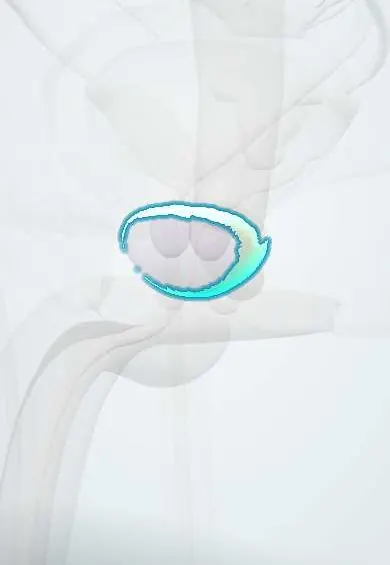
The peripheral zone is the back and outer part of the prostate, next to the rectum; most prostate cancers start here.
Official name: Peripheral zone of prostate
Opens in the Durgical app, no sign-up needed.
What it is
The back and sides of the prostate, about 70% of the gland in a young man; the part closest to the rectum.
What it does
Most prostate cancers (about 70%) start here, which is why a rectal examination can feel some of them as a hard nodule.
Key facts
- Where
- Posterior and lateral prostate from base to apex, wrapping around the central zone; about 70% of the young gland; the part nearest the rectum
- Function
- Origin of most prostate cancers (about 70%); felt as a hard nodule on digital rectal exam; main target of prostate MRI and biopsy
Relations
- Behind
- Rectoprostatic (Denonvilliers) fascia and the front wall of the rectum
- Lateral
- Neurovascular bundles with the cavernous nerves and the prostatic venous plexus; tumour that breaks out here can spread along the nerves
- In front
- Central zone at the base and transition zone above the verumontanum
- Below
- Prostatic apex near the external urethral sphincter, a frequent site of positive margins after surgery
How to find it
The part felt on digital rectal examination: a lobe on each side of the median groove, normally smooth and rubbery.
Examination
- Digital rectal examination: a hard, irregular or fixed area in this zone suggests cancer and leads to PSA testing, MRI and biopsy; a normal examination does not rule out a small tumour
On imaging
On multiparametric MRI, cancer appears as a dark T2 focus with restricted diffusion and early contrast enhancement. For this zone PI-RADS gives the diffusion images the main weight. Systematic biopsy samples it from base to apex on each side; MRI-targeted biopsy aims at the lesion.
Common problems
- Benign prostatic hyperplasia (BPH): growth with age, mainly of the transition zone, that squeezes the urethra.
- Prostate cancer, one of the most common cancers in men; most start in the peripheral zone.
- Prostatitis (infection or inflammation).
How it is diagnosed
Digital rectal examination; PSA blood test; MRI and a needle biopsy if cancer is suspected; ultrasound.
Treatment
- Medicines for BPH (alpha-blockers, 5-alpha-reductase inhibitors); surgery through the urethra (TURP) if needed.
- Prostate cancer: active surveillance, radical prostatectomy or radiotherapy, depending on the risk.
Clinical notes
- Tumour that breaks through the capsule at the back and sides (extraprostatic extension) can reach the neurovascular bundle, which may then be removed rather than spared
- A firm area on rectal examination is not always cancer: chronic prostatitis, calcifications and old biopsy scars also feel hard
Related conditions
Test yourself
Think of the answer, then tap the question to see it.
What proportion of prostate cancers start in the peripheral zone, and why can some be felt?
About 70%; the peripheral zone lies against the rectum, so a hard nodule may be felt on digital rectal examination.
How does the healthy peripheral zone look on T2-weighted MRI, and what is suspicious?
Bright; a dark focus with restricted diffusion is the classic suspicious finding. PI-RADS weights diffusion images most here.
What is the surgical capsule, and why does cancer screening continue after TURP?
The peripheral zone compressed by BPH into a thin rim; it is left behind after TURP and can still develop cancer.
Besides cancer, what can feel firm in the peripheral zone on rectal examination?
Chronic prostatitis, calcifications and old biopsy scars.
Educational information, not medical advice. For any symptom, see a health professional.
Its names
- Official Spanish (DeCS)
- Zona periférica de la próstata
- English (TA2)
- Peripheral zone of prostate
Related
Sources: Anatomy, Abdomen and Pelvis, Prostate.
Spotted a mistake?We are always improving for the community. Tell us what is wrong and our team will review it.Report a mistake
Representative model, for educational purposes only.