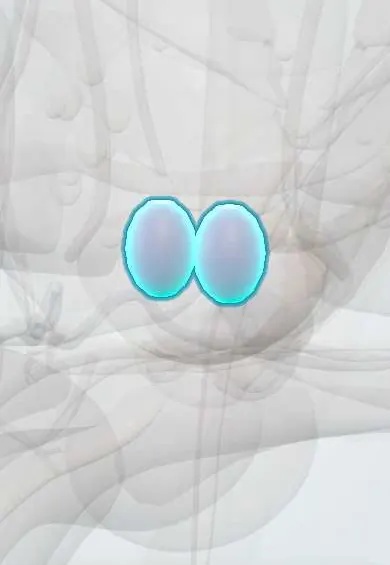
Reproductive system · Pelvis · Male
Transition zone !
The transition zone is the small part of the prostate around the urethra; with age it can grow (benign prostatic hyperplasia) and narrow the urethra.
Official name: Transition zone of prostate
Opens in the Durgical app, no sign-up needed.
What it is
Two small lobes (about 5% of the young gland) around the urethra just above the verumontanum.
What it does
The zone where benign prostatic hyperplasia (BPH) grows; with age it can become most of the gland and narrow the urethra.
Key facts
- Where
- Two small lobes beside the proximal prostatic urethra, just above the verumontanum; about 5% of the young gland
- Function
- Site of benign prostatic hyperplasia (BPH), which narrows the urethra; origin of about 20% of cancers, often anterior and not felt rectally; tissue removed in TURP
Relations
- Medial
- Proximal prostatic urethra, from the bladder neck to just above the verumontanum, which it flanks on both sides
- In front
- Anterior fibromuscular stroma
- Behind
- Central zone with the ejaculatory ducts
- Lateral
- Peripheral zone, compressed by BPH into the surgical capsule
- Above
- Bladder neck and the periurethral glands, which together with this zone can form a middle lobe
On imaging
Transrectal ultrasound or MRI measures it and the total volume. On T2-weighted MRI, BPH looks like many round nodules with capsules ('organized chaos'); cancer here is a uniform, dark, lens-shaped area with blurred edges ('erased charcoal'). PI-RADS relies mainly on T2 images for this zone.
Common problems
- Benign prostatic hyperplasia (BPH): growth with age, mainly of the transition zone, that squeezes the urethra.
- Prostate cancer, one of the most common cancers in men; most start in the peripheral zone.
- Prostatitis (infection or inflammation).
How it is diagnosed
Digital rectal examination; PSA blood test; MRI and a needle biopsy if cancer is suspected; ultrasound.
Treatment
- TURP or laser surgery removes the enlarged transition zone from inside the urethra.
Clinical notes
- TURP, laser enucleation and open or robotic simple prostatectomy for very large glands all remove transition-zone adenoma and leave the peripheral zone, so later cancer screening still applies
- Drug classes used in BPH act here: alpha-1 blockers relax the smooth muscle of the bladder neck and prostate; 5-alpha-reductase inhibitors slowly shrink the gland
- Acute urinary retention from BPH presents with a painful, tense bladder felt above the pubis and is relieved by a urethral or suprapubic catheter
Development
Like the rest of the glandular prostate it buds from the urogenital sinus under androgen control. The gland about doubles in size at puberty and slowly grows again from roughly age 25; in later life that growth is mostly nodular hyperplasia of this zone.
Related conditions
Test yourself
Think of the answer, then tap the question to see it.
What condition starts in the transition zone, and how does it affect the urethra?
BPH: nodules beside the proximal urethra grow and narrow it, pushing the peripheral zone outward into the surgical capsule.
How can a middle lobe of the transition zone cause obstruction?
It bulges into the bladder and can block the bladder neck like a ball valve.
How do BPH and cancer in the transition zone differ on T2-weighted MRI?
BPH: many round encapsulated nodules («organized chaos»). Cancer: a uniform, dark, lens-shaped area with blurred edges («erased charcoal»).
How do the drug classes for BPH act on the transition zone?
Alpha-1 blockers relax smooth muscle of the bladder neck and prostate; 5-alpha-reductase inhibitors slowly shrink the gland.
Educational information, not medical advice. For any symptom, see a health professional.
Its names
- Official Spanish (DeCS)
- Zona de transición de la próstata
- English (TA2)
- Transition zone of prostate
Related
Sources: Anatomy, Abdomen and Pelvis, Prostate; 27.1 Anatomy and Physiology of the Testicular Reproductive System (OpenStax (Rice University), 2022) · adapted, CC BY 4.0.
Spotted a mistake?We are always improving for the community. Tell us what is wrong and our team will review it.Report a mistake
Representative model, for educational purposes only.