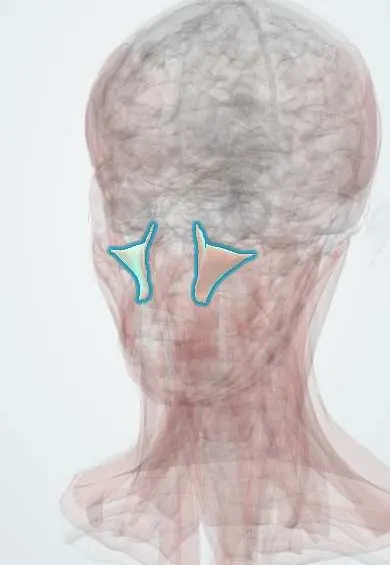
Muscular system · Head and neck
Levator labii superioris !
The levator labii superioris is a thin facial muscle from below the eye and beside the nose to the upper lip; it lifts the lip and flares the nostril.
Opens in the Durgical app, no sign-up needed.
What it is
Thin muscles from below the eye and beside the nose to the upper lip.
What it does
Lift the upper lip and flare the nostril.
Key facts
- Origin
- Infraorbital margin of the maxilla (and frontal process: alaeque nasi part)
- Insertion
- Upper lip (and nasal ala)
- Action
- Lifts the upper lip, flares the nostril
- Nerve
- Facial nerve (CN VII): zygomatic and buccal branches
- Blood supply
- Facial artery branches
Relations
- Superficial
- Orbicularis oculi at its origin, then skin and the malar fat of the cheek
- Deep
- Infraorbital foramen with the infraorbital nerve and vessels, and the levator anguli oris
- Medial
- Alaeque nasi slip on the frontal process of the maxilla and the side of the nose, reaching the nasal ala and nasal cartilages
- Lateral
- Zygomaticus minor, with which it inserts into the upper lip
- Below
- Orbicularis oris in the upper lip
How to find it
Asked to raise the upper lip in a sneer (show the upper teeth and wrinkle the side of the nose), the muscle tightens between the lower orbital rim and the upper lip, beside the nose.
Examination
- Sneer or showing the upper teeth: on a weak side the upper lip and nostril do not lift (zygomatic and buccal branches of the facial nerve)
On imaging
Not seen as a separate muscle on routine CT; high-resolution ultrasound or MRI can show it covering the infraorbital foramen. It is mainly a landmark: coronal CT shows the foramen just below the orbital rim, and orbital floor or zygoma fractures that run through it explain numbness of the cheek and upper lip. Ultrasound finds the foramen to guide an infraorbital nerve block.
Clinical notes
- Facial palsy flattens the nasolabial fold and lets the nostril collapse on breathing in, adding nasal obstruction
- Weakening this group by botulinum toxin injection is a procedure for gummy smile; overcorrection lengthens the lip and flattens the smile
- In maxillary and orbital-floor surgery through the face, the infraorbital nerve is protected as it emerges under this muscle
Development
Second pharyngeal arch muscle, supplied for that reason by the facial nerve.
Memory aid
Levator labii superioris alaeque nasi is often quoted as the muscle with the longest name; it lifts the lip and the ala, as the name says.
Test yourself
Think of the answer, then tap the question to see it.
Which foramen and nerve lie deep to the levator labii superioris?
The infraorbital foramen; the infraorbital nerve emerges between it and the levator anguli oris.
What does the alaeque nasi part of the levator labii superioris do, and what follows its loss?
It flares the nostril; in facial palsy its loss lets the nostril collapse on breathing in, narrowing the nasal valve.
Which muscle is the main target when a gummy smile is treated by weakening the upper-lip elevators?
The levator labii superioris; overcorrection lengthens the lip and flattens the smile.
Educational information, not medical advice. For any symptom, see a health professional.
Its names
- Official Latin (TA2)
- levator labii superioris TA2 2081
- Official Spanish (DeCS)
- Músculo elevador del labio superior
- English (TA2)
- Levator labii superioris
- Also called
- levator labii superioris muscle · caput infraorbitale musculi quadrati labii superioris
Related
Sources: Terminologia Anatomica (TA2); Anatomy, Head and Neck: Levator Labii Superioris Muscle; Anatomy, Head and Neck: Facial Muscles; Anatomy of the Human Body (20th ed.): Development of the Muscles (Lea & Febiger (Gray's Anatomy, 1918), 1918) · adapted, Public domain.
Spotted a mistake?We are always improving for the community. Tell us what is wrong and our team will review it.Report a mistake
Representative model, for educational purposes only.