Cardiovascular system · Head and neck
Facial artery !
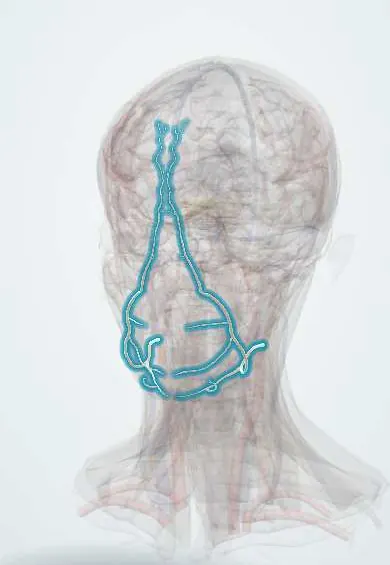
The facial artery winds over the jaw onto the face to feed the lips, cheek and side of the nose; its pulse is felt on the lower edge of the jaw.
Opens in the Durgical app, no sign-up needed.
What it is
A winding artery over the jaw edge, past the mouth corner to the inner corner of the eye.
What it does
Feeds the face and lips; its pulse is felt on the jaw in front of the masseter.
Key facts
- Origin
- External carotid
- Branches
- Ascending palatine, tonsillar, submental, labial, angular
- Supplies
- Face, lips, tonsil, submandibular gland; pulse at the mandible in front of the masseter
Relations
- Course
- From the external carotid just above the lingual artery, it runs up deep to the digastric and stylohyoid, grooves the back of the submandibular gland, hooks round the lower border of the mandible at the front edge of the masseter, winds past the corner of the mouth and along the side of the nose, and ends as the angular artery at the medial canthus
- Behind
- Facial vein, which runs a straighter course behind the artery on the face
- Superficial
- Platysma, risorius and zygomaticus major; at the mandible, the marginal mandibular branch of the facial nerve
- Deep
- In the neck, the superior constrictor of the pharynx and the palatine tonsil; on the face, the mandible, buccinator and levator anguli oris
How to find it
With the teeth clenched, the front edge of the masseter stands out; the pulse is felt where that edge meets the lower border of the mandible. The labial arteries can be felt pulsing when the lip is held between finger and thumb.
On imaging
Colour Doppler follows it around the lower border of the mandible in front of the masseter and up the face; before filler injections it maps the artery near the nasolabial fold, where injection into it can cause skin necrosis or blindness. CT angiography or catheter angiography shows it in facial bleeding, vascular malformations or for embolisation.
Clinical notes
- Danger triangle (corners of the mouth to the bridge of the nose): the facial vein beside the artery drains through the ophthalmic veins to the cavernous sinus, so infection here can spread inside the skull
- Pressing the artery against the mandible reduces bleeding from the face, though flow returns from the other side and from neighbouring branches
- Filler injected into the facial or angular artery can block skin vessels and, through the link with the ophthalmic artery, cause blindness
- The facial artery musculomucosal (FAMM) flap, based on this artery, is used to rebuild the palate, lips and floor of the mouth
Anatomical variants
- It often shares a linguofacial trunk with the lingual artery
- It may end early as the superior labial or lateral nasal artery (at the ala of the nose in up to about 40% in some series), with the angular area fed by the ophthalmic artery instead
Related conditions
Test yourself
Think of the answer, then tap the question to see it.
Where is the facial artery pulse felt?
On the lower border of the mandible at the front edge of the masseter, best with the teeth clenched.
Which nerve branch crosses the facial artery at the lower border of the mandible?
The marginal mandibular branch of the facial nerve, superficial to the artery and vein; submandibular incisions go well below the bone.
Why can filler injected near the nose cause blindness?
The angular artery (end of the facial artery) joins the dorsal nasal branch of the ophthalmic artery, so emboli can reach the eye.
Why does a cut lip bleed from both ends?
The superior and inferior labial branches of the facial artery join across the midline.
Educational information, not medical advice. For any symptom, see a health professional.
Its names
- Official Latin (TA2)
- arteria facialis TA2 4388
- Official Spanish (DeCS)
- Arteria facial
- English (TA2)
- Facial artery
- Also called
- external maxillary artery · arteria maxillaris externa
Related
Sources: Terminologia Anatomica (TA2); Anatomy, Head and Neck: Facial Artery; Tratado de anatomía humana (9.ª ed.), tomo II, Libro IV, sección 2 Arterias, caps. I-III (sistema de la arteria pulmonar; aorta y ramas del cayado hasta la carótida interna).
Spotted a mistake?We are always improving for the community. Tell us what is wrong and our team will review it.Report a mistake
Representative model, for educational purposes only.