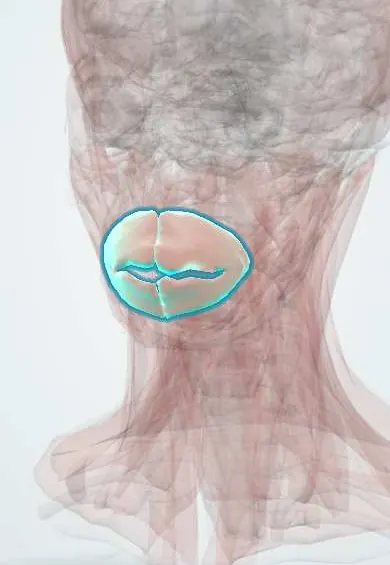
Muscular system · Head and neck
Orbicularis oris !
The orbicularis oris is the ring of muscle in the lips; it closes and purses the lips for speaking, whistling and keeping food in the mouth.
Official name: Orbicularis oris muscle
Opens in the Durgical app, no sign-up needed.
What it is
The ring of muscle in the lips.
What it does
Closes and purses the lips; needed for speaking, whistling and keeping food in.
Key facts
- Origin
- Maxilla and mandible near the midline, other lip muscles
- Insertion
- Skin and mucosa of the lips
- Action
- Closes and purses the lips
- Nerve
- Facial nerve (CN VII): buccal and marginal mandibular branches (each half from its own side)
- Blood supply
- Facial artery branches
Relations
- Superficial
- Skin of the lips, including the philtrum and the vermilion border (white roll)
- Deep
- Labial glands and mucosa; the superior and inferior labial arteries (from the facial artery) run between the muscle and the mucosa
- Lateral
- Modiolus, where the buccinator, zygomaticus major, levator and depressor anguli oris and risorius meet it
- Above
- Nasal base, with the levator labii superioris inserting into it
- Below
- Mentalis and depressor labii inferioris
How to find it
Asked to purse the lips or whistle, it is felt as a firm ring in both lips; pressing the lips together against a finger shows its strength.
Examination
- Whistling or holding air in with puffed cheeks: air escapes from the weak corner
- Pursing the lips against resistance: the mouth pulls toward the healthy side
- The House–Brackmann scale includes mouth movement when grading facial nerve function
On imaging
Ultrasound shows it as a ring of muscle in the lips, between the skin and the mucosa. It can check that the ring is continuous after cleft lip repair, and it assesses lip lumps such as a mucocele. Prenatal ultrasound, sometimes with fetal MRI, looks for cleft lip as a gap in the upper lip. MRI is used for deeper lip tumours.
Clinical notes
- In lip lacerations the vermilion border is aligned first; a step of even a millimetre shows, and the muscle layer is closed separately
- The labial arteries lie deep, close to the mucosa, so full-thickness lip wounds bleed briskly from both cut ends
- With the buccinator and tongue it balances the forces on the teeth; lip incompetence and mouth breathing affect dental arch shape
Development
The upper lip forms where the medial nasal and maxillary prominences fuse; failure of fusion gives a cleft lip, with the muscle running up along the cleft instead of across it.
Related conditions
Test yourself
Think of the answer, then tap the question to see it.
Which facial nerve branches supply the orbicularis oris, and what does weakness cause?
The buccal and marginal mandibular branches; weakness causes drooling and poor articulation of p, b and m.
Which step comes first when repairing a lip laceration through the orbicularis oris?
Aligning the vermilion border, since a step of even a millimetre shows; the muscle layer is closed separately.
Why do full-thickness lip wounds bleed briskly?
The superior and inferior labial arteries run deep, between the orbicularis oris and the mucosa, and bleed from both cut ends.
Educational information, not medical advice. For any symptom, see a health professional.
Its names
- Official Latin (TA2)
- musculus orbicularis oris TA2 2073
- Official Spanish (DeCS)
- Músculo orbicular de la boca DeCS D005152
- English (TA2)
- Orbicularis oris muscle
Related
Sources: Terminologia Anatomica (TA2); DeCS; Anatomy, Head and Neck, Orbicularis Oris Muscle.
Spotted a mistake?We are always improving for the community. Tell us what is wrong and our team will review it.Report a mistake
Representative model, for educational purposes only.