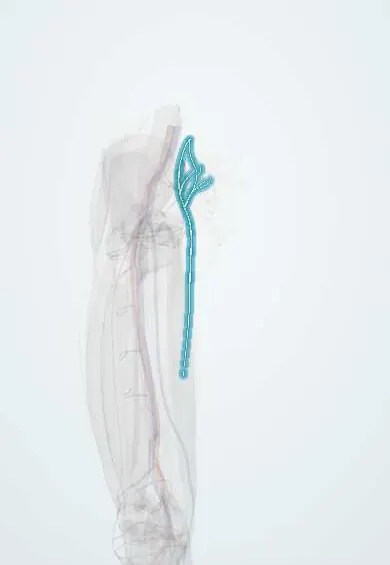
Posterior femoral cutaneous nerve !
The posterior femoral cutaneous nerve carries feeling from the skin of the back of the thigh and the lower buttock.
Opens in the Durgical app, no sign-up needed.
What it is
A skin nerve that leaves the pelvis below the piriformis and runs down the back of the thigh, just under the fascia.
What it does
Carries feeling from the lower buttock, the back of the thigh and the top of the back of the calf.
Key facts
- Roots
- S1–S3
- Moves
- None (purely sensory, cutaneous)
- Feeling from
- Posterior thigh and popliteal fossa; lower buttock (inferior cluneal nerves); perineum (perineal branches)
Relations
- Course
- Leaves the pelvis through the greater sciatic foramen below the piriformis, descends under the gluteus maximus beside the sciatic nerve, runs down the middle of the back of the thigh under the fascia lata over the long head of the biceps femoris, and pierces the fascia near the popliteal fossa to reach the upper calf
- Deep
- The sciatic nerve in the buttock; the long head of the biceps femoris and the groove between the hamstrings in the thigh
- Superficial
- The gluteus maximus in the buttock; the fascia lata in the thigh
How to find it
It cannot be felt. Its line runs down the midline of the back of the thigh from the gluteal fold to the popliteal fossa. At the gluteal fold ultrasound shows it next to the sciatic nerve, so a sciatic block at or above the fold can also numb the back of the thigh, while a popliteal block cannot.
Examination
- Pinprick along the back of the thigh: a strip of loss with normal hamstring strength and Achilles reflex points to this nerve
On imaging
Usually seen only on high-resolution ultrasound or MR neurography, as a small nerve beside the sciatic nerve below the piriformis and at the gluteal fold; this view guides a selective block. A lesion has no muscle to show denervation, so imaging mainly looks for a cause along its path: a mass, haematoma or scar in the buttock. Radiographs and CT do not show it.
Clinical notes
- Can be injured by low gluteal injections, proximal hamstring repair and posterior hip surgery, leaving numb or painful skin on the back of the thigh
- Its perineal branches can contribute to perineal pain that is usually blamed on the pudendal nerve
- The posterior thigh (gluteal thigh) flap carries it, giving a flap with sensation for covering ischial pressure sores or perineal defects
Related conditions
Test yourself
Think of the answer, then tap the question to see it.
What does numbness on the back of the thigh point to, given the sciatic nerve's territory?
The posterior femoral cutaneous nerve or the S1–S3 roots: the sciatic nerve has no skin territory in the thigh.
What are the roots and function of the posterior femoral cutaneous nerve?
S1–S3; it is purely sensory, supplying the posterior thigh, popliteal fossa, lower buttock and perineum.
Why can a sciatic block at the gluteal fold numb the back of the thigh, but a popliteal block cannot?
At the gluteal fold the posterior femoral cutaneous nerve lies next to the sciatic nerve; it does not reach the popliteal block site with it.
Educational information, not medical advice. For any symptom, see a health professional.
Its names
- Official Latin (TA2)
- nervus cutaneus posterior femoris TA2 6566
- Official Spanish (DeCS)
- Nervio cutáneo femoral posterior
- English (TA2)
- Posterior femoral cutaneous nerve
- Also called
- posterior cutaneous nerve of thigh · nervus cutaneus femoris dorsalis
Related
Sources: Terminologia Anatomica (TA2); Anatomy, Bony Pelvis and Lower Limb: Thigh Nerves.
Spotted a mistake?We are always improving for the community. Tell us what is wrong and our team will review it.Report a mistake
Representative model, for educational purposes only.