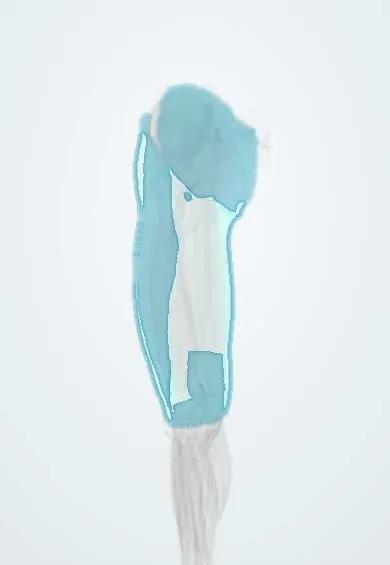
Fascia lata !
The fascia lata is a thin, tough sheet wrapping the thigh muscles; on the outer thigh it thickens into the iliotibial band.
Opens in the Durgical app, no sign-up needed.
What it is
A thin, tough sheet wrapping the thigh muscles.
What it does
Holds the thigh muscles together; it thickens on the outside into the IT band.
Key facts
- Where
- Deep fascia of thigh, sleeve around all thigh muscles
- Attaches
- Inguinal ligament, iliac crest, pubis, ischial tuberosity, sacrotuberous ligament; below to patella, tibial condyles, fibular head
- Function
- Encloses thigh muscles; thickened laterally as iliotibial tract; saphenous opening for great saphenous vein
Relations
- Superficial
- Subcutaneous fat with the great saphenous vein and its tributaries, the superficial inguinal lymph nodes and the cutaneous nerves of the thigh
- Deep
- All the thigh muscles; it sends lateral, medial and posterior intermuscular septa to the linea aspera of the femur
- Above
- Continuous with the gluteal fascia behind; in front, the membranous layer of the abdominal wall fuses with it just below the inguinal ligament
- Below
- Continues as the popliteal fascia and the crural fascia; blends with the patellar retinacula at the knee
- Contents
- Anterior compartment: quadriceps, sartorius, femoral nerve branches, femoral artery and vein. Medial: adductors, gracilis, obturator nerve. Posterior: hamstrings and the sciatic nerve
How to find it
Its iliotibial tract is felt as a tight band on the outer thigh when the person stands on that leg or lifts it sideways. The saphenous opening lies under the skin of the upper medial thigh, just below the medial part of the inguinal ligament.
Examination
- Ober test: lying on the other side with the knee bent, the upper leg is extended and abducted at the hip and then let go; if it stays up instead of dropping, the iliotibial tract and tensor fasciae latae are tight
- Noble compression test: pressure over the iliotibial tract just above the lateral femoral epicondyle while the knee straightens from flexion causes pain near 30° of flexion in iliotibial band syndrome
On imaging
Ultrasound and MRI show it as a thin band wrapping the thigh muscles; it is thickest laterally as the iliotibial tract. On MRI the tract is a dark line to Gerdy's tubercle. Iliotibial band syndrome shows as fluid or oedema between the tract and the lateral femoral condyle. In necrotising fasciitis, CT shows fluid and gas along the fascia; that must not delay surgery.
Clinical notes
- Fascia lata grafts are used for ptosis (frontalis) slings, tendon and ligament reconstruction, superior capsular reconstruction of the shoulder, and dural or abdominal wall repair
- A femoral hernia leaves the femoral canal and may turn up through the saphenous opening, appearing below and lateral to the pubic tubercle
- Thigh compartment syndrome is uncommon because the compartments are large and open towards the hip; when needed, a lateral incision releases the anterior compartment and then the posterior one through the lateral septum
- The falciform margin of the saphenous opening is the landmark for the saphenofemoral junction in varicose vein surgery
Related conditions
Test yourself
Think of the answer, then tap the question to see it.
Why does urine from a ruptured spongy urethra spread up the abdominal wall but not into the thigh?
The membranous layer of the abdominal wall (Scarpa fascia) fuses with the fascia lata just below the inguinal ligament, closing the way into the thigh.
Where is the saphenous opening of the fascia lata, and what passes through it?
About 3–4 cm below and lateral to the pubic tubercle; the great saphenous vein passes through it to join the femoral vein.
Which muscles insert into the iliotibial tract, the lateral thickening of the fascia lata?
The tensor fasciae latae and most of the gluteus maximus.
Why is thigh compartment syndrome uncommon compared with the leg?
The thigh compartments enclosed by the fascia lata are large and open towards the hip, so pressure rises less easily.
Educational information, not medical advice. For any symptom, see a health professional.
Its names
- Official Latin (TA2)
- fascia lata TA2 2689
- Official Spanish (DeCS)
- Fascia lata DeCS D005206
- English (TA2)
- Fascia lata
Related
Sources: Terminologia Anatomica (TA2); DeCS; Anatomy, Bony Pelvis and Lower Limb: Fascia Lata.
Spotted a mistake?We are always improving for the community. Tell us what is wrong and our team will review it.Report a mistake
Representative model, for educational purposes only.