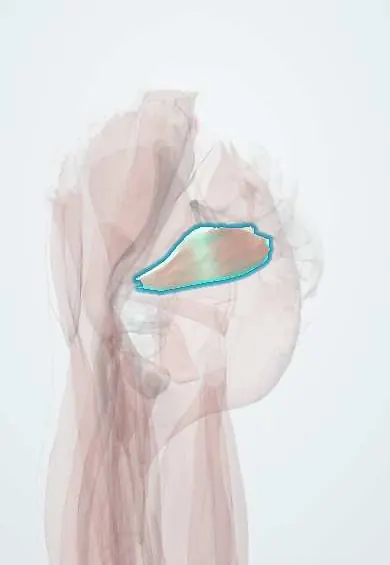
Piriformis syndrome !
Piriformis syndrome is buttock pain, often spreading down the thigh, blamed on the piriformis muscle irritating the sciatic nerve; it is debated.
Updated 2026-10-29
Structures involved
Tap one to see what it is and open it in 3D.
- Piriformis
- Sciatic nerve
- Gluteus maximus
- Sacrum
- Hip bone
- Superior gemellus
- Obturator internus
- Posterior femoral cutaneous nerve
- Piriformis fascia
What it is
Buttock pain, often spreading down the back of the thigh, attributed to irritation or compression of the sciatic nerve by the piriformis muscle. It is a diagnosis of exclusion and its existence and criteria are debated.
Who gets it
Its true frequency is unknown because no test confirms it; it is reported more often in women and in middle-aged adults, and it is now often grouped under deep gluteal syndrome.
Causes
- Direct trauma or a fall onto the buttock
- Muscle hypertrophy, spasm or overuse
- Anatomical variants in which the sciatic nerve or part of it passes through or above the piriformis
- Prolonged sitting on hard surfaces or on a wallet in the back pocket
- Scarring after hip surgery
Risk factors
- Prolonged sitting
- Running or sports with repeated hip rotation
- Buttock trauma
- Leg length difference or altered gait
Pathophysiology
The sciatic nerve leaves the pelvis through the greater sciatic foramen, usually just below the piriformis. Spasm, swelling, scarring or a variant course can compress or stretch the nerve at this point, causing pain and sometimes sensory change along the sciatic distribution.
Classification
- Primary: from anatomical variants of the muscle or nerve
- Secondary: from trauma, mass, scarring or other causes
- Considered one cause within deep gluteal syndrome
Symptoms and signs
- Deep buttock pain, often one-sided
- Pain spreading down the back of the thigh, usually not below the knee
- Worse with sitting, climbing stairs or hip rotation
- Tenderness over the piriformis near the sciatic notch
Diagnosis
- Clinical
- Tenderness at the piriformis and provocation tests that stretch or contract the muscle: FAIR (flexion, adduction, internal rotation), Freiberg, Pace and Beatty tests. No test is diagnostic alone.
- Tests
- Nerve conduction studies and EMG mainly exclude radiculopathy; an image-guided injection of local anesthetic into the muscle that relieves pain supports the diagnosis.
- Imaging
- Lumbar and pelvic MRI exclude disc herniation, stenosis, sacroiliac disease or masses; MR neurography can show the nerve and anatomical variants.
Differential diagnosis
- Lumbar disc herniation with radiculopathy
- Lumbar spinal stenosis
- Sacroiliac joint pain
- Greater trochanteric pain syndrome
- Proximal hamstring tendinopathy
- Pelvic mass or vascular lesion
Goal of treatment
Relieve pressure on the sciatic nerve and buttock pain, and restore normal sitting and activity, after other causes have been ruled out.
Treatment
- Rehabilitation
- Physiotherapy with piriformis stretching, hip strengthening and gait correction; this is the main treatment.
- Medical
- NSAIDs, muscle relaxants and neuropathic pain agents.
- Procedure
- Image-guided injection of local anesthetic with or without corticosteroid into the piriformis; botulinum toxin in refractory cases.
- Surgical
- Release of the piriformis tendon and freeing of the sciatic nerve in selected patients who fail other treatments.
- Lifestyle
- Avoiding long sitting on hard surfaces or with a wallet in the back pocket.
Complications
- Chronic buttock and leg pain
- Missed alternative diagnosis, such as radiculopathy or a mass
- Nerve injury from injection or surgery
Prognosis
Most patients improve with physiotherapy and, when needed, injections. Surgery is uncommon.
Test yourself
Think of the answer, then tap the question to see it.
Which nerve is compressed in piriformis syndrome?
The sciatic nerve, as it leaves the pelvis below or through the piriformis.
Why is piriformis syndrome called a diagnosis of exclusion?
No test confirms it, so lumbar radiculopathy, stenosis, sacroiliac and hip causes must be ruled out first.
What does the FAIR test involve?
Hip Flexion, Adduction and Internal Rotation, which stretch the piriformis and reproduce buttock pain.
Which anatomical variant predisposes to piriformis syndrome?
The sciatic nerve, or one of its divisions, passing through or above the piriformis.
Which red flags point away from piriformis syndrome?
Saddle numbness, bladder or bowel problems, progressive weakness or systemic signs such as fever or weight loss.
Related conditions
- Sciatica (Lumbar Radiculopathy)
- Lumbar Disc Herniation
- Lumbar spinal stenosis
- Greater Trochanteric Pain Syndrome
- Hamstring Strain
- Sacroiliac joint pain
Educational information, not medical advice. For any symptom, see a health professional.
Sources: Piriformis Syndrome (StatPearls (NCBI Bookshelf), 2023).
Spotted a mistake?We are always improving for the community. Tell us what is wrong and our team will review it.Report a mistake
Representative model, for educational purposes only.