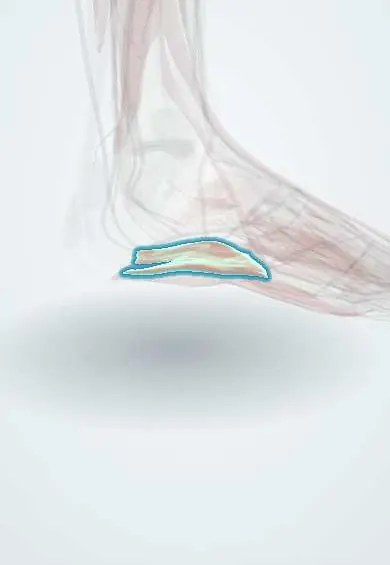
Quadratus plantae !
The quadratus plantae is a flat muscle in the sole that pulls on the long toe-flexor tendon to straighten its pull on the toes.
Official name: Quadratus plantae muscle
Opens in the Durgical app, no sign-up needed.
What it is
A flat, square muscle of the sole, from the heel bone to the long toe-flexor tendon.
What it does
Pulls on the flexor digitorum longus tendon so the toes curl straight instead of at an angle.
Key facts
- Origin
- Medial surface and lateral margin of plantar calcaneus (two heads)
- Insertion
- Posterolateral margin of flexor digitorum longus tendon
- Action
- Assists flexor digitorum longus in flexing toes 2–5; straightens its oblique pull
- Nerve
- Lateral plantar nerve (S2–S3)
- Blood supply
- Medial and lateral plantar arteries
Relations
- Superficial
- Flexor digitorum brevis, with the lateral plantar nerve and vessels running between them
- Deep
- Plantar surface of the calcaneus and the long plantar ligament
- Medial
- Abductor hallucis; the plantar nerves and vessels enter the sole along its medial edge
- In front
- The flexor digitorum longus tendon where it divides, with the lumbricals arising just beyond
How to find it
It cannot be felt. In dissection it appears under flexor digitorum brevis; on MRI it lies on the underside of the calcaneus and joins the flexor digitorum longus tendon in the midfoot.
On imaging
Not seen on radiographs. MRI or ultrasound shows it in the second layer of the sole, running from the calcaneus to the flexor digitorum longus tendon. It is a landmark for Baxter's nerve, which passes between it and abductor hallucis; in suspected entrapment, MRI looks for oedema or fatty atrophy of abductor digiti minimi.
Common problems
- Like the other small muscles of the foot, it can weaken with age, nerve problems or tight shoes, which can let the arch drop or the toes change shape.
Clinical notes
- Baxter's nerve entrapment: chronic medial heel pain that mimics plantar fasciitis, sometimes with wasting of abductor digiti minimi
- In medial approaches to the heel, the lateral plantar neurovascular bundle lies on its superficial surface
Anatomical variants
- Its lateral head is small or absent in some people
Test yourself
Think of the answer, then tap the question to see it.
What are the origin, insertion and nerve supply of the quadratus plantae?
Two heads from the plantar calcaneus, to the posterolateral margin of the flexor digitorum longus tendon; lateral plantar nerve.
What is the action of the quadratus plantae?
It assists the flexor digitorum longus in flexing toes 2–5 and straightens its oblique pull, so the toes curl straight.
Which nerve runs between the quadratus plantae and the flexor digitorum brevis?
The lateral plantar nerve, with the lateral plantar artery, crossing the sole obliquely.
Educational information, not medical advice. For any symptom, see a health professional.
Its names
- Official Latin (TA2)
- musculus quadratus plantae TA2 2684
- Official Spanish (DeCS)
- Músculo cuadrado plantar
- English (TA2)
- Quadratus plantae muscle
- Also called
- flexor accessorius muscle · musculus flexor accessorius
Related
Sources: Terminologia Anatomica (TA2); Anatomy, Bony Pelvis and Lower Limb, Foot Muscles.
Spotted a mistake?We are always improving for the community. Tell us what is wrong and our team will review it.Report a mistake
Representative model, for educational purposes only.