Joints and ligaments · Lower limb
Long plantar ligament !
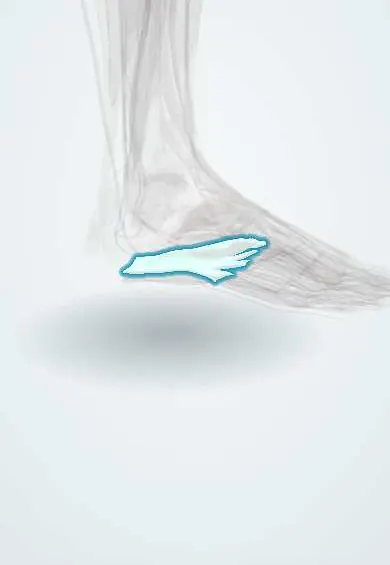
The long plantar ligament is the longest ligament of the foot, under the heel bone and cuboid; it helps hold up the arch.
Opens in the Durgical app, no sign-up needed.
What it is
The longest ligament of the foot, running under the heel bone to the cuboid and the bases of the outer metatarsals.
What it does
Helps hold up the arch of the foot. It roofs the groove for the fibularis longus tendon.
Key facts
- Attaches
- Plantar calcaneus in front of tuberosity to cuboid ridge and bases of metatarsals 2–5 (some texts: 3–5)
- Function
- Supports lateral longitudinal arch; converts cuboid groove into tunnel for fibularis longus
- Tight in
- Weight-bearing (arch flattening)
Relations
- Superficial
- Muscles of the sole (quadratus plantae, abductor digiti minimi, flexor digiti minimi) and the lateral plantar nerve and vessels
- Deep
- Short plantar ligament, separated from it by a thin layer of fat, and the calcaneocuboid joint
- Contents
- Fibularis longus tendon, in its sheath, passing through the tunnel between the ligament and the cuboid groove on its way to the medial cuneiform and first metatarsal
- Medial
- Tibialis posterior tendon slips to the cuneiforms and metatarsal bases, and the spring ligament further medially
How to find it
Not palpable. In dissection it appears as a broad, shiny band once the plantar muscle layers are lifted off the calcaneus and cuboid; on MRI it is a long dark band under the calcaneus and cuboid on sagittal images.
On imaging
MRI (sagittal and coronal) shows it as a low-signal band from the plantar calcaneus to the cuboid ridge and metatarsal bases. X-rays may show an os peroneum at the tunnel entrance.
Clinical notes
- Complete release of the plantar fascia shifts load to this ligament and the lateral column, which can cause lateral midfoot pain
- Painful os peroneum syndrome: the sesamoid in the fibularis longus tendon at the cuboid can fracture or irritate the tendon where it enters the tunnel
- In Charcot collapse of the midfoot, failure of the plantar ligaments lets the cuboid drop and become a pressure point where ulcers form under the lateral midfoot
Anatomical variants
- An os peroneum, a small sesamoid in the fibularis longus tendon beside the cuboid, is present in some people; texts differ on how often
- Its distal fibres reach the bases of metatarsals 2–5 in some descriptions and 3–5 in others
Test yourself
Think of the answer, then tap the question to see it.
What are the attachments of the long plantar ligament?
From the plantar calcaneus in front of the tuberosity to the cuboid ridge and the bases of metatarsals 2–5 (some texts: 3–5).
Which tendon passes through the tunnel formed by the long plantar ligament and the cuboid groove?
The fibularis longus tendon, on its way to the medial cuneiform and first metatarsal.
Which arch does the long plantar ligament mainly support?
The lateral longitudinal arch.
Educational information, not medical advice. For any symptom, see a health professional.
Its names
- Official Latin (TA2)
- ligamentum plantare longum TA2 1934
- Official Spanish (DeCS)
- Ligamento plantar largo
- English (TA2)
- Long plantar ligament
Related
- Short plantar ligament
- Fibularis longus tendon
- Calcaneus
- Lateral cuneiform
- Medial cuneiform
- First metatarsal
- Second metatarsal
- Third metatarsal
Sources: Terminologia Anatomica (TA2); Anatomy, Bony Pelvis and Lower Limb: Arches of the Foot; Anatomy, Bony Pelvis and Lower Limb, Foot Joints.
Spotted a mistake?We are always improving for the community. Tell us what is wrong and our team will review it.Report a mistake
Representative model, for educational purposes only.